

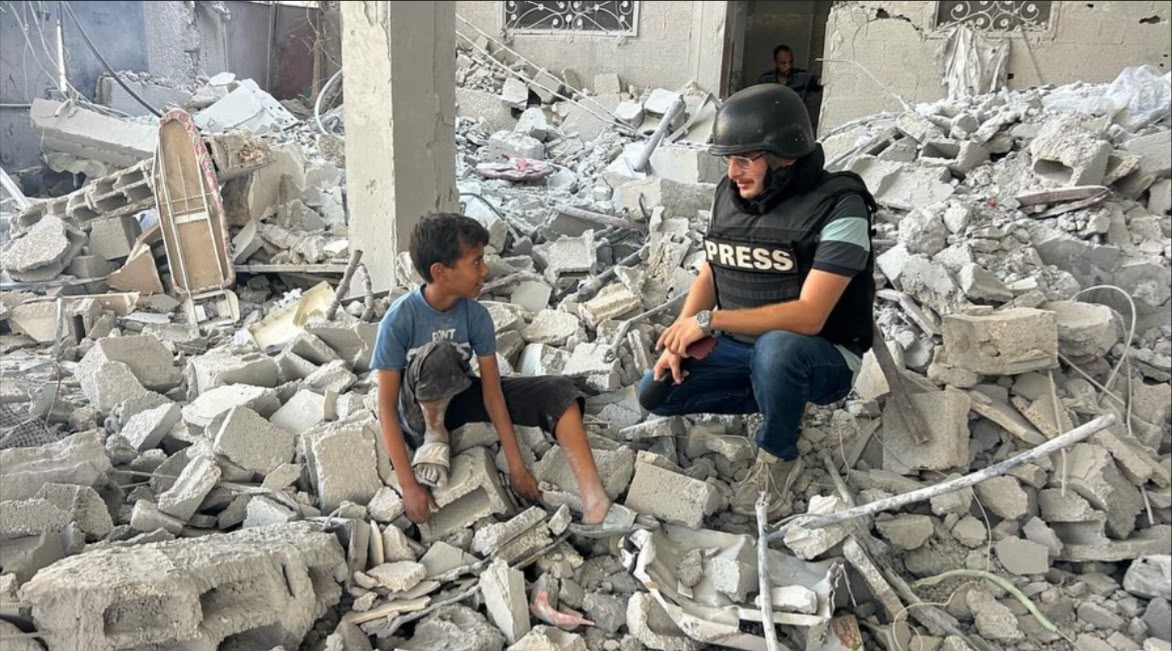
TORONTO (CCN) — Before being a writer or a broadcaster, a journalist “must be human first,” said Diaa Ostaz, a reporter in Gaza for ABC News and ONE Magazine, the publication of Catholic Near East Welfare Association. The call to a sense of humanity is for everyone, he added.
“We are human beings before we are Muslims or Christians or Jewish or anything,” he said. “We have to be human. If you are human, you will succeed. And I believe that if you are a human, God will love you.”
On August 18, Ostaz, spoke over Zoom with fellow journalists and aspiring journalists who participated a week earlier in CCN’s 2026 intensive journalism seminar, “God in the City.” He shared his story of faith, learning and personal growth amid tragedy. He also spoke about how his journalism career began.
“As a 15-year-old, I dreamed of being a journalist,” said Ostaz, 25. “I prayed for it a lot. And if people have a dream, God puts people in their lives to make it a reality.”
His story bears him out. Patient teachers, mentors, co-workers — and sometimes total strangers — accompanied and guided him on his career path. He mentioned a few of them by name: Ashraf Shannon, an American-trained journalist whom he met at his first job, and Ellie Kaufman at ABC News, who trained him and pushed him to continue writing despite the famine and destruction that surrounded him.
Ostaz’s path into journalism was not straight and neither was it free from confusion, failure and embarrassment. Before the war began, he worked as a broadcast engineer, handling the technical side of TV news. Then, as a “producer,” he asked interview subjects questions someone else had written. All the other tasks that come with being a producer, such as how a newsroom works, how to select the news or write questions, he learned on the job.
“I made a lot of mistakes,” he admitted readily.
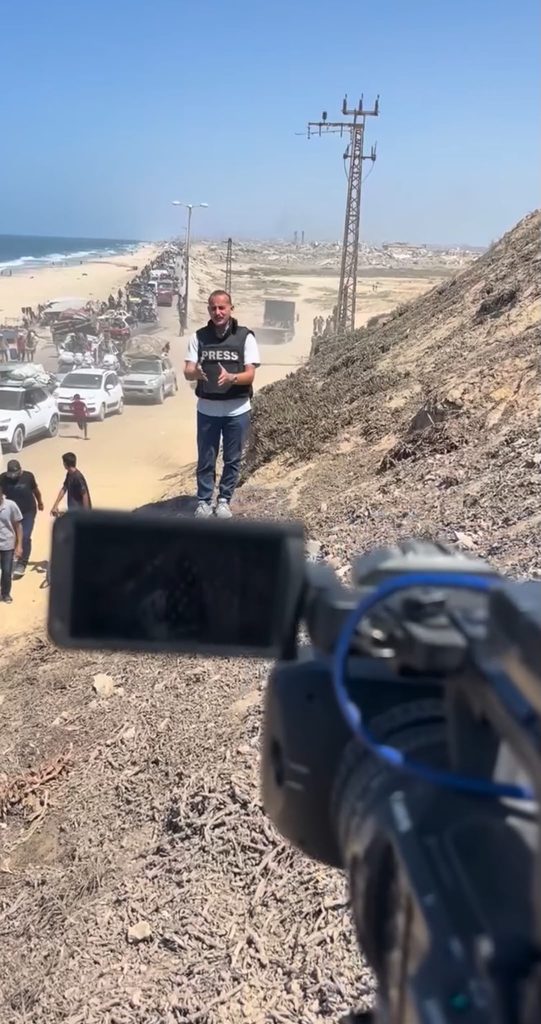
Ostaz’s first appearance in front of the camera started as a bit of a joke. In 2024, a colleague asked him to conduct a microphone check, so he started speaking into the mic: “Here I am, Diaa Ostaz, standing in front of the United Nations warehouse in Gaza City, and there is no flour.” The clip made its way to a producer at ABC, who invited Ostaz to report on camera and provided him with training.
Before the Israel-Hamas war, Ostaz lived in Gaza City, where he studied medical engineering and business management. Then, despite the shortages, Gaza City was “part of paradise,” he said. All that was lost due to the war, including “our memories,” he said.
When the war started, Ostaz was immediately affected. In October 2023, his fiancée was killed in an airstrike in which he sustained a back injury. This tragedy made it impossible for him to work for a while and plunged him into a period of doubt when he could hardly pray.
“It was the worst time of my life,” he said.
After a few months, he returned to his work. Ostaz is also now married, and he and his wife are expecting their first child. Ostaz, a Muslim, said his faith has been restored.
“When I started praying again, reading religious works again, I felt comforted. I felt some calm. In the end, I believe that everything in our life is from God,” he said.
Altogether, Ostaz said, he escaped death nine times. He also was displaced several times, once to a camp in Khan Yunis where there was “absolutely nothing, no homes, no streets, no hospitals, no bathrooms even.”
Currently in Gaza, whether people are Christian or Muslim, “every one of us is struggling,” he said.
“The Gaza Strip itself is small, only 365 square km. Now, the 2 million people who live in the Gaza Strip are crammed into an even smaller area, as Israel aims to occupy 70% of the strip.
“In every street there are tents with whole families, large families, living in a single tent. These are educated people, lawyers, doctors. Not everybody is Hamas. Many are normal civilians, highly educated people, who work for international agencies.”
People are without basic necessities, including clean drinking water, and educational opportunities, he said.
“A litre of gas costs $50 (USD),” he continued. “According to the UN, 90% of the buildings in the strip are destroyed in part or in whole.”
The ongoing bombings and political tensions make his work dangerous and compel him to focus on human interest stories. In reporting as a journalist, “you have to be in the centre” and cannot allow special interest groups to “pull you to their side” though they might try, he advised.
“To be a journalist… you have to be a real human,” he repeated. “You are confronting the reality, especially when you [are] in a war zone.”
For Ostaz, every day is a learning experience.
“You have to be in the field, learn from the field,” he said. “You will face a lot of problems, but I believe a good journalist who faces a problem in the field can solve it, solve it as a journalist, as a human.”



They, the so-called Palestinians, under the direction of hamas started a war on October 7th, 2023. They killed over 1,400 Israeli citizens in one day and took over 200 hostages. They would have continued to kill all the way to Tel Aviv and Jerusalem if they had not been stopped by the IDF the next day. Now that they are loosing a war that they started, they are suddenly “humans” and expect that we should feel sorry for them and send them millions of dollars. I do not. They certainly did not act very humanely on October 7th and they did not treat the hostages very humanely, did they? Sorry, but I am not fooled by this type of propaganda and neither should you be.