Editors’ note: Canadian Catholic News obtained the B.C. Ministry of Health’s “Medical Assistance in Dying (MAiD) Oversight 2024 Year End Report” through a freedom of information request. CCN is publishing the report in full for readers to examine. The document contains aggregate statistical information and no identifiable patient information.
VANCOUVER (CCN) — An internal B.C. government document obtained by Canadian Catholic News through a freedom of information request shows doctors, nurse practitioners and pharmacists in the province made thousands of errors in managing euthanasia in 2024.
According to the report of the Ministry of Health, more than half of all MAiD cases in B.C that year were found to have had errors requiring government follow-up.
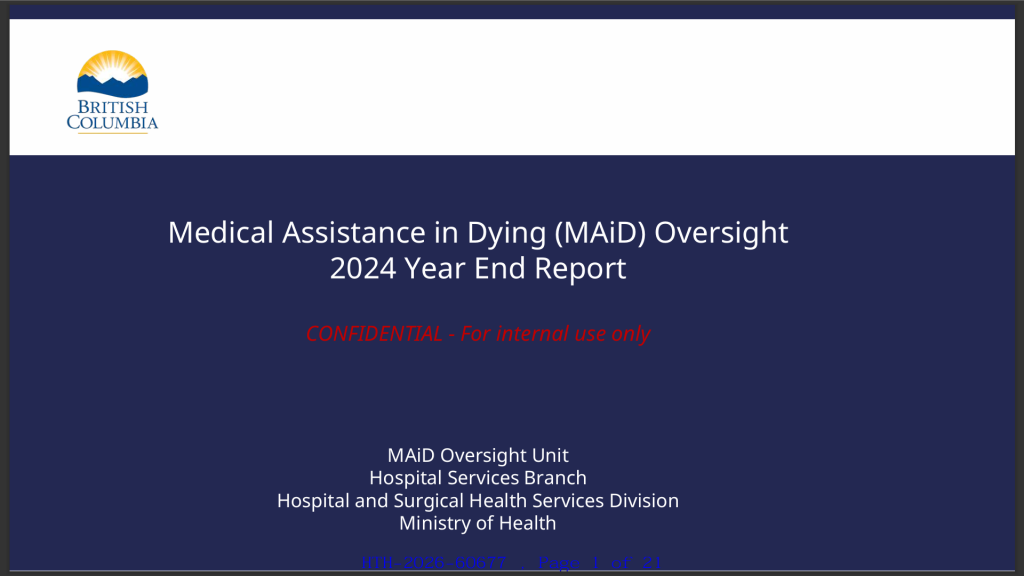
Page 3 of the “Medical Assistance in Dying (MAiD) Oversight 2024 Year End Report” states 4,169 individuals requested MAiD in 2024 — a nearly 10 per cent increase since 2023.
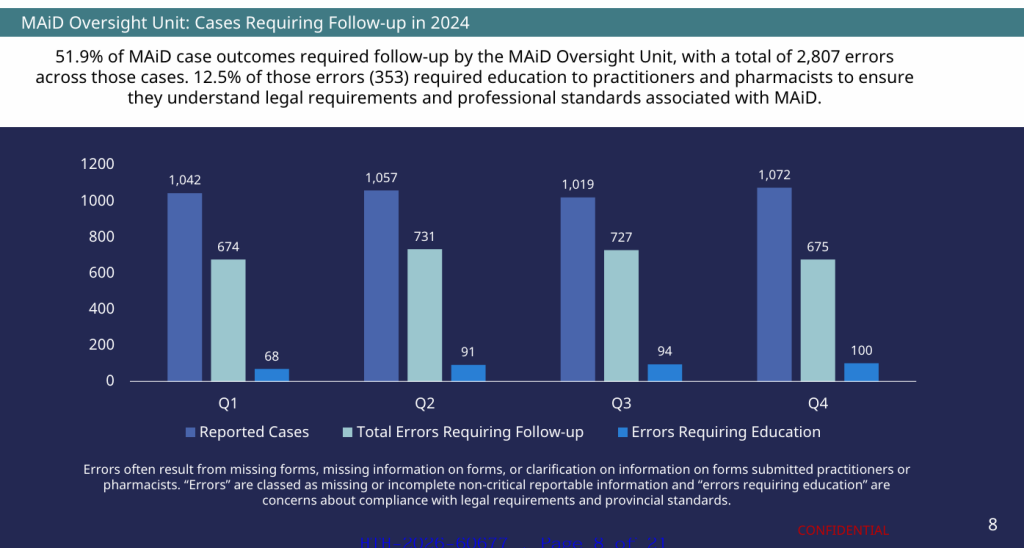
However a bar graph from the report, included with this article, indicates a total of 4,190 MAiD cases in 2024. It also indicates the MAiD Oversight Unit found 2,807 errors among 51.9 per cent of “MAiD case outcomes” requiring corrective “follow-up.” The report says “follow-up” means obtaining missing information or clarifying existing information.
Among these thousands of errors, 353 cases — or about 12.5 per cent — raised compliance concerns and “required education” of practitioners and pharmacists “to ensure they understand legal requirements and the professional standards associated with MAiD,” the report says.
Other data associated with 4,169 total MAiD cases indicate 72 per cent of these individuals died by MAiD; 23 per cent died of other causes, and 4 per cent were found ineligible to access MAiD. Only 1.4 per cent of individuals withdrew their request.
The 2024 findings closely mirror those from 2023, which included 2,833 errors in the management of 3,808 MAiD cases, as reported in The B.C. Catholic last year. These findings suggest that concerns identified in 2023 persisted in 2024.
“It’s all very shocking that you have such a large amount and percentage of errors in British Columbia,” said Alex Schadenberg, executive director of the Euthanasia Prevention Coalition, based in London, Ontario. “It’s clear there are huge problems.”
The situation is particularly acute because B.C. leads the country in percentage of deaths caused by MAiD, Schadenberg told CCN. In 2024, 6.5 per cent of B.C. deaths were attributed to euthanasia, compared with the national average of 5.1 per cent.
Amanda Achtman, ethics director of Canadian Physicians for Life, said the report has troubling implications, indicating MAiD is not medical care “but rather abandonment.”
“The staggering level of errors surrounding the practice of euthanasia in Canada betrays a level of indifference and callousness toward Canadian patients at end of life,” Achtman said in an interview. “At the same time, every euthanasia death is a medical ‘error’ because it is an aberration of sound medical practice rooted in the Hippocratic oath to ‘do no harm.’”
The impact of the errors is far-reaching and go beyond mere gaps in paperwork, she said. Each mistake represents “negligence with which their loved ones were dismissively treated at the height of their greatest vulnerability.”
B.C. Minister of Health Josie Osborne did not respond to a CCN interview request, nor has she answered questions raised in the B.C. Legislature in May by Opposition health critic Dr. Anna Kindy about the need for better and more-public oversight of B.C.’s MAiD regime.
“Will B.C. commit to public annual reporting, not just of MAiD volume but of compliance concerns, referrals … [MAiD] trends, and recommendations for system improvement?” Kindy asked Osborne.
Kindy’s questions were based in part on The B.C. Catholic’s article in July 2025 of the MAiD Oversight Unit’s 2023 report, which found 2,833 errors in the management of 3,808 MAiD cases.
Dr. Kevin Sclater, who in 2022 resigned from his position at a hospice in Port Moody, British Columbia, in part because of the “moral distress” caused by having to discuss MAiD with patients, said he is “shocked” by the high error rate and called for the health ministry to “tighten up” regulations.
CCN asked B.C.’s professional medical association Doctors of B.C. for comment on MAiD management and was told the evaluation of “clinical outcomes falls outside our scope.” A spokesperson said answers to “questions related to regulatory oversight” were best directed to the College of Physicians and Surgeons of British Columbia.
When reached by CCN, the college said its mandate is to regulate physicians and surgeons, not to “comment on clinical, health or health system matters, and suggested contacting the health ministry.
Sclater said the health ministry should be responsible for MAiD oversight. He said a euthanasia assessment is only a “superficial competency” evaluation that “doesn’t evaluate and document a person’s competence” for making a medical decision.
“The entire evaluation process is really a sham,” he said.
The process leaves the public “vulnerable to the whims” of euthanasia providers who may consider it their “mission to help” individuals who have “restricted capacity to object,” he said.
The overlapping concerns of inadequate oversight, lack of any agency responsibility for regulatory enforcement, and enthusiastic euthanasia specialists also arose in a June 17 report by the Special Joint Parliamentary Committee on Medical Assistance in Dying. The committee recommended the government “indefinitely exclude” patients from MAiD for the sole condition of mental illness.
Committee co-chair Dr. Marcus Powlowski (Lib—Thunder Bay-Rainy River) wrote in a “supplementary opinion” to the main report that the committee “heard disturbing stories of questionable conduct by some MAiD providers.”
“It is not hard to conclude that some providers take an exceedingly expansive interpretation” of MAiD-eligibility rules and exhibit “a seemingly cavalier attitude towards end of a life,” he wrote.
The committee heard “scant, if any evidence” to indicate that any regulatory bodies “provide adequate safeguards” or have “seriously pursued allegations of misconduct by MAiD providers,” he continued.
“Several witnesses suggested the criminal system, the medical colleges, and at times the government ministries responsible for MAiD provision … all allegedly treat enforcement as someone else’s responsibility,” he wrote.
Release of the B.C. government document to CCN coincides with the tenth anniversary of legalized euthanasia in Canada this year. The Canadian Conference of Catholic Bishops’ Standing Committee for Family and Life marked the anniversary with a statement urging Catholics to “remain steadfast in opposing euthanasia and assisted suicide, to pray for the conversion of hearts and minds away from this practice, and to be present to persons who are sick and vulnerable.”
While eliminating legal euthanasia is the Euthanasia Prevention Coalition’s ultimate goal, Schadenberg said there is also urgent need for tighter control, better oversight and public reporting on MAiD in B.C. and elsewhere.
https://canadiancatholicnews.ca/wp-content/uploads/2026/07/HTH-2026-60677.pdf