ATLANTIC CITY, N.J. (CCN) — This year’s Catholic Media Conference was titled “Innovation Anchored in Mission,” but it could have been subtitled “Pope Leo’s Guide to AI and a Divided Society,” as more than 350 Catholic communicators gathered and wrestled with the challenges of artificial intelligence and polarization.
These twin concerns ran through the June 16-19 conference like threads through a tapestry — the very image one speaker used to describe how Catholic media weave together the Word of God.
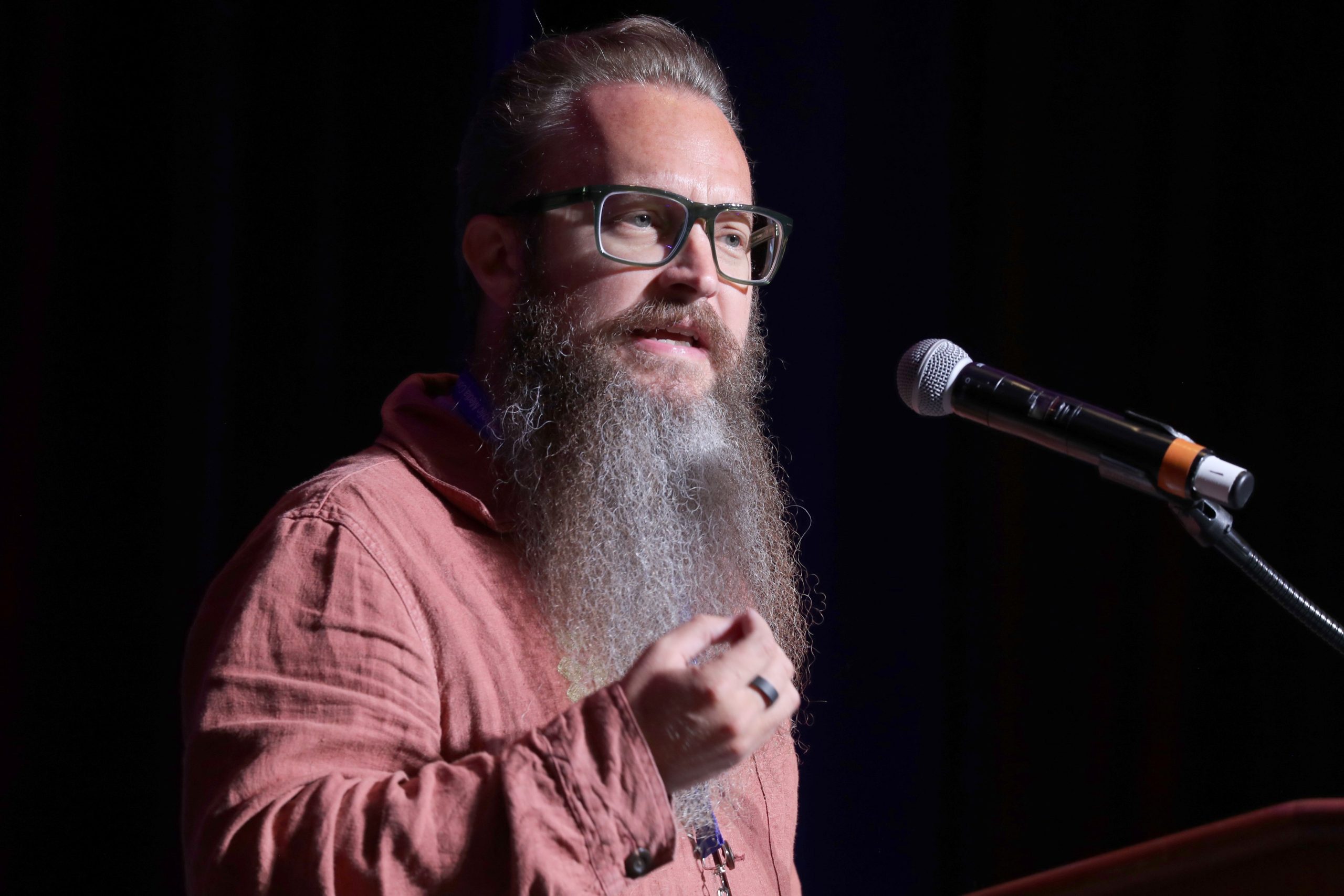
In his keynote address, Taylor Black, Microsoft’s director of AI, noted that one of the earliest calculating devices was a 19th-century loom that used punch cards to process patterns into cloth, making every computer a descendant of the loom. Their common genealogy is reflected in the words “textile” and “text,” from the Latin “texere,” meaning “to weave.”
Black, who is also director of the Institute for AI and Emerging Technologies at Catholic University of America, pointed to a Byzantine icon of the Annunciation depicting Mary with a spindle in her hand, spinning scarlet thread as the angel Gabriel arrives.
“The Word enters the world and finds a woman at her work, and the angel does not tell her to put the thread down,” Black said. “The question was never whether to take up the new loom. The question is what gets woven on it.”
Catholic communicators are called to be “weavers of hope” as they use AI technology, he said.
Black expanded on the theme of trust by pointing to the risks posed by an abundance of AI-generated information.
“When anyone can produce infinite plausible content, free content stops being the scarce thing. The scarce thing becomes prominence, judgment and institutional credibility.”
Fortunately, he said, the Catholic Church’s “provenance and infrastructure” have been assessing the truthfulness of information for centuries.
“‘Nihil obstat, imprimatur,’ the devil’s advocate — the whole unhurried machinery of canonization exists to answer one question: How do we know this testimony is true? We belong to the institution that invented institutional answers to deepfakes.”
The world, he said, “is about to need that patrimony desperately.”
St. Thomas Aquinas described human speech as proceeding from “an inner word — a “verbum cordis,” a word of the heart — born of understanding and judgment before it even reaches our lips.”
AI systems produce only “outer words without inner words,” Black said. “Our whole tradition — from ‘the Word was made flesh’ onward — is a 2,000-year meditation on that difference.”
Pope Leo’s encyclical describes new technologies as imitators of intelligence, judgment and decision, Black said. “Rome, in other words, has planted its flag precisely in Aquinas’s functional theory.”
Noting this year’s World Communications Day theme, “Preserving Human Voices and Faces,” Black said Pope Leo sees the face and voice as essential to every human encounter.
“The challenge,” Black said, “is not technological, but anthropological, and safeguarding faces and voices ultimately means safeguarding ourselves.”
He cautioned that AI models “are getting very good at company … and we’re handing them to the loneliest generation in recorded history.”
Within a few years, an individual’s first contact with the Catholic Church “will be mediated by an AI rather than by a human being,” he predicted. That mediation will be shaped by the prompts people give it.
While artificial intelligence, “the most sophisticated engine ever built,” is capable of offering highly tailored content, it can also create “behaviour engineered rather than persons encountered,” he said.
“The line between pastoral and predatory is not there in the software. It is in the intention of the people configuring it, which is the strongest argument I know for those people being you.”
The system prompt “is becoming a genre of pastoral literature. It deserves the care of a catechism and the review of a chancery. Somebody will write the words your institution’s machines say to the grieving.”
Yet even the most sophisticated technology cannot replace authentic human community, said Black, describing the parish as “the oldest anti-loneliness engine ever built, a place where you’re born, fed, missed when you’re gone, and buried when you die. No technology can supply that.”
That image of weaving resurfaced throughout the conference, especially in discussions of Pope Leo XIV’s new encyclical “Magnifica Humanitas,” which calls communicators “to engage the digital world in a human way,” Father Carlo Santa Teresa said in his homily at a conference Mass.
Gretchen Crowe, editor-in-chief of OSV News, who was named publisher of Our Sunday Visitor during the conference, reinforced Pope Leo’s call “for serious journalism and forums for debate, where reasoned argumentation and verification carry greater weight than immediate reaction.”
During a lunchtime discussion, she defended the need for trustworthy news organizations.
“We all know that life is crowded and noisy, with competing voices and little regard for the truth. Anyone can create content; few can create trust in this climate,” she said.
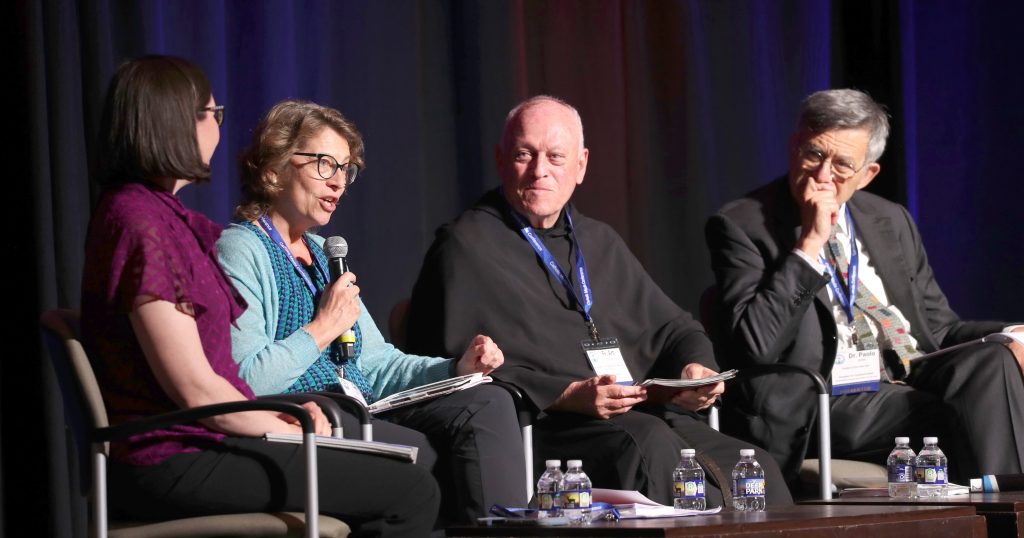
In a panel discussion on Pope Leo’s communications style, panelists said the new pope reflects a distinctly Augustinian approach, emphasizing the search for truth through listening and communion.
“For Pope Leo, communication is about communion … ‘being with,’” said Carol Glatz, editor-in-chief of the Catholic News Service Rome bureau.
Leo sees communion as “an ontological necessity toward a fuller understanding of the truth,” she said, with communication itself shaping those who participate in it.
Augustinian Father Arthur Purcaro related Leo’s approach to his family upbringing in Chicago, where differences of opinion were settled around the dinner table.
“Mother would say, ‘You’ve got to get along if you want to eat.’”
That search for truth fostered an understanding of conversation based on “the importance of searching together” and “understanding truth,” he said.
“That’s tough for us to understand here in our American culture, which is very polarized… ‘No, no, I’m right, you’re wrong.’”
Quoting St. Augustine — “The truth itself is neither mine nor yours” — he added, “it may be both yours and mine.”
Purcaro agreed with Glatz that communion is central to the Christian vocation.
“It’s in our DNA,” he said. “Pope Leo has learned his entire life that communication is discovering what is good about each and every human being.”
Paolo Ruffini, prefect of the Vatican Dicastery for Communication, said people are often tempted to mask themselves on social media, “to hide something of ourselves, because we are afraid of something.”
Picking up on the theme of communion, he said, “If there is a lesson communicators can learn from Pope Leo, it is that we should not be concentrated on our performance, but on communion.”
Moderator Kerry Weber, executive editor of America Media and president of the Catholic Media Association, observed that Leo appears “very free and very authentic,” noting his presence at the presentation of his latest encyclical, “Magnifica Humanitas.”
His presence “put a real weight behind it, made it clear that this is a priority to him,” she suggested, particularly in a polarized world.
The pope sees truth and knowledge as common goods that unite rather than divide, Ruffini said.
“I think we are losing a sense of common good,” he added.
In a time of division, people of faith and no faith alike are looking for guidance, something that “maybe in this time only the Church can do,” he said.
Purcaro described Leo’s message as a guide for “helping us to form conscience” and move toward community and harmony.
The encyclical calls humanity “to lower the temperature, to truly honour God in one another.” Even when we disagree, Purcaro said, “we are called to love that person.”
He concluded with the pope’s appeal: “Let us disarm words, and we will help disarm the world.”