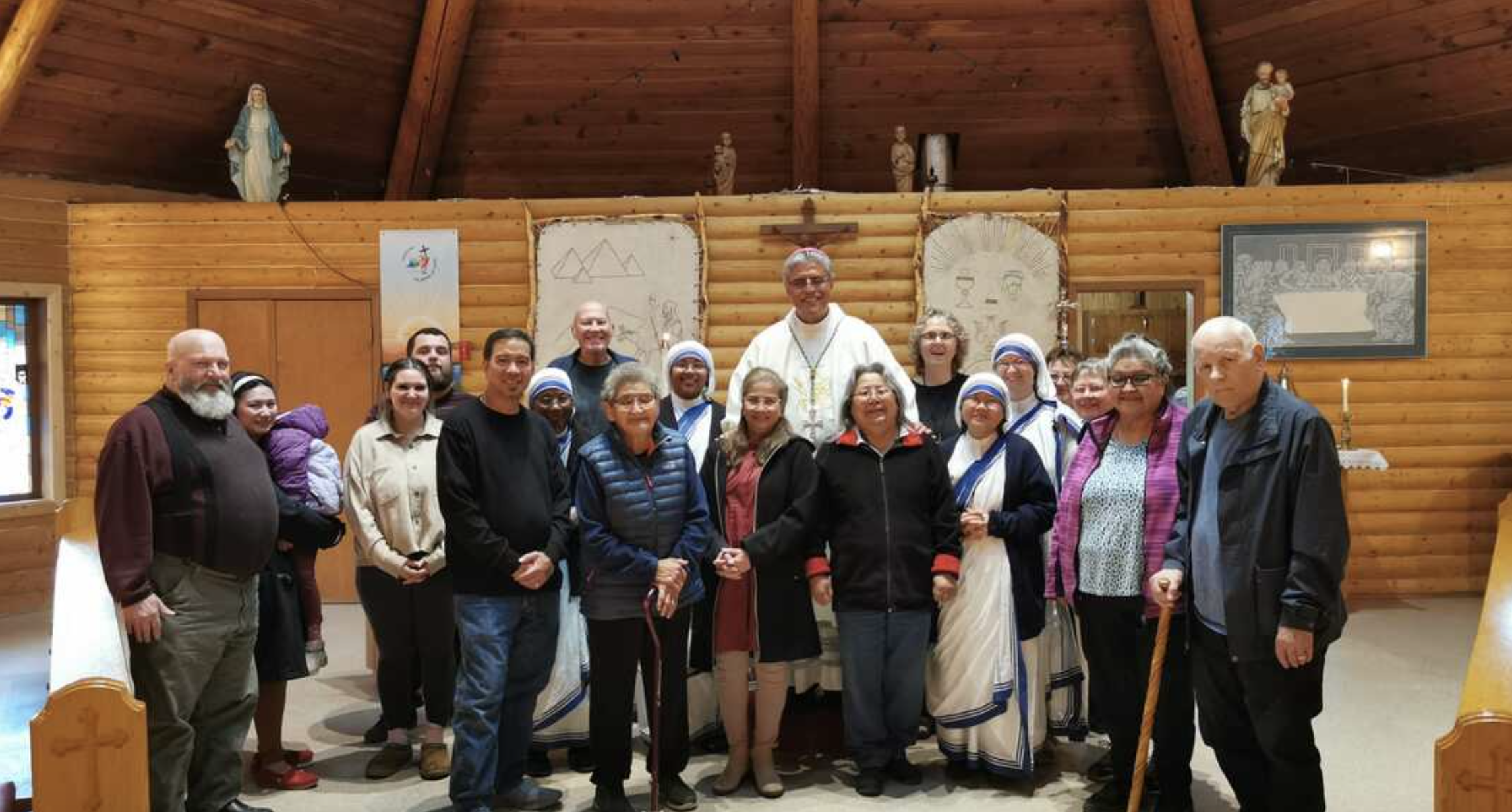
It’s hard not to talk about the natural environment when discussing the Diocese of Whitehorse. The snow and the ice loom large over the Canadian cultural imagination, but even still it’s hard to fathom what it’s like to be a Catholic living in the 21 active missions and churches spread over the diocese’s nearly 750,000 square kilometres.
Bishop Héctor Vila jokes that when he was first assigned to the diocese ten years ago, he was only vaguely aware of what it was like to live up north. “Geographically speaking, I knew it was there,” he told The B.C. Catholic with a smile. “But it’s a different thing when you arrive there – it’s immense.”
Bishop Vila spent 17 years serving the Church in various capacities in Toronto, so he was no stranger to the cold. However, the land of the midnight sun still stunned him. “The climate is totally different: 18 hours of darkness during the wintertime, 18 hours of daylight during the summer,” he said.
“I actually arrived there during the winter, at night,” he recalled. He would leave his residence before the sun came up and return home long after the 6-hour day was complete. It took months before he ever saw his house in the daylight.
He was impressed by the diversity of the diocese, where Catholics make up about 20% of the population and roughly 40% of those Catholics are indigenous, alongside large communities of Filipinos and Europeans.
After 10 years as bishop, Bishop Vila has come to understand that the largest issue facing his diocese is that of pastoral presence. Everything is very far away. Missions Canada notes that Whitehorse is the only northern diocese that “can be circumnavigated while driving, no airplanes needed,” but this downplays the reality of life in the remotest of Yukon communities.
The diocese has come up with some novel ways to keep parishes active and alive, and the remote reality of life up north has given Bishop Vila a deeper appreciation for the impact the Church can have on individual lives.
Bishop Vila is grateful for God’s generosity regarding their vehicles. “Long distances require a good car, and the temperature can go down to -40 or -50 centigrade. The Lord has sustained us and continues to sustain us … in providing good vehicles.”
This comes with concerns unheard of in the relatively clement Vancouver climate. “We provide the priest with special survival equipment,” he said. “Up there, it’s a matter of life and death.” The kit includes repair supplies for the vehicle and first aid supplies, as well as a satellite phone in case the pastor is stranded out in the wilderness.
All these challenges add up, but Bishop Vila still says the unique attributes of the north help people to learn something about how God work through the Church and in their lives.
“God waits for us in the least expected places,” he said. “You see that when you see a community that gathers and it’s only 12 people.”
In any other diocese, a small community like that might warrant a church closure or consolidation with a nearby parish. In the Yukon, these communities, often mission churches founded by the Oblates of Mary Immaculate, are too remote for people to simply drive to the next church over. It’s hard to imagine the grit and strength of the first missionaries to brave the great white north, and the remote nature of these churches and missions is a remarkable testament to the faith and tenacity of the people who built them, and the people who still live there. Regardless, in contemporary terms, their remoteness comes with challenges related to facility maintenance and the availability of enough clergy and personnel to serve such a large geographical area.
When a priest visits a remote community, the result is sometimes surprising, says Bishop Vila. Maybe there has been no priest for weeks or months, but when the doors of the Church open, the people come just the same.
“They’re looking for a priest – for confession,” said the bishop. “They know that they need confession: they have been in drugs or alcohol, pornography, all kinds of things. And you find God suddenly there.”
“God placed you in that community that you thought was nothing: a small group of people. And suddenly this young man comes around and says, ‘Father, I want to confess.’ And you find that he was bringing a huge load, and you were there for that man.”
“We cannot measure the quality of anything by the standards we use in Vancouver,” he said. “To close the church for 15 people would mean they have no sacraments, nothing. You see how God cares for these people.”
“You are there not to look for 100 sheep, but to look for the one who needs to listen to the Word of God and be nourished by the Word of God and the sacraments.”
He recounted another story in which a seminarian who was in Whitehorse as part of his formation encountered a homeless man. “He thought the man was going to ask for money or something,” recalled the bishop. Instead, the man told the seminarian, “I want to kill myself.”
The seminarian was shocked and ran to get a priest. The two spent the entire day with him. They took him out for lunch and listened to the things he had to say. At one point, the man asked to pray with them, and before he left, he asked for confession. By the end of the day he was in tears, thanking the seminarian and the priest for saving his life.
“Those events are where you see the [hand] of God,” said Bishop Vila. “God does not abandon those who are in much need in these isolated areas, where people suffer from much loneliness, where there is no community aspect. Just that the Church is present is a big sign of hope.”