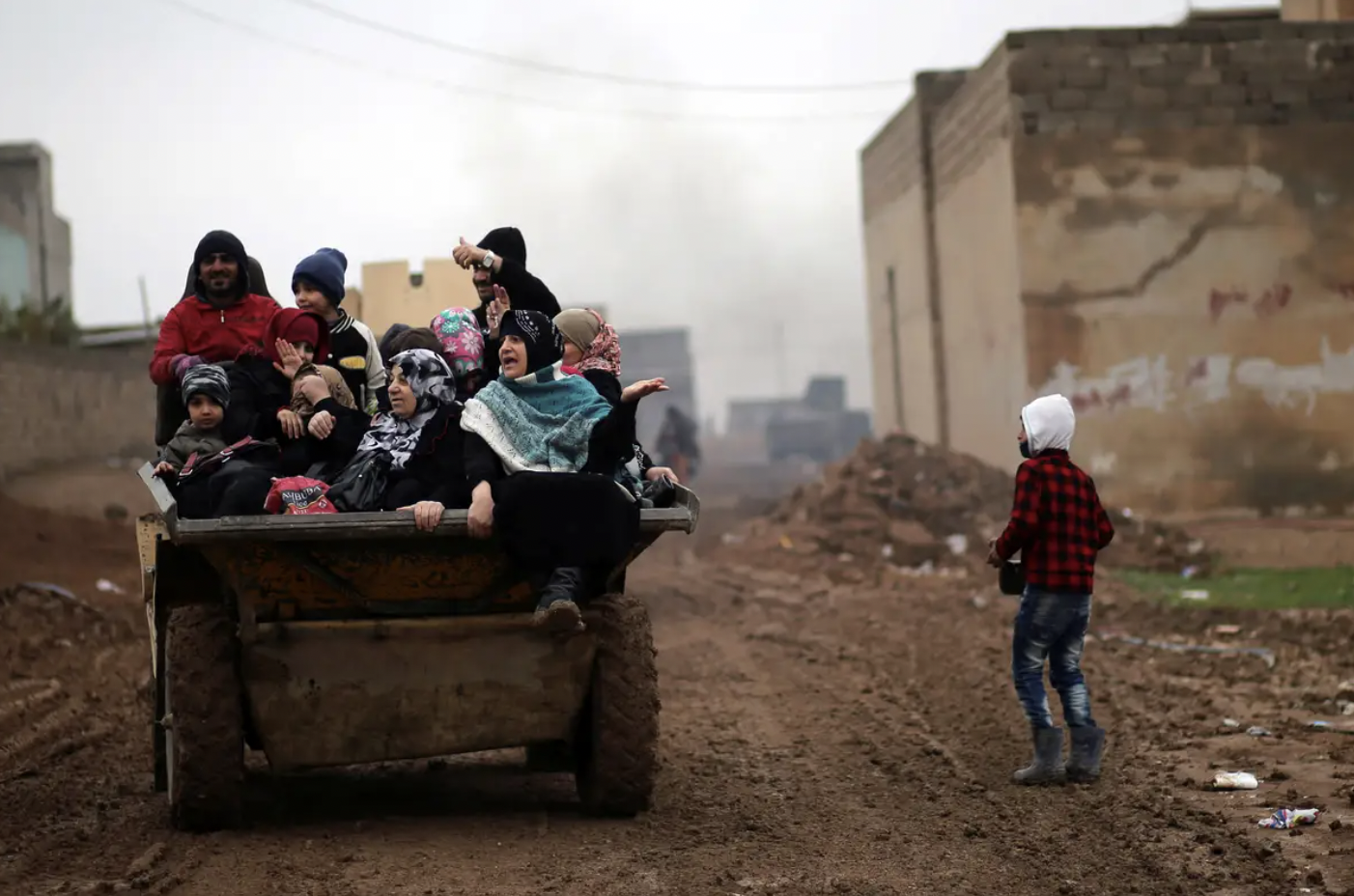
To the thousands of Iraqi Christians who fled their homeland in the wake of war, persecution and genocide, any return to their country, even at the invitation of Prime Minister Ali al-Zaidi, is not a realistic prospect without a firm guarantee of security, equal rights and equal opportunities, say community leaders and activists.
At a recent meeting with the Patriarch Paul III Nona of the Chaldean (Eastern rite Catholic) Church, Iraq’s Prime Minister said it was his government’s priority to encourage the return of Christians who were forced to leave their ancient homeland. The exodus occurred in waves starting in the early 1990s, and reached a peak with the fall of Mosul to ISIS extremists in 2014, when 200,000 Christians, along with an equal number of Yazidis, another minority religious group, fled in terror from the genocidal campaign unleashed against them.
Community and Church leaders agree it’s a big step to roll out the welcome mat and to invite Christan expatriates to participate in the reconstruction and development of Iraq. They contend, however, there is plenty of work to do to eliminate the conditions that reduced Iraq’s Christian population from 1.5 million in 2003 to fewer than 150,000 today.
The worldwide Iraqi Christian diaspora is significantly larger than the Christian population that remains in Iraq. An estimated 25,000 Iraqi Christians live in the Greater Toronto Area alone, in addition to a thousand in Ottawa and a massive, established community in Windsor, Ont. Statistics Canada’s 2021 census places the total in Canada at 27,000.
Spearheading efforts to ensure security, safety and equal rights for all Christians — those who wish to return and those who never left — is Iraqi MP Kaldo Oghanna, a Chaldean Catholic who holds one of the five seats reserved for Christians under Iraq’s quota system. He also chairs a parliamentary Christian group called Soyana.
“At a recent parliamentary session, I demanded a law banning hate speech,” he told The Catholic Register from his home base in Erbil.
Hate speech and frequent attacks, as well as land theft, corruption and unequal opportunities for employment were some of the reasons for the more recent departure of Christians from their beloved homeland.
Oghanna made an impassioned speech in parliament beginning with the words: “In the name of the Father, and of the Son and of the Holy Spirit, Amen,” in Syriac, his native tongue. Syriac is a dialect of Aramaic, the language Jesus spoke. Beginning with the invocation was in itself a deliberately calculated move intended to convey the message that Christians, their language and culture are not recent imports, but part of the ancient heritage of Iraq, Oghanna said.
“I am proud of my Christian heritage and identity and I wanted to make sure our language was heard in Iraq’s parliament,” he added.
He then transitioned into a formal political speech addressing the dangers of sectarian divisions and the rapid decline of Iraq’s indigenous minority populations — such as Christians and Yazidis.
Oghanna accepts it is a monumental task to construct an Iraq where all citizens are treated as equals and are guaranteed safety, security and the freedom to practice their religion in peace without fear of attacks or harassment.
He is hopeful, however, it can be achieved. At a meeting he held with his Prime Minister outside the parliamentary session, he highlighted the importance of maintaining the unique character of areas with a historic Christian presence. He offered the assistance of his parliamentary group to combat hate speech and to reform the current electoral law because the quota system is open to manipulation and often results in muting the Christian voice.
“The Prime Minister was very positive,” Oghanna said. “I found him supportive of the concerns and aspirations of the Christian community.”
Oghanna’s optimism is not yet shared by many Iraqi Christians, who greeted the news with more scepticism than enthusiasm.
Rabea Allos is a prominent Iraqi Canadian activist based in the Greater Toronto Area, and a member of the Chaldean eparchy (archdiocese) of Toronto. A respected spokesperson for Canada’s Chaldean community, he has appeared before parliamentary committees in Ottawa to give testimony on the challenges of Middle Eastern Christian refugees.
“We receive Prime Minister al Zaidi’s invitation with respect, and I appreciate that the Prime Minister is trying his best,” he said.“Most of us left Iraq to ensure a better future for our children.”
He laid out the conditions that need to change before any of the diaspora can consider returning, including stopping “the outflow before inviting diaspora Christians to return.”
“Iraq’s government is weak and has inadequate control of Iran-backed militias that cause a lot of trouble,” he said.
He said he gets frequent inquiries from Iraqi Christians who would like to emigrate to Canada, but Canada’s doors are no longer wide open and the quota reserved for ORAT (Office for Refuges Archdiocese of Toronto) has been reduced by 70 per cent.
Allos explained that because of the closure of the Strait of Hormuz, Iraq’s oil exports have been reduced to a minimum, and Iraq needs to diversify its economy and needs more investment.
“Hate speech needs to be banned, and Christians, who are often passed over for jobs, need the same opportunities as everyone else,” he emphasized.
Nick Shallal is a well-established Canadian Chaldean. Owner of the popular restaurant La Favorita in Ottawa’s Little Italy area, he reluctantly left his country to avoid conscription in Saddam Hussein’s army, and arrived in Canada in 1985 after training in culinary arts in Europe. He is even less sanguine than Allos about the prospects of Iraqi Christians returning home in the near future.
“I would love to see Mosul, my birth city,” he said.
Mosul was once a Christian stronghold but fell 12 years ago to ISIS invaders who launched a genocidal campaign against Christians and other minorities. Even though ISIS was defeated in 2017 and the situation of Christians has improved since then, injustice, corruption and the theft of Christian owned lands are still rampant, Shallal said.
“Going back is just wishful thinking.”
Acknowledging the enormity of the task before him, Oghanna is seeking the support of friendly foreign governments. He traveled to Washington to ask the American government to provide support and financial aid for Iraqi Christians to remain and prosper in their homeland.
He would welcome Canada’s support as well.
Canada’s Foreign Minister Anita Anand recently spoke with her Iraqi counterpart, Fuad Hussein. According to a social media post from Global Affairs Canada, they shared concerns over the conflict with Iran, reaffirmed Canada’s solidarity with the Iraqi people and exchanged views on the security challenges facing the region.
“As a multicultural and multi-faith country, Canada champions inclusive and accountable governance, pluralism and respect for diversity in all spheres of society. As part of our broader commitment to human rights, Canada will continue to protect and promote freedom of religion or belief, including the protection of religious and ethnic minority communities,” Anand said in response to a question from The Catholic Register on whether they discussed minorities in Iraq. “All people should be able to live in safety and security, free from discrimination and persecution, regardless of their religion, belief, ethnicity or identity.”