VANCOUVER (CCN) — Themes of loneliness, woundedness and division shot through the pastoral messages shared during the installation of three new bishops in Canada last month. As one bishop said, it is not always easy to love a wounded Church.
Over the span of six days at the end of August, three dioceses across Canada received new bishops.
BISHOP KENNETH THORSON, DIOCESE OF PRINCE ALBERT, SASKATCHEWAN
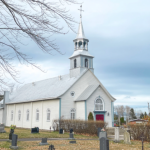
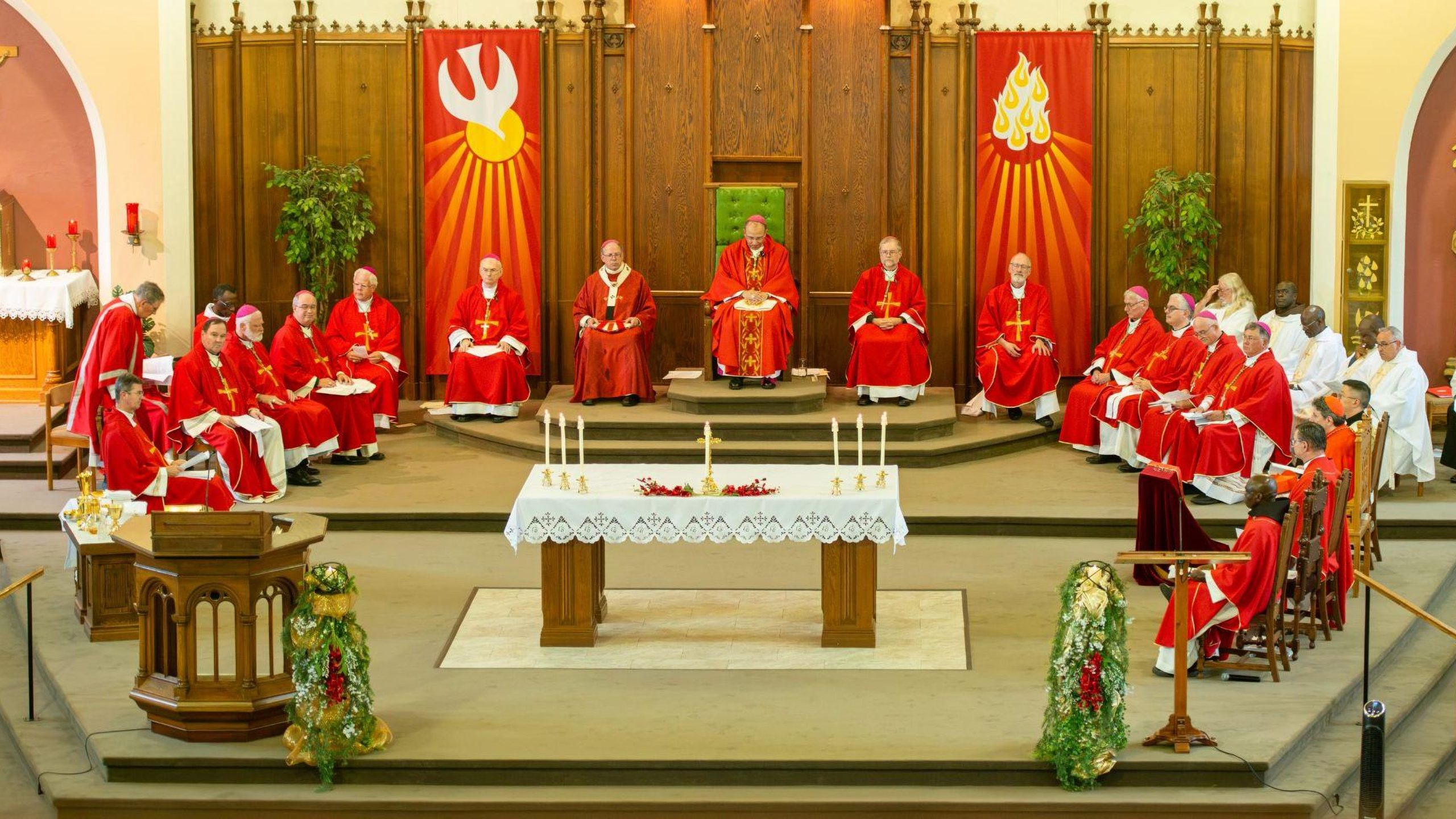
In Prince Albert, Saskatchewan, the Aug. 22 ordination and installation of Bishop Kenneth Thorson, OMI, at Sacred Heart Cathedral became an opportunity to teach about the need for the Church to build unity while accompanying those in need.
Archbishop Albert LeGatt of Saint-Boniface, Manitoba, spoke at Thorson’s episcopal ordination and said his prayer was that Thorson’s ministry would be “filled with that constant desire to be a witness and a messenger and an instrument of all that is God’s love shared in in relationships, in friendships, in marriage, in family, in a parish, in a diocese, that whole web of people you now engage as with.”
He told Thorson that in “oneness” he can bring God’s love to everyone. “Oneness in the desire that the oppressed be free, the blind see, the traumatized helped, (and) that you be a bishop who leads a diocese in that abundant overflowing of love that transforms everything.”
He prayed that Thorson and the Prince Albert diocese might walk with everyone in “the light, the truth of God’s love,” discovering the presence of God’s love in unexpected places.
He said he hoped Thorson would “always be able, deep down, to say, ‘I wouldn’t want to be anywhere else doing anything else.’”
LeGatt then read from the Church’s ritual for the ordination of a bishop, which calls on the bishop to love those placed in his care and to listen to the faithful who work with him. “Synodality is not a new invention,” LeGatt said in a personal aside.
In his remarks at the end of Mass, Thorson pledged to continue the work of his predecessor, Bishop Stephen Hero, now archbishop of Edmonton, who was present at the ceremony. “You discerned synodally with the people of the diocese, and through that process developed a strategic plan for the diocese, which is a blessing to me, and I will discern with the people of the diocese as to how we take that forward.”
Thorson spoke of learning from and walking with the people of the diocese. He asked the priests to help him learn what it is to be a bishop, telling them, “We walk forward together.” He told the deacons he looked forward to “continuing to develop the relationships” and to journeying with them and their wives “together in ministry.”
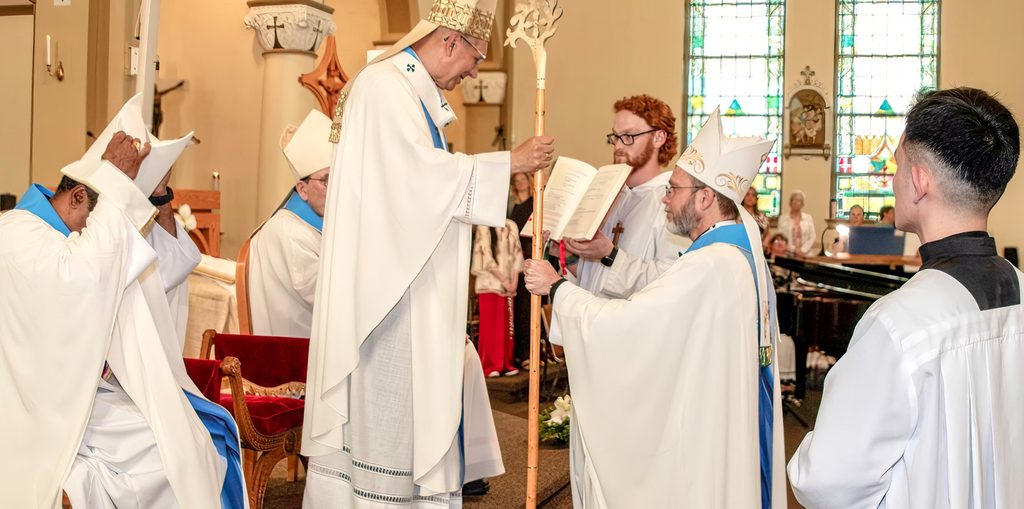
Addressing the religious communities in the diocese, he assured them of his presence and said they would work and walk together. “We are not a large number of religious, but we’re mighty, and I’m looking forward to getting to know you better.”
He thanked members of his family in attendance, saying, “Everything good begins at home.”
And to the people of the Diocese of Prince Albert, he said: “It’s like coming home. … I am blessed to be here as your bishop, and I commit to walking with you as a brother, and I look forward to all that God will do through us in the years to come.”
Msgr. Paul Butnaru, representing the apostolic nuncio to Canada, Archbishop Ivan Jurkovič, singled out Thorson’s “invaluable work of healing and reconciliation with our First Nation communities,” saying it was “a work that will continue in the years ahead.”
Thorson, an Oblate of Mary Immaculate, is a Saskatoon native and served as provincial superior of the OMI Lacombe Province from 2019 to 2025. As provincial, his truth and reconciliation involvement included working on the release of historical records and addressing the order’s role in residential schools.
Thorson’s coat of arms shows an eagle feather, in recognition of First Nations and Métis peoples, and a canoe, which was “the primary means of travel for many Indigenous Peoples” and later “became essential to explorers, settlers, and missionaries,” according to a diocesan description. Canoeing in northern Saskatchewan was also a formative part of Thorson’s young adult years.
BISHOP ROCH MARTIN, DIOCESE OF TIMMINS, ONTARIO
Just two days later, on Aug. 24 at St. Anthony of Padua Cathedral in Timmins, Ontario, Archbishop Marcel Damphousse of Ottawa-Cornwall reminded newly installed Bishop Roch Martin that although the Church is holy, it is also a Church that can cause doubt and difficulty.
“It is not always easy to love a Church that is, in a way, wounded,” he said speaking in French.
During painful moments, Damphousse said, “I have learned to discover how a wounded Church needs even more love.”
Damphousse then used the responsorial psalm, Psalm 144 (145), whose refrain was “May your faithful, Lord, proclaim the glory of your kingdom,” to remind Martin that the kingdom is God’s, not the bishop’s, and that he is called to help it grow every day.
Born in Sturgeon Falls, Ontario, Martin was a pastor for more than 20 years in the Sudbury area before becoming vicar general of the Diocese of Sault Ste. Marie in 2021.
In his remarks, Martin said his roots in the Diocese of Sault Ste. Marie remain important to him. He recalled his May visit to Timmins, saying his warm welcome by the college of consultors confirmed the call the Lord was making of him.
Martin also quoted the words of Jesus in John 15:16 that had guided his priestly ministry: “It was not you who chose me, but I who chose you and appointed you to go and bear fruit, fruit that will remain.”
He then explained that his episcopal motto comes from the same passage in John’s Gospel: “that you should go and bear fruit,” a reminder that “we can only bear fruit when we remain in Christ.”
Speaking on behalf of the apostolic nunciature, Butnaru connected Timmins and its new bishop to St. Anthony of Padua, patron of the cathedral, emphasizing Anthony’s preaching and his efforts to bring people to Christ and into communion with the Church.
He also spoke about why Martin is particularly equipped for his new role, pointing to his years of accepting different assignments in a spirit of obedience, including his recent service as vicar general. He said Martin’s theological formation and experience in education prepared him for episcopal ministry.
Butnaru thanked Bishop Serge Poitras, who led the northern Ontario diocese for 14 years, including most recently as its administrator.
BISHOP MARTIN LALIBERTÉ, DIOCESE OF SAINT-JEAN-LONGUEUIL, QUEBEC
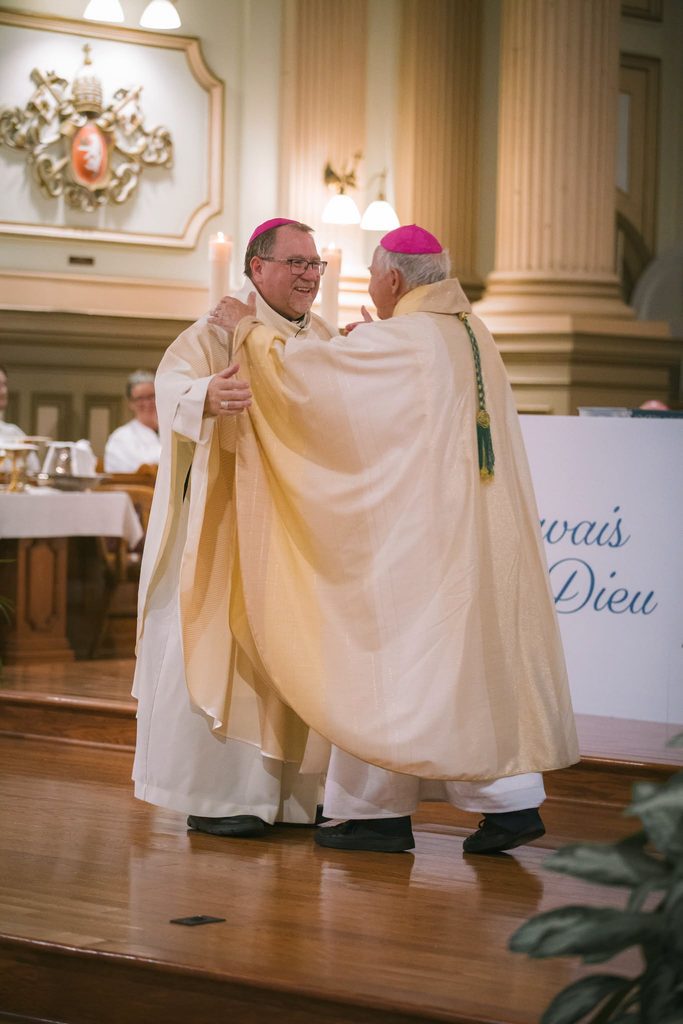
Three days later the installation Mass for Bishop Martin Laliberté of Saint-Jean–Longueuil, Quebec, was the setting for speakers who emphasized a Church that listens before speaking, discerns before acting, and walks together.
At the Cathedral of Saint-Jean-l’Évangéliste in Saint-Jean-sur-Richelieu, speakers Caroline Rodrigue and Father Fritznel Mertyl described the diversity of circumstances and people within the diocese, calling it a place where young people feel they belong. The diocese also “promotes co-responsibility between pastors and mandated lay people,” and carries out its mission “by being open to the world.”
They described a Church that has “the ability to roll up its sleeves, take action and always remain ready for service, especially when needs arise,” and that wants to be close to people, particularly those experiencing poverty, isolation, exclusion or different forms of vulnerability.
Rodrigue cautioned Laliberté, “Bishop, you are not arriving in a perfect Church,” but one that is “on a journey, with its weaknesses, questions and dreams, but, above all, with people who care deeply about the mission of the Gospel. We are happy to travel this road with you. We assure you of our prayers.”
Laliberté, a member of the Society of Foreign Missions of Quebec, previously served as bishop of Trois-Rivières and auxiliary bishop of Quebec. Before becoming a bishop, he was superior general of the missionary society and served in Haiti and Brazil.
Laliberté said he was arriving in a diocese “already on the move — not a perfect Church, as Caroline told us,” and adding that he, too, was far from perfect.
In his French-language homily, he spoke of the Samaritan woman as an image of searching humanity and of the deep thirst in every human heart to be “loved, recognized, welcomed and heard.”
“What Jesus offers her is neither a theory nor a set of rules or prescriptions. He offers her an encounter,” he said.
Earlier in the homily, he said Christ helps people discover that they are loved by the Father “before even our successes and despite our weaknesses.”
“In a world often marked by divisions and fractures, this Word remains a mission entrusted to the Church: to become ever more the living sign of the unity God desires for the human family.”
Laliberté said he was not arriving with a program based first on his own ideas or abilities, but with the conviction that the Holy Spirit was already at work in the diocese and with a desire to “walk with” its people.
He pointed to Horizon 2030, the pastoral directions developed through the diocese’s synodal process, in which some 3,000 people participated. Laliberté said people from communities across the diocese had taken time to “listen to one another, share their hopes and discern together the calls of the Spirit for our time and our surroundings.”
“Before speaking, it listens. Before acting, it discerns. Before planning, it seeks to welcome what the Spirit is stirring in the hearts of the people of God.”
Laliberté urged the faithful to dream of a missionary Church that does not turn inward but “dares to encounter those who are searching, those who doubt, those who feel far from God, and those who suffer from loneliness or discouragement.”
Bishop Claude Hamelin, in farewell remarks, noted three key elements that marked his time as bishop: the synodal process; pastoral choices made during the pandemic; and the settlement of a class action concerning allegations of sexual assault.
“In responding to the class action, key words guided us: listening, truth, transparency, forgiveness, humility and justice.”
“During my years as bishop, we drew close to people made most vulnerable by life. We listened to people searching for meaning and those who wished to deepen their faith.”