VANCOUVER (CCN) — When a WestJet aircraft returned to Vancouver International Airport several weeks ago because of landing gear trouble, the atmosphere inside YVR’s Integrated Operations Centre changed instantly.
A room that is often quiet quickly filled with personnel preparing for a possible emergency response.
Airport officials coordinated air traffic and airfield vehicle movements, while representatives of communications, security, airport operations, and outside agencies huddled in the centre monitoring the situation.
The aircraft landed safely, but the incident offered a glimpse into the hidden response network behind the scenes at one of Canada’s busiest airports.
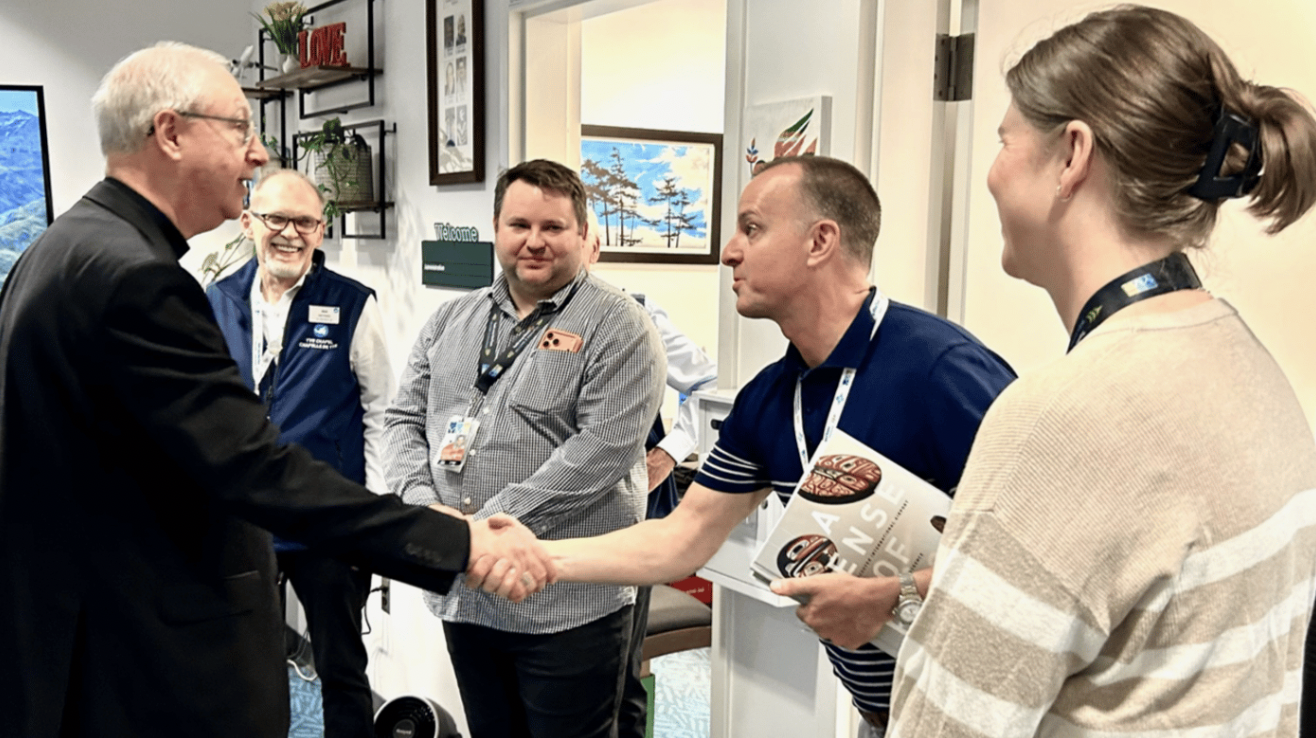
Archbishop Richard Smith recently got a firsthand look at that little-seen part of YVR during a tour that explored the airport’s emergency-response systems, chaplaincy ministry, and efforts to support vulnerable travellers.
The tour began not in an operations room, but at the YVR Chapel beside the International Arrivals area.
Deacon Wilfred Victoria, who serves as Catholic chaplain at YVR, accompanied the Archbishop and described the airport as a place that “moves and breathes like a miniature city.”
Every Sunday at 4 p.m., the chapel becomes a gathering place for Catholic Mass celebrated by Father Mark Bautista of nearby St. Monica Parish in Richmond. When Father Bautista is unavailable, Deacon Victoria leads a Liturgy of the Word and Communion service.
The ministry is supported by a small team of volunteers, including Henjie and Tess San Juan and Ed and Baby San Jose from Couples for Christ, who help bring Father Bautista to the airport.
A small community of airport workers has formed around the Sunday Catholic Mass, including one airport-security employee and a couple whose wife later entered the Catholic Church through RCIA and attended a wedding Mass and convalidation at St. Paul’s Parish.
The Archbishop’s visit continued through the International Departures area, where airport personnel and travellers occasionally stopped to greet him or ask for a selfie.
From there, airport staff led the delegation through secured corridors and into the Integrated Operations Centre, where staff monitor emergencies, passenger flow, baggage systems, security concerns, and the daily movement of one of Canada’s busiest airports.
Inside, large screens displayed live airport activity, including gate operations, passenger congestion points, baggage systems, aircraft movements, weather conditions, and security alerts.
“This is where our emergencies are dealt with,” Nick Anderson of YVR told the Archbishop as the group entered the operations area.
The scale of YVR’s operations is difficult to grasp from the public side of the airport. About 25,000 people work on Sea Island across airlines, airport operations, ground handling, retail, custodial services, and other organizations. Vancouver Airport Authority itself has about 1,100 employees. During busy summer periods, as many as 90,000 passengers may move through the building in a single day. Beneath the airport is a 42-kilometre baggage system.
The Integrated Operations Centre is designed to bring those many moving parts into one coordinated space.
Inside the room, the various airport functions maintain their own workstations, screens, and monitoring hubs only metres apart from one another. Operations staff, security personnel, dispatchers, technology support teams, and others each monitor their own areas while remaining close enough to communicate directly when an issue crosses from one department into another.
Staff in the room handle everything from customer-service calls and aircraft emergencies to passenger congestion and gate assignments. Screens throughout the centre allow staff to monitor crowding, dispatch resources when needed, and adjust operations when flights are delayed or gates become unavailable.
Security personnel also monitor access points between public and restricted areas, curb traffic, parking areas, and unattended vehicles that may become security concerns. If a vehicle is left where it should not be, airport staff can page the driver and send security personnel — including a dog team if necessary — to assess the vehicle.
“That’s why it’s the integrated operation centre,” Anderson said, “because you have a wide variety of folks in different capacities in the same space that makes it easier to communicate and facilitate work that needs to be done.”
From the Integrated Operations Centre, the group moved into YVR’s Emergency Operations Centre, a room purpose-built to bring personnel together during emergencies.
The Emergency Operations Centre is used “on average, two or three times a week,” most commonly for inbound aircraft emergencies, Anderson said. In those situations, airport fire-rescue crews are dispatched to the runway while YVR coordinates with 911, RCMP, and ambulance services so they can respond if needed.
Coloured vests visible throughout the room identify different emergency-response roles, including planning, logistics, and operations.
The airport also relies on staff and volunteers who can offer support to distressed passengers or anxious family members.
Anderson pointed to the airport chaplaincy as one of the resources available to passengers needing someone to speak with “in some cases, a spiritual sense.” In such situations, staff may call on Deacon Victoria and others to help support travellers.
“Airports are can be stressful spots to be,” Anderson said.
At YVR, that stress can take many forms. Some incidents involve aircraft. Others involve passenger frustration, medical emergencies, stranded travellers, anxious families, or vulnerable people moving through a major transportation hub.
Last year’s Delta Air Lines crash at Toronto Pearson International Airport illustrated the role airport chaplains can play during a crisis.
Chaplains were summoned after the aircraft skidded during landing and flipped over on the tarmac. Father John Mullins, a senior chaplain with the Toronto Airport Catholic Chaplaincy, later credited previous emergency exercises with helping the response run smoothly.
“When I got there, I said ‘This is exactly what we did in the mock up two years ago,’” Father Mullins told The Catholic Register.
He and Father Eduardo Lopez spoke with passengers after arriving and accompanied them on buses.
“Our presence to all was our contribution as we were in solidarity with both the rescue efforts and with the powerlessness of the passengers,” Father Mullins said.
The YVR tour also highlighted another area where airport staff and chaplaincy volunteers are being asked to recognize vulnerability: human trafficking.
The YVR chapel team recently attended airport training related to children being transported across the country and signs of human trafficking.
YVR’s Drew Pancratz described the airport as “such a large ecosystem” that “it takes a community to protect people and keep people safe.”
He said YVR does “a lot of work on human trafficking” so airport employees can recognize warning signs and help protect vulnerable people.
The chapel team also attended a recent human-trafficking-awareness session connected with Not In My City, an organization that works to raise awareness of the issue.
Archbishop Smith also reflected on YVR’s Indigenous symbolism and location on traditional Musqueam territory, mentioning he had recently attended a meeting of the International Conference on Catholic Indigenous Ministry in Auckland, New Zealand.
He said he hoped Indigenous visitors travelling to the conference in Canada in 2028 would experience that aspect of YVR.
Pancratz responded that the airport would “love to give them a Musqueam welcome” if possible, noting that YVR’s Indigenous-relations team often participates when VIPs and heads of state arrive.