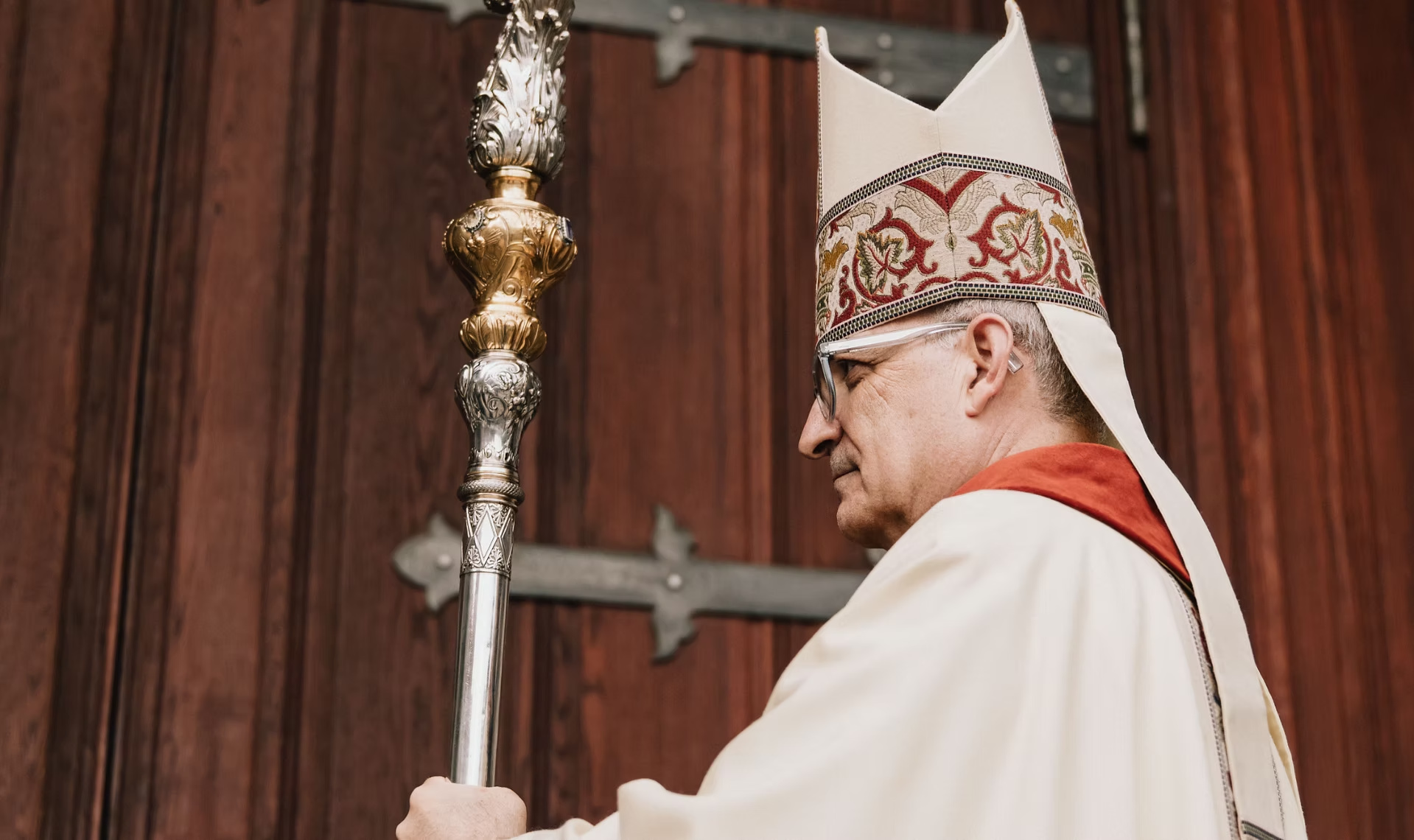
The new archbishop of Sherbrooke, Quebec, has returned to the diocese where he was ordained a priest, and he says much has changed during his six years away.
Archbishop Guy Boulanger was ordained a priest for the Archdiocese of Sherbrooke in 1991 and appointed bishop of Rouyn-Noranda, Quebec, in 2020. In 2023, Pope Francis also appointed him bishop of Amos, Quebec, uniting the two northern dioceses in persona episcopi. Under that arrangement, each diocese remained a separate jurisdiction but was entrusted to the same bishop.
Pope Leo XIV appointed Boulanger to Sherbrooke April 10. The new archbishop inaugurated his pastoral ministry June 19 at Saint-Michel Basilica-Cathedral in Sherbrooke.
As he settles into his new ministry, Boulanger says the archdiocese has undergone significant changes since he left for northern Quebec.
“The major change has been in the parishes,” he told Canadian Catholic News in an email response to questions. “A few churches have closed. Others have been sold, although Mass is still celebrated in the buildings under agreements.”
Amid declining Mass attendance and rising maintenance costs, excess church buildings have been finding new uses across the province. Dioceses have sought ways to preserve them as community centres, housing or commercial spaces, sometimes under arrangements that still allow Mass and other religious services to be celebrated.
Such arrangements may become more complicated under Quebec’s expanded secularism law, adopted in April, which places restrictions on religious practices in public institutions and spaces.
For Boulanger, the loss of church buildings is one sign of the increasingly secular character of Quebec society and of the need for a different pastoral approach.
“Quebec is becoming more and more missionary territory,” he said. “We need to change our pastoral approach so that we can reach people who know nothing about the faith.”
At the same time, a Church that once sent missionaries abroad increasingly welcomes priests from other countries to sustain its own parishes. Boulanger said more priests from abroad are now serving in Sherbrooke.
He became familiar with this development during his ministry in Amos and Rouyn-Noranda.
“I had the opportunity to discover this ministry in a different region, with fewer people and a large territory,” he said. “I gained experience welcoming priests, religious and future priests from other countries.”
That background now serves him as Sherbrooke welcomes both priests and lay Catholics from abroad. Boulanger said immigration has increased noticeably since he left in 2020, and he sees it as an opportunity for renewal.
“Many people have come from different countries,” he said. “We do our best to welcome them, and they have an important place in our communities and celebrations. We hold intercultural celebrations, and they bring renewal to our Church.”
In fact, he said, “renewal comes mostly through immigration.”
His years as bishop of Rouyn-Noranda and Amos also gave him experience working with First Nations Catholics and leading dioceses across a vast region.
“I worked with faithful from First Nations communities,” he said. “We moved the bishop’s residence and offices and managed several other properties. I also gained experience in pastoral planning, leading diocesan councils and introducing new projects.”
In Sherbrooke, Boulanger points to the involvement of laypeople and the growing number of priests from other countries as important resources for the future.
“Laypeople are involved in the life of the Church,” he said. “We now have a significant number of priests from different countries, and they are invaluable in continuing the mission.”
He also finds optimism in young people encountering Catholicism with fewer preconceived ideas, sometimes discovering the faith online.
“In a way, it is an advantage with young people, who can discover the faith without prejudices,” he said. “It gives hope.”