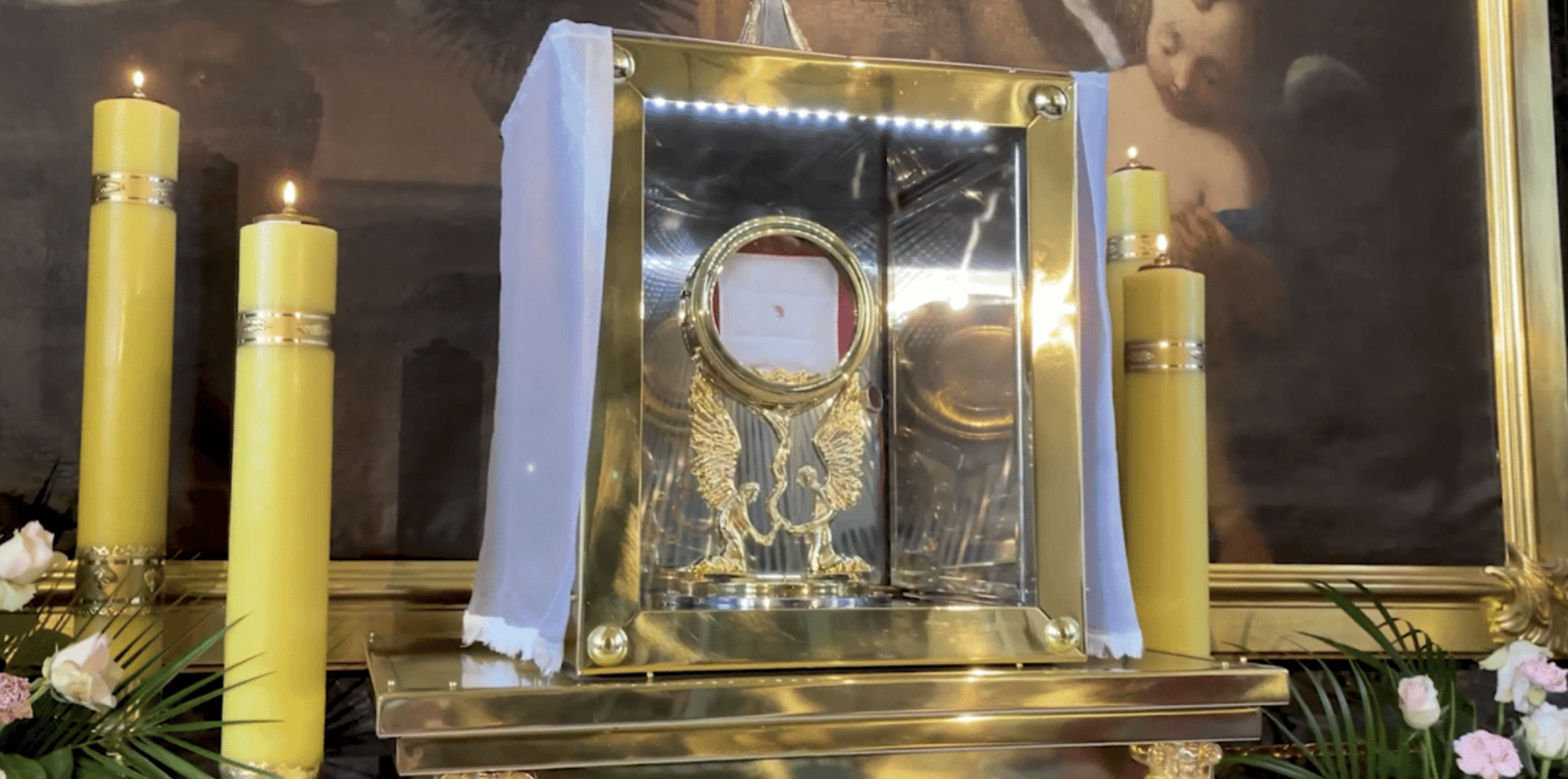
Eucharistic miracles in which consecrated bread and wine turn into human flesh and blood have been documented for centuries, but four more recent cases are of particular in interest for Dr. David Neima because of the rigorous scientific investigation they’ve received.
Neima, a New Westminster ophthalmologist with a background in neurophysiology research discussed the miracles in a talk at St. Thomas Aquinas Regional Seconday, part of a series exploring faith and science.
One of the most well-known Eucharistic miracles is Lanciano, Italy, which occurred around the year 750, when a priest reportedly doubted the real presence during Mass and the host began to bleed. The event has been examined multiple times over the centuries. In 1970, testing identified the host as human cardiac tissue with an AB blood type.
Neima said the chain of custody, showing who handled the evidence and when, is key in ruling out tampering or false findings such as the introduction of other people’s DNA. In the Lanciano case, the chain of custody is limited, since many people handled the host over time.
Neima’s talk focused on four more recent cases. Reported between 1996 and 2013, they received more controlled investigation, meeting scientific standards including protecting the chain of custody, blind testing, multidisciplinary teams, repeated investigation, and long observation periods before testing.
The first case was in Buenos Aires, Argentina, in 1996. A host was found abandoned at the back of a church and, according to church practice, was placed in water to dissolve. Days later, the water appeared bloody and tissue-like material was visible. The host remained submerged in water for three years. The bishop at the time, Cardinal Jorge Bergoglio, later Pope Francis, ordered an investigation.
The tissue was sent to multiple independent investigators who were not told what they were examining. Human tissue and white blood cells were identified. The tissue was classified as myocardial tissue near the aortic root.
Neima said investigators reported that the presence of white blood cells indicated an inflammatory response and was consistent with trauma. He also said some investigators concluded the tissue appeared to come from a living or recently deceased person, and expressed surprise when told the sample had remained in water for an extended period.
The second case took place in Mexico in 2006. A host in a pyx was reported to be releasing a blood-like substance and was placed in the tabernacle. At the bishop’s request, a team was organized to investigate, including an anatomical pathologist, surgical histopathologists, DNA experts, forensic geneticists, biochemists, a pharmacist, a legal expert, and computer imaging specialists.
Investigators found red and white blood cells. Neima said the white blood cells were engaged in phagocytosis, which is associated with tissue responding to injury. The blood type was identified as AB, and hemoglobin and immunoglobulins were present. He said the host was reported to produce blood over a period of four years. Investigators identified the material as cardiac tissue and reported pressure forcing blood from the host.
In Sokolka, Poland, in 2008, a priest dropped a host at Mass and placed it in water to dissolve. After seven days, red tissue appeared, and after 48 days the tissue remained. The host was later placed on a corporal in a dry place, where the tissue remained after two and a half years. At that point, the bishop requested a scientific investigation.
The investigation concluded that the tissue was recently living and had undergone severe trauma, that it was cardiac tissue, and that the host and the cardiac tissue were integrated at a microscopic level.
In 2013, in Legnica, Poland, a host dipped in the Precious Blood was dropped and placed in water to dissolve. After a few days, a crescent of red tissue appeared. After seven days, the host had dissolved but the tissue remained. The material was placed on a corporal and later tested, with results identifying it as cardiac tissue of human origin.
Across all four cases, Neima said investigators identified cardiac tissue and reported findings consistent with trauma. In multiple cases, red and white blood cells were present, with white blood cells associated with inflammatory response. He noted that such cells are typically found in living tissue and degrade quickly outside the body.
Another common element in the cases was the presence of AB blood type. Neima said the same blood type has been reported in studies of the Shroud of Turin and is more commonly found in populations from the Middle East. In medicine, he said, AB is known as the “universal recipient,” meaning a person with that blood type can receive transfusions from any blood type.
Neima said he was initially puzzled by this, expecting a “universal donor” designation, but later concluded that the classification reflects how, in the Eucharist, the faithful receive Christ.
The Catholic Church does not require belief in reported Eucharistic miracles and they are not part of the deposit of faith.
Neima’s final talk in the series is “The Fossil Record and Intelligent Design” and is scheduled for Thursday, June 4, at 7 p.m. at St. Thomas Aquinas Regional Secondary.