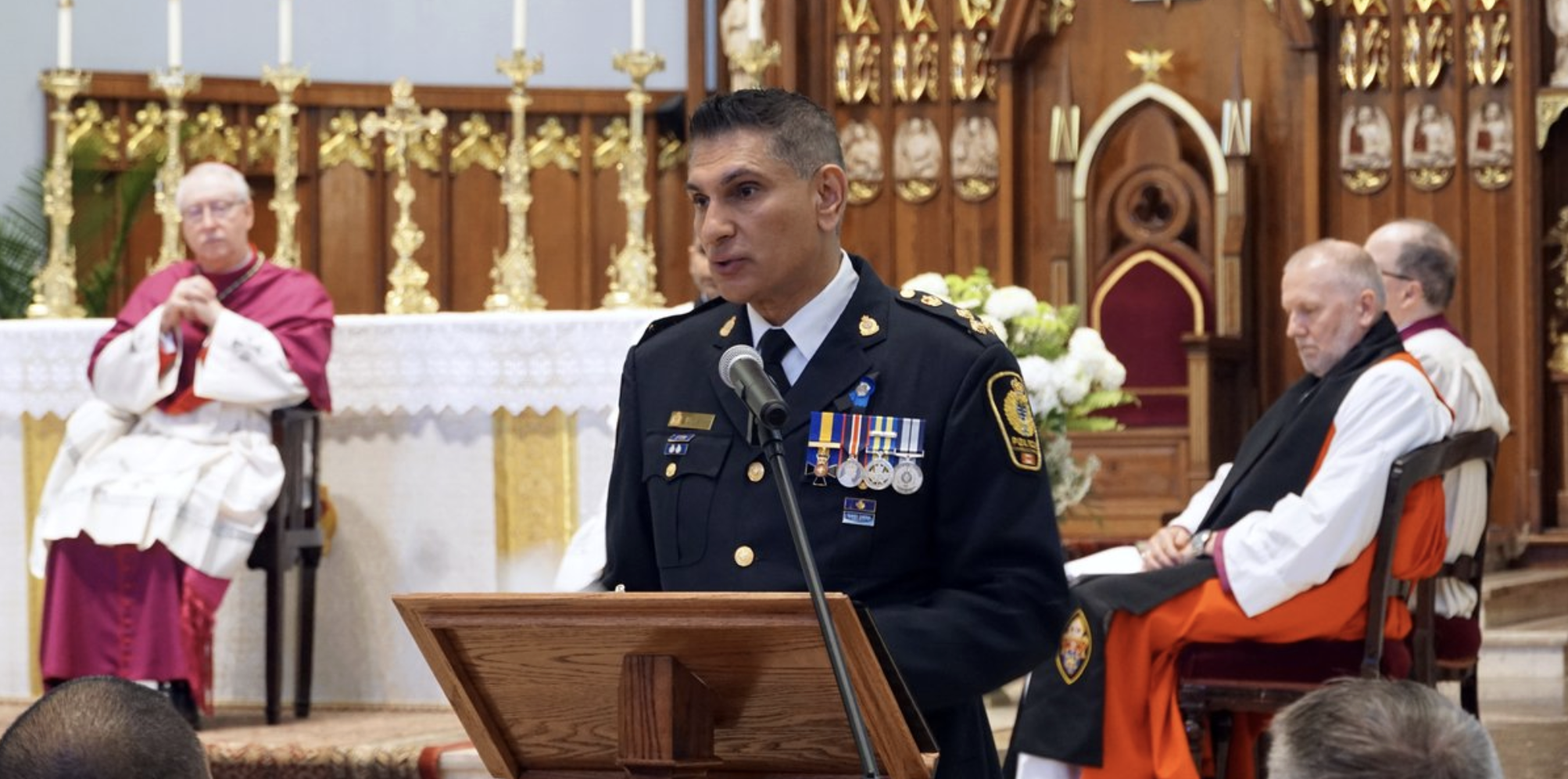
VANCOUVER (CCN) — Archbishop Richard Smith delivered this homily on April 29 at Holy Rosary Cathedral at the memorial Mass for the victims of the Lapu-Lapu Festival tragedy.
As we gather this evening one year after the unspeakable tragedy that occurred at the Lapu-Lapu festival, the memory of that event is vivid and the shock and pain it occasioned arise afresh in our hearts and minds. This usually happens on the first anniversary of death and tragedy, so it is good to be together in solidarity and support.
Yet this is the moment when we also experience within us a keen desire for the healing of our pain and an earnest search for a reason to hope. This is why our gathering tonight unfolds within the context of prayer.
We realize instinctively that God shares our desire, and wants to lead us to deep inner peace, a tranquillity of soul that lies far beyond human effort or understanding. We gather to place our abiding pain before our loving and tender God and ask of him this wondrous gift that He alone can bestow.
To guide and shape our prayer, allow me to propose as helpful a brief poem of extraordinary beauty and astonishing depth written by Saint Teresa of Avila in the late 16th century. In rough English translation it runs as follows: “Let nothing disturb you; let nothing frighten you; all things pass away. God never changes. Patience obtains all things. The one who has God lacks nothing. God alone suffices.”
St. Teresa knew more than her fair share of trouble and pain, especially as she went about the work of reforming her Carmelite order. Yet from the very midst of the hardships arose this poem expressive of deep peace: “Let nothing frighten you; patience obtains all things; God alone suffices.”
Is such peace possible for those who suffered permanent injury or the devastating loss of loved ones in the Lapu-Lapu tragedy? In faith we affirm that it is.
The peace of which St. Teresa speaks is far more than the healing that comes with time. Rather, it is a peace that co-exists with pain and abides even as hardships endure. To human reason, such inner peace is inexplicable; for human effort, it is unattainable. Yet to the eyes of faith, its wellspring is clear: the victorious love of God.
We are gathering in the Easter season, that sacred time when Christian believers celebrate with joy and thanksgiving the triumph of Jesus Christ over the grave. his rising from the tomb is God’s definitive victory over evil, sin, and death.
Those who live with faith in him, those who surrender all things to his love, know deep within their hearts that no tragedy, however horrible and catastrophic, can possibly have the last word. That last word always belongs to God, who loves us beyond all imagining, and whose power can turn all hardship, suffering, and pain to the good, though we see not how.
From that all-powerful love nothing can separate us, as St. Paul confidently proclaims. God is always near, and “God alone suffices”.
The more we allow ourselves to be seized by the truth of God’s never-failing love and providence, the more there arises in our hearts a peace that is beyond the world’s understanding and that no anguish or sorrow, however traumatic or excruciating, can ultimately shake.
Jesus himself invites us to this faith that brings peace in its wake. In the Gospel passage from St. John, Jesus speaks to his terrified disciples. They have awakened to the likelihood of his impending death, and the prospect of separation from him leaves them deeply shaken.
The Lord summons them to let their fear give way to faith. “Do not let your hearts be troubled. Believe in God, believe also in me.” Then he goes on to explain that through his death he will accomplish the mission he received from the Father.
“In my Father’s house there are many dwelling places. If it were not so, would I have told you that I go to prepare a place for you?” By his dying and rising Jesus has made death the gateway to eternal life.
Those same words, “let nothing trouble you”, he addresses to us this evening. Both evil and death have been conquered by the death and resurrection of the Lord, which means they cannot conquer us.
And they haven’t! It is important to acknowledge and embrace this.
One year ago, the shockwaves emanating from the Lapu-Lapu tragedy reverberated far and wide, and left hearts everywhere deeply shaken as we witnessed the indescribable pain of people whose lives had been shattered.
This gave immediate rise to a mighty surge of solidarity. Countless numbers of people, most until then strangers to one another, came together spontaneously to stand with the broken, grieve with them, and offer solace and support.
Prayer services were held. People gave what they could of their own substance to provide for the needs of the suffering. Professional accompaniment was offered to persons seeking help to deal with the mental health impacts of trauma.
Blessed with the eyes of faith, believers can see moving in and through all this the invincible love of God prompting us toward one another, to overcome by his grace the tragedy that would otherwise have left us irreparably broken.
Thus does our own experience verify the truth underlying the encouragement given by St. Teresa: “God alone suffices.”
Living in the awareness of God’s abiding presence and the assurance of his love, the heart is able to rest in deepest peace, certain that the love of God is ceaselessly at work in our broken world and grief-stricken lives to set all things right and mysteriously turn everything to the good.
It is this assurance that draws us together this evening and motivates our prayer. As we ask our tender God to bestow eternal life upon those whose lives were taken from us, we pray, too, that those who grieve will be led by God’s grace to the consolation they seek and the peace God wills to grant them.