

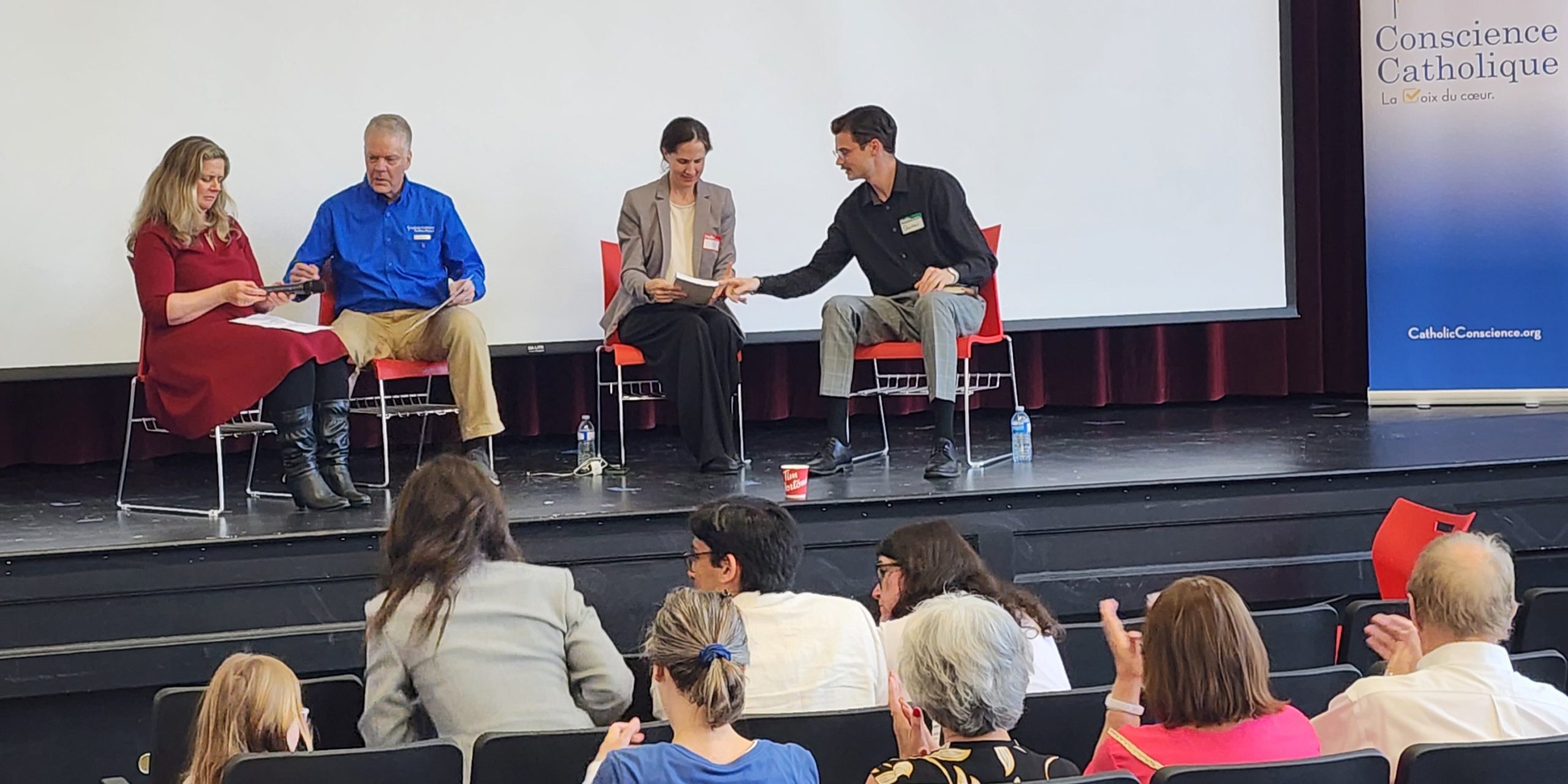
TORONTO (CCN) —When dozens of Catholics gathered at De La Salle College in Toronto May 30, they came with a common belief: Catholic social teaching can restore the social covenant that once held Canadians together.
However, organizer Matthew Marquardt of Catholic Conscience cautioned his audience that the goal might not be as simple as they think and that healing society starts with them.
“We’re going to talk about a lot of things, and we’re not going to all agree on everything,” he told about 75 people gathered in the college lecture hall.
As founder of the Catholic civic-engagement organization Catholic Conscience, Marquardt knows something about Catholics having differing views. Catholic social teaching covers a broad spectrum of issues, including immigration, poverty, the environment, health care and reconciliation.
Therefore, in the spirit of Pope John XXIII’s maxim, “In essentials, unity; in doubtful matters, liberty; in all things, charity,” Marquardt told the crowd that “as long as we can agree on what the principle is, that’s enough.”
Agreeing on principles, after all, would allow Catholics “to talk to one another,” something Canadians are finding increasingly difficult in an age of isolation and polarization.
Beyond talking, participants also discussed the need to collaborate and “cover the full range of the things we’re supposed to be talking about in a very efficient and fruitful way.”
The theme of dialogue echoed discussions at a Christian Communicators of Canada conference two weeks ago where participants explored the idea of “disagreeing well” and the need for greater collaboration among Christian organizations and media outlets.
Marquardt and Catholic Conscience have been trying to bring Catholic culture into public affairs and political discourse for eight years, and keynote speaker Bishop Mark Hagemoen of Saskatoon thanked them for it.
At a time when some argue “we are dealing with a sadder and madder society,” Bishop Hagemoen said, “Catholics should be very interested and engaged in politics and in political and social dialogue.”
Saskatchewan’s bishops have promoted Catholic Conscience for years. In 2020, they gave its election resources their imprimatur at a time when, Bishop Hagemoen said, many people of faith were “tempted to hide themselves away from the increasingly difficult and complex issues of our world.”
Such withdrawal runs contrary to Catholic teaching, he said. Political participation, according to the Catechism of the Catholic Church, “is a moral obligation” rooted in Christian witness in public life.
“We are to manifest excellent human conduct … especially in the difficult discourse of politics.”
Bishop Hagemoen cited a U.S. bishops’ document lamenting that politics has become “a contest of powerful interests, partisan attacks, sound bites and media hype.”
The Church calls for “a different kind of political engagement,” the bishop said, “one shaped by the moral convictions of well-formed consciences and focused on the dignity of every human being, the pursuit of the common good, and the protection of the weak and the vulnerable.”
He noted Pope Francis’ call in “Evangelii Gaudium” for “more politicians capable of sincere and effective dialogue aimed at healing the deepest roots.” The document described politics as a vocation that can become one of the highest forms of charity when directed toward the common good.
Citizens, he said, should likewise be guided more by moral conviction than political loyalty.
“When necessary, our participation should help transform the party to which we belong. We should not let the party transform us in such a way that we neglect or deny fundamental moral truths, or, of course, approve intrinsically evil acts.”
The bishop also explored the relationship between theology and politics, describing how “religious ideas shape public structures and how state power mimics or claims higher authority.”
Drawing on the Old Testament image of kingship, Bishop Hagemoen said rulers were called to possess “the mind and heart of God, especially for the disadvantaged, the widows, the orphans, the strangers, those dealing with physical and other ailments of their human condition.”
While power ultimately belongs to God, he said, “human government is a delegated authority,” bringing responsibilities of stewardship meant to “restrain chaos and promote human flourishing” through “civic order and material stability in a flawed, pluralistic world.”
Modern society, however, increasingly privatizes morality, he said. Citing columnist David Brooks, Bishop Hagemoen warned that when people create their own moral frameworks, “we don’t have shared standards.” The result is that people become “naked and morally alone.”
Returning to the conference theme of dialogue, Bishop Hagemoen urged participants to reject bitterness and hostility in public discourse. Quoting St. Paul’s instructions in Ephesians 4, he called for “dialogue, diplomacy, respect, and forgiveness.”
“Be kind to one another, compassionate and mutually forgiving, just as God has forgiven you in Christ.”
He closed by quoting Pope Leo’s encyclical “Magnifica Humanitas”: “Let us disarm words, and we will help to disarm the world.”
Father John Meehan of the University of St. Michael’s College approached the theme of dialogue through reconciliation, namely reconciliation with Indigenous peoples.
Drawing on 2 Corinthians 5, he described Christians as recipients and bearers of “the message of reconciliation.”
Father Meehan recalled a recent Theology on Tap gathering where some young adults admitted they were reluctant to attend.
“Nothing good can come from this talk, only anger and hostility,” one participant said, a comment Father Meehan suggested reflects the anxieties of many young people.
Some students, he said, were unfamiliar with Catholic social teaching and surprised to hear that the Church “is called to be political but not partisan.” Others struggled with the concept of social sin.
“They’ve individualized sin and focus on their own sins, very important, of course, but they often don’t realize social sin — the largest sin that we all contribute to, often without realizing it.”
Father Meehan illustrated the point through his experiences working with Indigenous communities in Regina, including at Campion College, at a correctional centre where most inmates were Indigenous and on First Nations reserves.
“I did funerals of 16-year-olds who had committed suicide. I’ve seen a place with no paved roads, no clean drinking water,” he said. “As a Canadian, as a Catholic, as a human being, that’s something that is just not good enough.”
He recounted his friendship with Noel Starblanket, a Cree elder, residential school survivor, and former national chief of the National Indian Brotherhood, the precursor to the Assembly of First Nations.
Starblanket emerged from residential school angry at white people and Catholics. Through years of friendship and collaboration, he and the Jesuit worked together to promote education, spirituality, reconciliation,and healing.
“Over the next few years, he and I did a lot to bring our communities together.”
Reconciliation, Father Meehan said, “is the centre of our faith” because Jesus reconciled God and humanity. “We all need it, because we have a broken society. It’s not working.”
Reconciliation requires listening, he added, even when that is uncomfortable. “I learned how just to be quiet and listen, to be present in someone’s pain.”
Father Meehan closed with reflections from Theology on Tap students who, rather than focusing on politics, wanted to talk about social media, technology, artificial intelligence, loneliness and alienation.
“The problem for them is not politics but polarization. They don’t know how to engage in conversation with people who have different opinions.”
He left them with some practical steps for dialogue, starting with cultivating an active prayer life to fill their spiritual emptiness rather than relying on “the online world, anger, frustration and identity politics.”
He encouraged them to engage in healthy and meaningful dialogue by focusing more on respectful listening than speaking. “Avoid toxic echo chambers. What would you say to the person if they were right in front of you before hitting send?”
The themes raised by the keynote speakers carried through the rest of the day in sessions examining Catholic social teaching through the lenses of family life, economics, media, civic participation, education, intercultural relations, peacebuilding, prayer and care for creation.
Speakers included moral theologian Moira McQueen, journalist Peter Stockland, economist Peter Copeland, Luke Stocking of Development and Peace-Caritas Canada, and Myron Rogal, coordinator of justice and peace in the Diocese of Saskatoon.

What an encouraging conference this must have been. So long we have been in our “echo chambers” bouncing ideas around looking for answers from people who already agree with us. Regardless, I can certainly appreciate the need for the type of dialogue. It is not a matter of who comes around to my position but rather to engage in that old adage we heard in the 70s and 80s. WWJD. Therein lies our path forward.