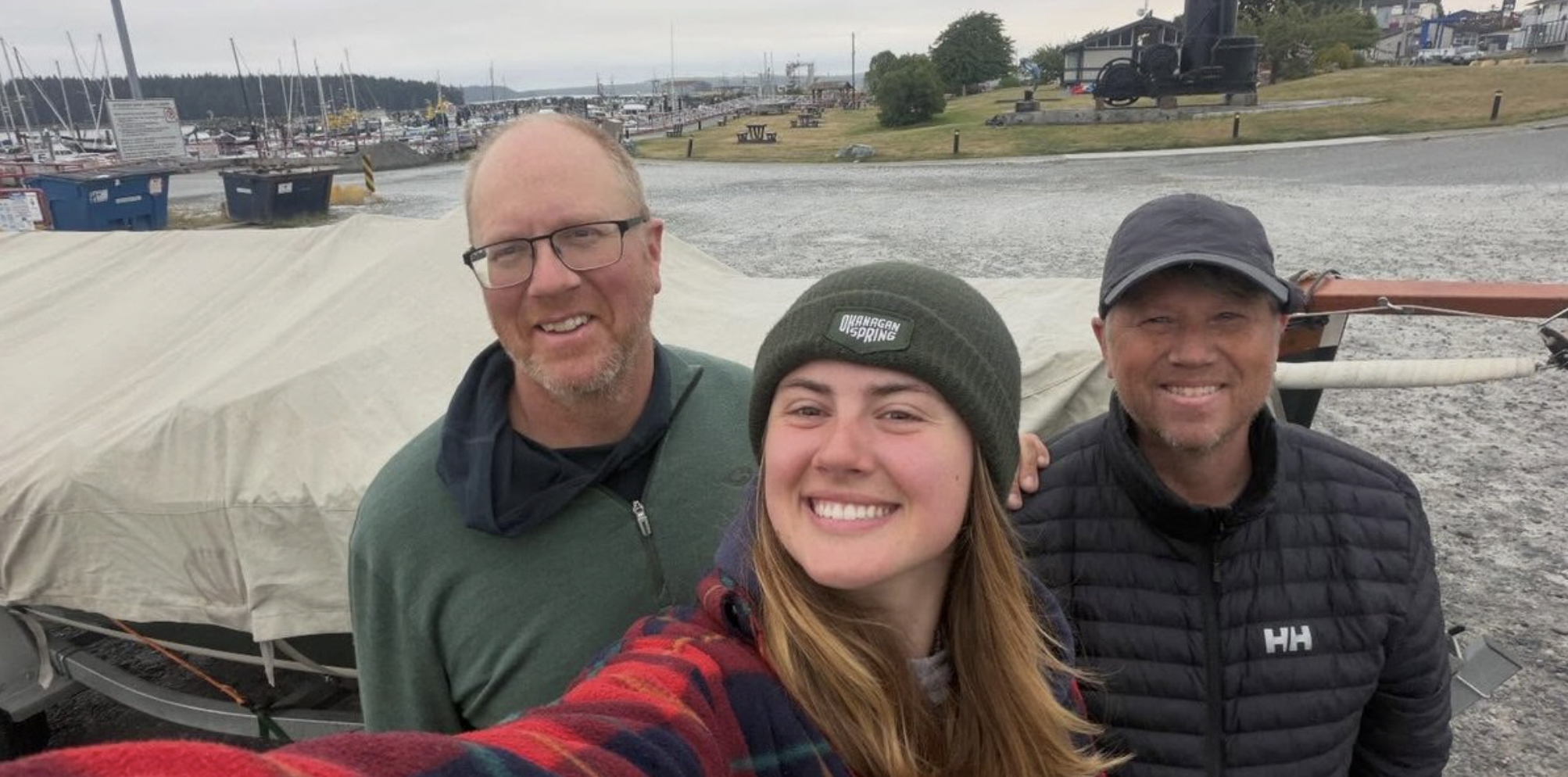
VANCOUVER (CCN) — Sailing in heavy winds off the coast of Vancouver Island, Team Kostamo realized their plans needed to change. Finishing the Race to Alaska was out of the question, but the trip was still worth it. They raised over $250,000 for the Burnaby Hospital Foundation, but more than that, Sophia Kostamo says she learned a lot about herself, her father, and trusting in God.
The trip ended after 13 days, just shy of open ocean. “There was a huge gale coming at the time when we would have to cross open water [north of Vancouver Island],” Sophia told The B.C. Catholic. Poor wind had cost them early in the race, and they were trying to make up for lost time. Apart from a lone B.C. Ferry, they were the only boat on the water as the winds reached 35 knots (or 55 km/hr).
“We had to take the mainsail down in the wind,” Sophia said. “I had the rope in my teeth – I felt very old sailor! My dad [Deacon Tim Kostamo] was at the helm for three straight hours – he had to keep things together, be he really did an incredible job,” she said. “I found it more fun, in the most intense weather.”
For the uninitiated, The Race to Alaska has attracted the best sailors from around the world for a little over a decade. The first race ran in 2015, and sailors go from Port Townsend, Washington up to Ketchikan, Alaska. It’s hard to beat the race’s official description on their website:
“First place gets $10,000, cash. Second place gets a set of steak knives. Everyone else gets to find out what they’re made of,” it reads. “The only way to win is to cross open water, navigate through tidal rapids, hug a coastline carved by glaciers, and keep going until you reach Ketchikan … This isn’t just a race. It’s a throwdown with one of the most storied and unforgiving coastal passages on the continent … Out here, self-reliance isn’t a virtue. It’s survival.”
Team Kostamo was one of 72 teams competing in this year’s event. When they decided to head home early, 13 hours into the race, they had made it up to Port McNeill and outlasted over 50 percent of the competition. Additionally, their donation page raised $262,192 for the Burnaby Hospital Foundation, to be used for the hospital’s new operating rooms.
“We tried to make more northern progress but got spanked pretty hard by the weather,” reads Deacon Tim’s July 1 Facebook post. “We are returning home, tired but in good spirits.”
Father-daughter sailing trips through treacherous waters rarely make the list of popular father-daughter outings, but Sophia has a long history of accompanying her father on such adventures. In recent years she has aided him on mission to Ecuador, where he volunteers his services as a surgeon. On their last trip, they climbed Mount Cotopaxi, the second-highest peak in Ecuador.
It helps that in addition to being her adventure-loving dad, Deacon Tim is a member of the permanent diaconate, something Sophia says she appreciates. “It’s made him grow as a person, and as a father,” she said. “I notice he puts more emphasis on being present and listening. He always listened, but you can feel it more. What he’s learned, going through the process to become a deacon, has made him more present and conscious.”
“I moved out [for university] before he got ordained,” she said. “So, I see him mostly in professional work settings. He loves to talk; he loves to engage with people, especially new people. I think that being a part of the diaconate, the parish, Catholic physicians, and the prayer ministry, brings him a lot of energy and joy.”
Energy and joy are exactly what a captain needs for such a journey. “He was a great captain,” she said. “You are so exposed and vulnerable to the elements – you have to consider so many things: the wind, the current and the tide.”
The sea has always been the final testing ground for human endurance and skill, and even with modern conveniences and tools, it teaches lessons about self-reliance and about trusting your crewmates.
“You can only move with it [the wind], or with your own strength [rowing],” Sophia said. “That experience, of only having your own strength and the strength of the people around you was very unique; it taught me a lot of mental resilience.”
The trip was full of remarkable moments, but the highlight for Sophia was when they passed through Seymour Narrows, which she described as “a turning point in the race.” Before this, the coastline is quite populated; you still have good signal and are easy to reach. Afterwards, the wilderness makes itself known. At one point, they were caught in a small whirlpool; at another junction, a pod of 15 dolphins swam in front of the boat. “It was really beautiful, being really immersed in nature,” she said.
God was with them, too. Early on, just out of Victoria, the wind failed, and they spent nearly six days rowing. “It was really flat, and were doing maybe five miles in five hours,” she said. Spirits were low when they received a message from the Burnaby Hospital Foundation telling them a donor had given $250,000 to their campaign. Almost immediately, one of Deacon Kostamo’s other cousins pulled up in his boat to offer encouragement.
“That was incredible,” said Sophia. “You can see the higher power present when things are down. God only gives you what you can handle. There was a lot of love through the whole journey.”
Fresh from university and deep in med school applications, Sophia said she didn’t need any convincing when her dad approached her to be a part of the crew. “I’ve been on boats with my dad since I was three or four,” she told The B.C. Catholic, “Mostly in the Howe Sound area – nothing that compares to this, but I am down to try anything.”
The team had only known about the race for a little over a year, and the voyage was undertaken, in part, to celebrate Deacon Tim Kostamo’s 50th birthday. Their three-man crew was bolstered by Deacon Tim’s cousin, Markku Kostamo, a lifelong adventuring partner, and a source of considerable sailing experience.
Their boat was a new acquisition, and the team had minimal time to get used to the 19 ½ foot Bay Raider before they were tested in the Proving Ground, a provisional first leg of the race, in which teams must make the passage from Port Townsend in Washington state northward to Victoria in under 36 hours or be disqualified. Their time was a modest 20 hours.