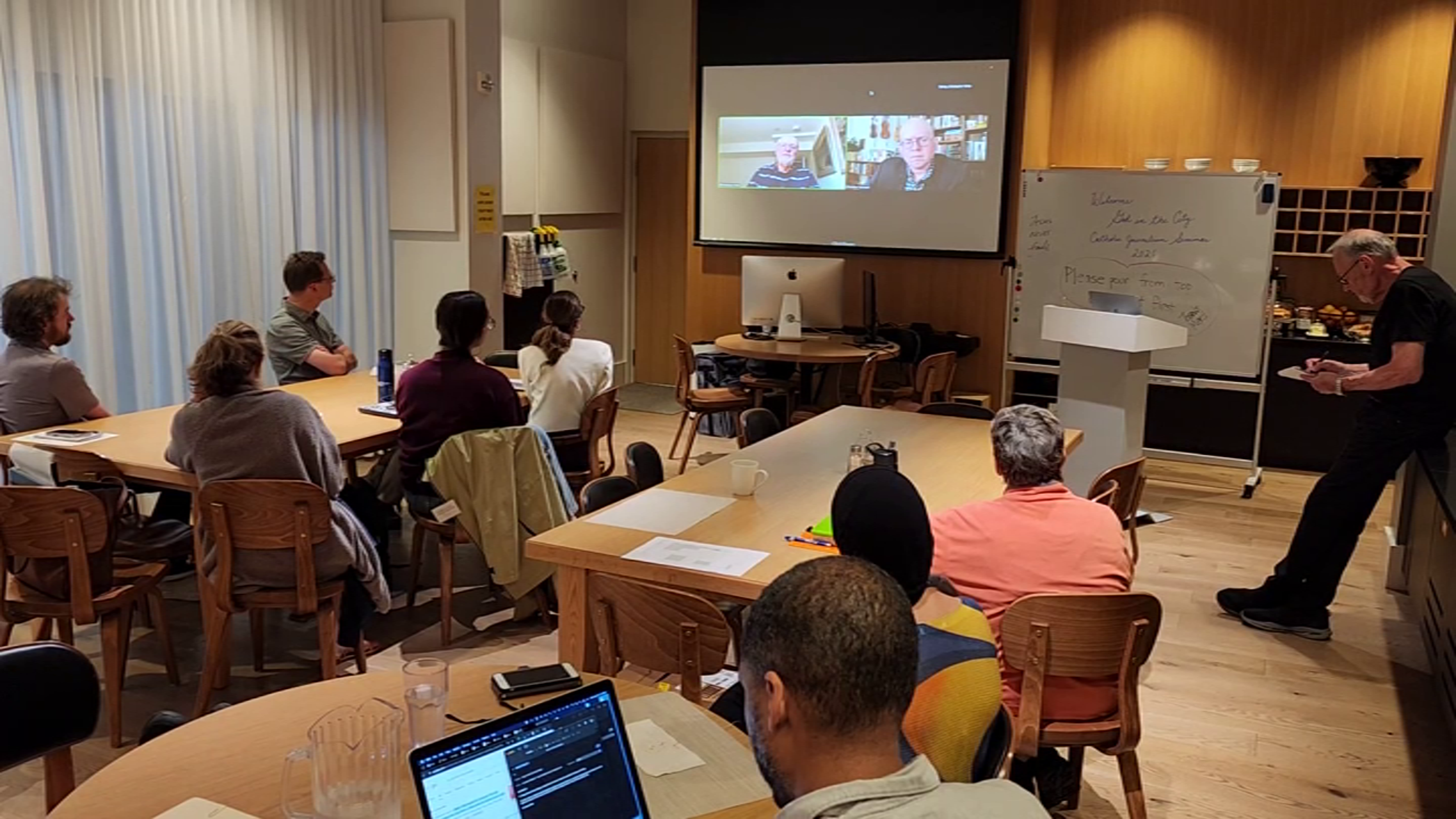
TORONTO (CCN) — Two veteran church journalists examined the role of journalism in faith communities and the future of independent religious journalism during an Aug. 10 webinar, which also questioned whether a church can report on itself.
The answer to the question depends greatly on whether its leaders appreciate the difference between journalism and communications, the panelists said. When communications staff, who are supposed to explain and promote the institution’s work, take the place of the scrutiny and accountability of journalists, problems arise.
“Every church has a share of thorny stories in its life. It’s just part of … the church,” said Matthew Townsend, former editor of The Anglican Journal.
Townsend spoke from experience. He resigned as editor of the official newspaper of the Anglican Church of Canada in 2021, after a draft article about survivors of misconduct provided to church officials was shared with the institutions implicated in the story. The survivors had been promised confidentiality, and the draft contained identifying details about the survivors.
Two months ago, the Council of General Synod, the national executive and administrative branch of the Anglican Church in Canada, approved a new mandate making The Anglican Journal the official voice of the church and part of its communications strategy rather than a separate journalistic entity.
The two events illustrated for the panel what can happen when church publications are expected to report on the same ecclesial bodies that fund and oversee them.
Townsend was joined on the webinar by Catholic journalist, broadcaster and author Michael W. Higgins, who summed up the problem of replacing news with in-house communications.
“I think that there’s a big difference between being an agent of communication and being a journalist,” Higgins told Christopher White, host of Broadview Live. “And part of it is the confusion in the minds of overseers about what the actual function of journalism is.”
A church is entitled to communicate its message and present its work positively, Higgins said. However, a mature institution must resist reducing everything to spin. When communications take over the work once entrusted to journalists, he said, “a very important voice is lost to the church.”
Higgins pointed to Catholic publications, such as Commonweal and The Tablet, which have maintained their editorial voice because they are independent of Church ownership or hierarchical control. Some are able to flourish.
Independent Catholic publications are not hostile to the Church or indifferent to its mission, he said, but they recognize that the Church, like every human institution, has weaknesses and pathologies that must be exposed, examined and scrutinized. They do so from a position of “critical faith.”
Higgins, who had served on The Anglican Journal’s editorial board, resigned with several other members in protest after the decision to bring the publication under the church’s communications operation.
Asked what is lost when journalism disappears, Higgins said the institution itself is compromised. He noted that in Canada, the Catholic Church’s sexual abuse crisis was not uncovered by official Church communications or its own press.
The Church has since become far more open about abuse, he said. “There is absolute transparency. There is a commitment to get to the heart of the matter.”
But that transformation would not have occurred without a scorching period in which the Church, its journalists, and its publications had clearly failed, Higgins said. The lesson was forced on the institution from outside because its internal mechanisms had not done their job.
White asked how churches can tell their stories in a world increasingly marked by distrust, disinterest and competing noise.
“I don’t know that it does, or can, or should,” Townsend said.
The church has one story ultimately worth telling — the story of Jesus Christ, he said. Faith is communicated most powerfully through personal encounter, not journalism.
“In my experience, the church is best told one person at a time,” Townsend said.
The world is not going to become less noisy, he added, and churches may be concentrating too heavily on trying to broadcast themselves into it. He suggested they pay more attention to the conversation within the church and to helping their members understand what the institution is, where it is succeeding, and where it is failing.
Townsend linked the handling of The Anglican Journal with the drop in membership Anglicanism has seen in Canada since the 1960s.
“A church that doesn’t talk with its editorial board about the decision to remove the journalistic mandate from its publication is a church that’s going to decline,” he said.
Higgins said religious media respond to people who have different interests and needs, offering different services. “One is reportage, one is analysis, one is theological discourse.”
Those functions must remain distinct from newsletters, parish bulletins and directives from head office, he said.
“They have a role with a function and form, [but] it’s not journalism.”