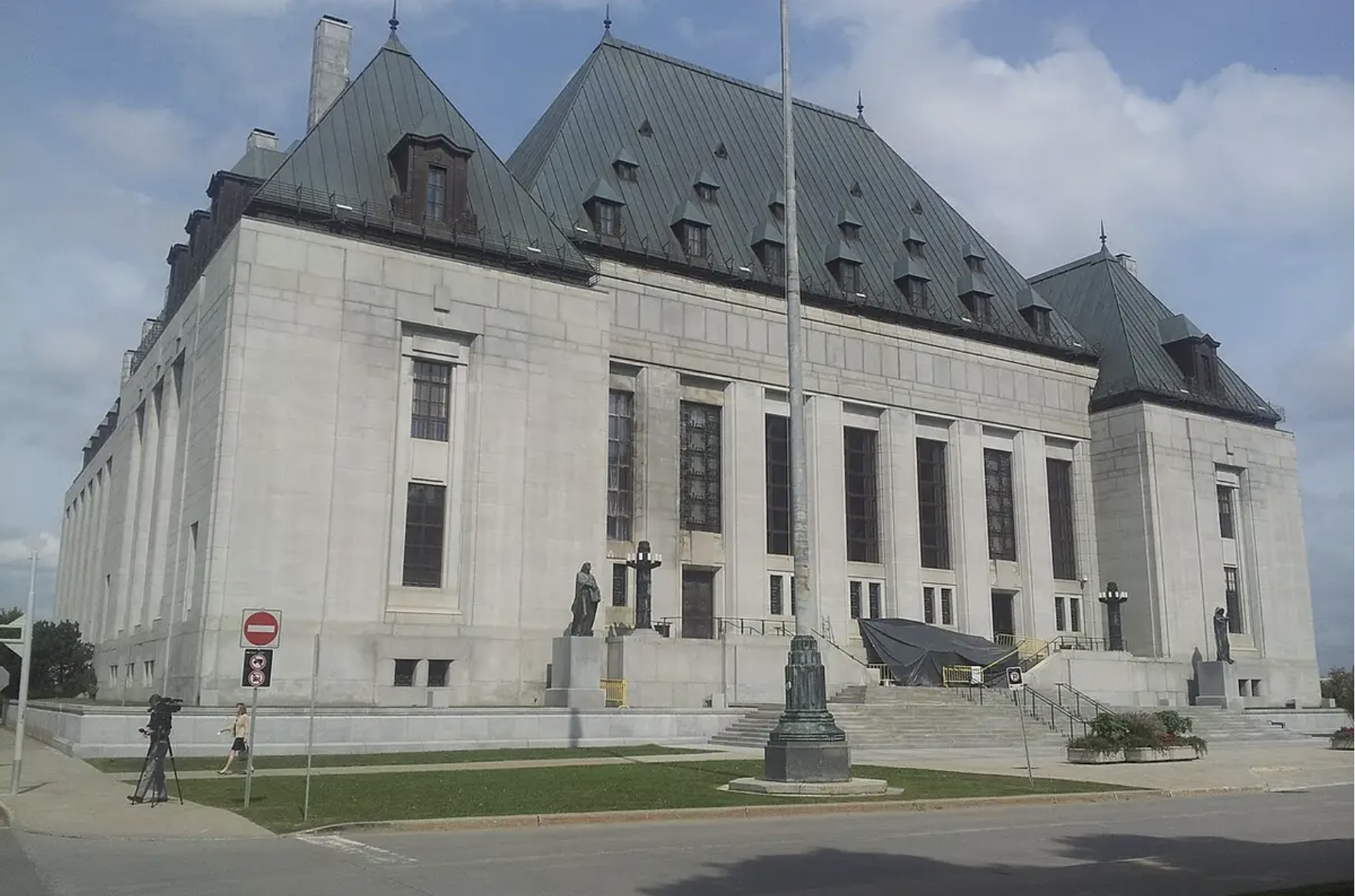
Reporting by Quinton Amundson, The Catholic Register
Religious and civil rights advocates reacted with disappointment to the Supreme Court of Canada’s landmark ruling on Nov. 27 that largely upholds Quebec’s Bill 21, banning public servants from wearing religious symbols such as hijabs, turbans, kippahs, and crucifixes.
The apex court’s wide-ranging judgment is highlighted by a 6-1 ruling that declared Quebec validly invoked the Charter’s notwithstanding clause when the Coalition Avenir Québec (CAQ) government enacted Bill 21, its state secularism law, in 2019. The decision arrives eight months after a historic four-day ruling from March 23-26, featuring arguments from a record 51 intervenors, including six attorneys general, joined those of the main appellants and respondents.
Chief Justice Richard Wagner stated in the majority opinion of English Montreal School Board, et al. v. Attorney General of Quebec, et al that “Bill 21 is rooted in Quebec’s legitimate and historical commitment to ensuring the laicity of the state in a free and democratic society.”
The lone exception to the law, issued by all seven justices in this case, is for elected members of the National Assembly of Quebec. They found Section 8 of Bill 21, which prevented members of the National Assembly from working with their faces uncovered, infringes on Section 3 of the Charter, which declares every citizen of Canada has a right to vote or seek election as a member of a legislative body.
This ruling also contained two narrow 4-3 decisions. The first is that judicial declarations — declaratory relief — may be allowed when a law infringes on Charter rights even when the notwithstanding clause keeps the law in force. But the other 4-3 ruling was against such a formal declaration for Bill 21. Justices Nicholas Kasirer, Andromache Karakatsanis and Michelle O’Bonaswin dissented and found that the law contravenes freedom of religion, expression and equality.
The Canadian Conference of Catholic Bishops (CCCB) was one of the intervenors in the case. In a statement responding to the ruling, the bishops said they are “deeply concerned about the future of religious freedom and the full participation of persons of faith in public life, both in Québec and across Canada.”
Citing the Second Vatican Council’s Dignitatis Humanae declaration and the Catechism of the Catholic Church (2106-2109), the CCCB declared: “religious freedom is a fundamental human right rooted in the dignity of the human person. It encompasses the freedom to practise and express one’s faith, privately and publicly, individually and in community with others, within just limits.
The CCCB noted how the Catholic Church “recognizes the legitimate autonomy of civil authority and the distinction between religious and political institutions,” but the “religious neutrality of the State should not entail the exclusion of religious expression from public life. “And this means “no person should be required to choose between the faithful expression of his or her religious convictions and the opportunity to serve society.”
Phil Horgan, a Toronto Catholic lawyer serving as president and general counsel of the Catholic Civil Rights League (CCRL), presented the CCCB’s oral arguments during the Bill 21 Supreme Court hearing. He shared that the CCRL “share the concern of the CCCB.”
The Christian Legal Fellowship (CLF), Canada’s national association of Christian lawyers and law students, also intervened in the case. Derek Ross, CLF’s executive director, acknowledged that many are fixating on how the top court interpreted usage of the notwithstanding clause. But, he said, “it is important not to lose sight of whois most directly impacted by the law at the centre of the case: religious minorities who are excluded from public service simply because they openly identify as religious.”
He expressed concern about what this ruling will lead to in the future.
“Once a law embraces the idea that people of faith are not welcome to participate in government unless they hide their religious identity, where does it end? We’ve already seen that laicity’s restrictions have not been limited to government workers but extended to religious expressions by private citizensin schools, colleges, public parks, and sidewalks. What was proposed as state neutrality is increasingly being imposed as societal irreligion.”
The Canadian Civil Liberties Association (CCLA) is also “deeply disappointed” by the decision. The organization’s Executive Director Howard Sapers wrote that “since 2019, we have witnessed how Bill 21 has treated religious minorities, particularly Muslim women, as second-class citizens. This judgment does not restore the rights, opportunities and careers that have been taken away.”
Federal and provincial Quebec politicians largely celebrated the ruling.
Yves-François Blanchet, the leader of the Bloc Québécois, declared that “we are now more than ever in a position to move forward with the preservation of the very elements that profoundly define the distinct nature of Quebec society.”
François Legault, the former Quebec premier and leader of the CAQ, wrote in French on social media that he is “very proud of this legacy.”
Current Quebec Premier Paul St-Pierre Plamondon’s reaction was more mixed. While acknowledging the ruling as a victory for secularism, he warned that the decision allowing declaratory relief represents “a setback for the provinces” in terms of wielding the notwithstanding clause.
The Bill 21 ruling was rounded out by a 4-2 decision rejecting an argument that the law violates minority language education rights found in section 23 of the Charter.
The English Montreal School Board chair Joe Ortona noted that while the ruling marks the “end of the legal road,” the political fight is still ongoing, as “we have a minority government in Quebec and the notwithstanding clause needs to be renewed every five years, and that’s going to come again in 2029 (for Bill 21).