CARMEL, Sask. (CCN) — Under sunny skies and cooled by a breeze that kept mosquitoes at bay, hundreds of pilgrims filled the hill for the 104th annual pilgrimage to the Shrine of Our Lady of Mount Carmel July 19 in the Roman Catholic Diocese of Saskatoon.
Bishop Mark Hagemoen presided at Mass, joined by priests from the area, including Benedictines from St. Peter’s Abbey, which established the sacred site north of Carmel, SK, in 1922.
Abbey Prior Br. Basil Schaan, OSB, welcomed people from throughout the area and beyond to the 2026 pilgrimage, inviting them to “remember God and Our Lady of Mount Carmel and their love… they call you to reach out and to ring out your joy.”
The 2026 pilgrimage July 19 started with hymns, the Rosary, and the Sacrament of Reconciliation, followed by celebration of Sunday Eucharist.
Music ministry was again provided by the Mount Carmel choir, which includes past and present parishioners of St. Scholastica Parish in Burr and St. Augustine of Canterbury Parish in Humboldt.
In his homily, Bishop Hagemoen reflected on the scriptural account of Elijah’s demonstration of the power of the true God over false gods, which took place on the original Mount Carmel in 1 Kings 18. Idols and addictions continue to deliver false promises, the bishop observed.
“As with the false gods in the scripture account of Elijah in the Book of Kings, an addiction seem to point to something that is life-giving, but it takes away our life,” he said.
Hagemoen noted that in addition to obvious addictions such as drugs or alcohol, there are many other more subtle addictions, such as power or technology, that can become idols. “It is anything that is inordinate that takes us away from God and God’s call to us to be fully human and fully alive.”
Reflecting on the Gospel parable from Matthew 13 about letting the wheat and the weeds grow together until the harvest, the bishop said we rely on the power and the mercy of God in our own lives. “It is because God is the God of forgiveness that we are able to heal and to respond to the call to be ‘wheat with the weeds’ in our life,” he said.
He concluded by praying: “Thank you God of mercy for bringing us here this day. And may the pilgrimage day here on Mount Carmel be a continued journey in our lives of reconciliation, new life, confronting the obstacles with God’s help and the help of one another, and moving forward with God’s grace and strength – that is true power.”
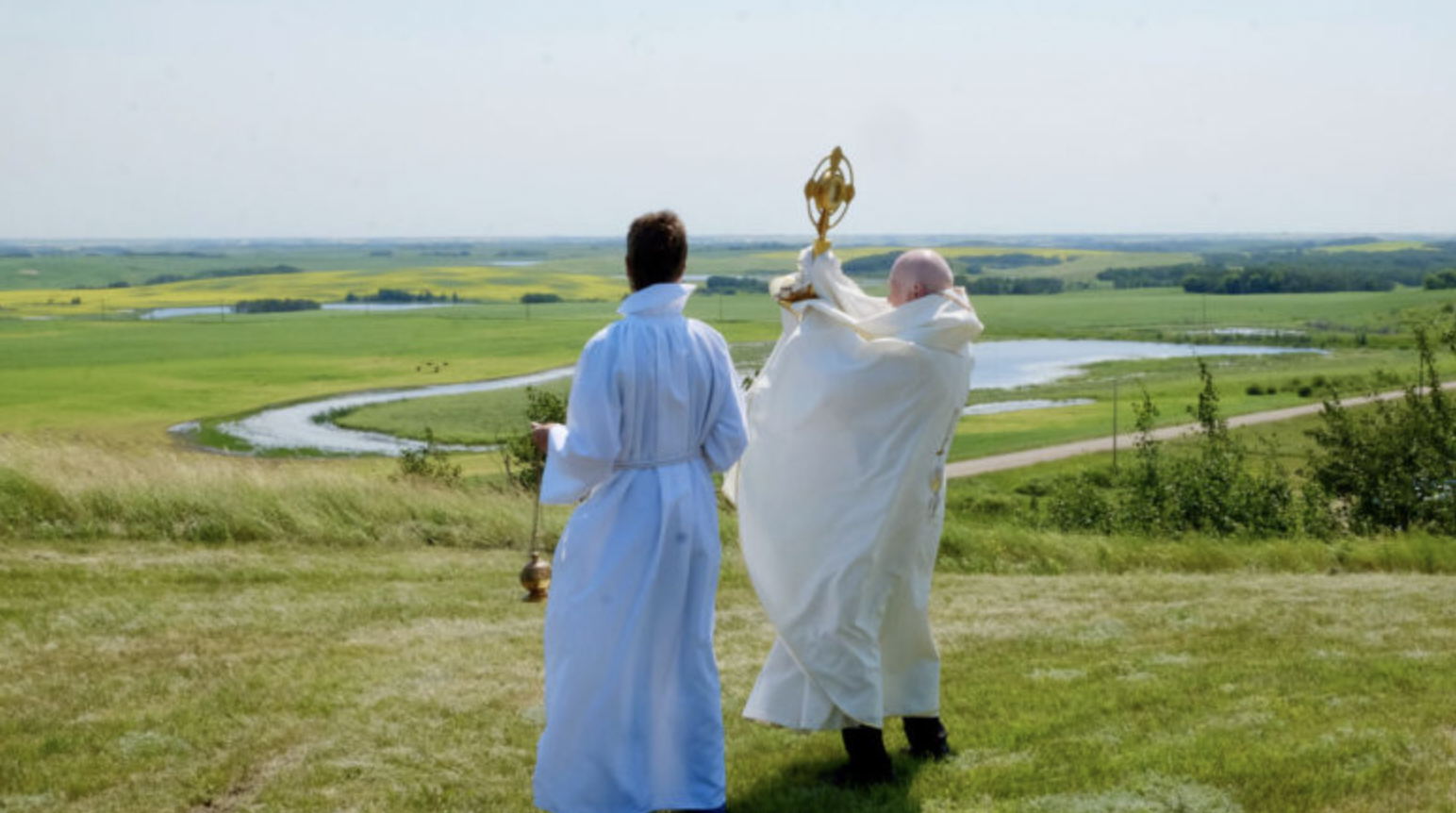
After communion, the bishop carried the Blessed Sacrament to the top of the hill for the traditional blessing of the fields beneath the statue of Mary and the child Jesus.
After Mass, many also came forward for a blessing, with events continuing after lunch with pilgrims walking and praying the Stations of the Cross that are embedded in the hillside.
The pilgrimage continued with Eucharistic adoration at the outdoor chapel, and enrolment in the Confraternity of the Brown Scapular, a Carmelite devotion which involves wearing a small scapular, living chastitity according to one’s state in life (married/single) and promising various observances of faith.
Pilgrimage history
Mount Carmel, SK, named after the famous Mount Carmel in Israel, is the highest spot in the district (1,987ft above sea level).
In 1902 Fr. Bruno Doerfler, OSB, and his exploration team, working at the establishment of a Benedictine abbey in Saskatchewan, stopped at the hill and replaced a cross that had been on the top of the hill.
Doerfler conceived the idea of dedicating the mount to Mary, however, it was Abbot Michael Ott, OSB, who solemnly blessed the mount 20 years later, on Sept. 10, 1922 with 3,500 people in attendance.
Ott announced that an annual pilgrimage would be held the following July 16, the Feast of Our Lady of Mount Carmel. He also dedicated the entire abbacy to the Blessed Virgin.
The site was donated by area farmer John Bunko in 1921 and 15 acres of land was obtained for parking.
In 1928 an Italian-made white carrara marble statue of Mary was placed on top of the hill.
The Stations of the Cross were erected July 16,1936.
In 1938, stone mason Antonio Molaro constructed the outdoor chapel and altar from local stone.
Fr. Patrick Peyton launched his family rosary crusade at Mount Carmel on Sept. 26,1948,with a crowd of 12,000 present.