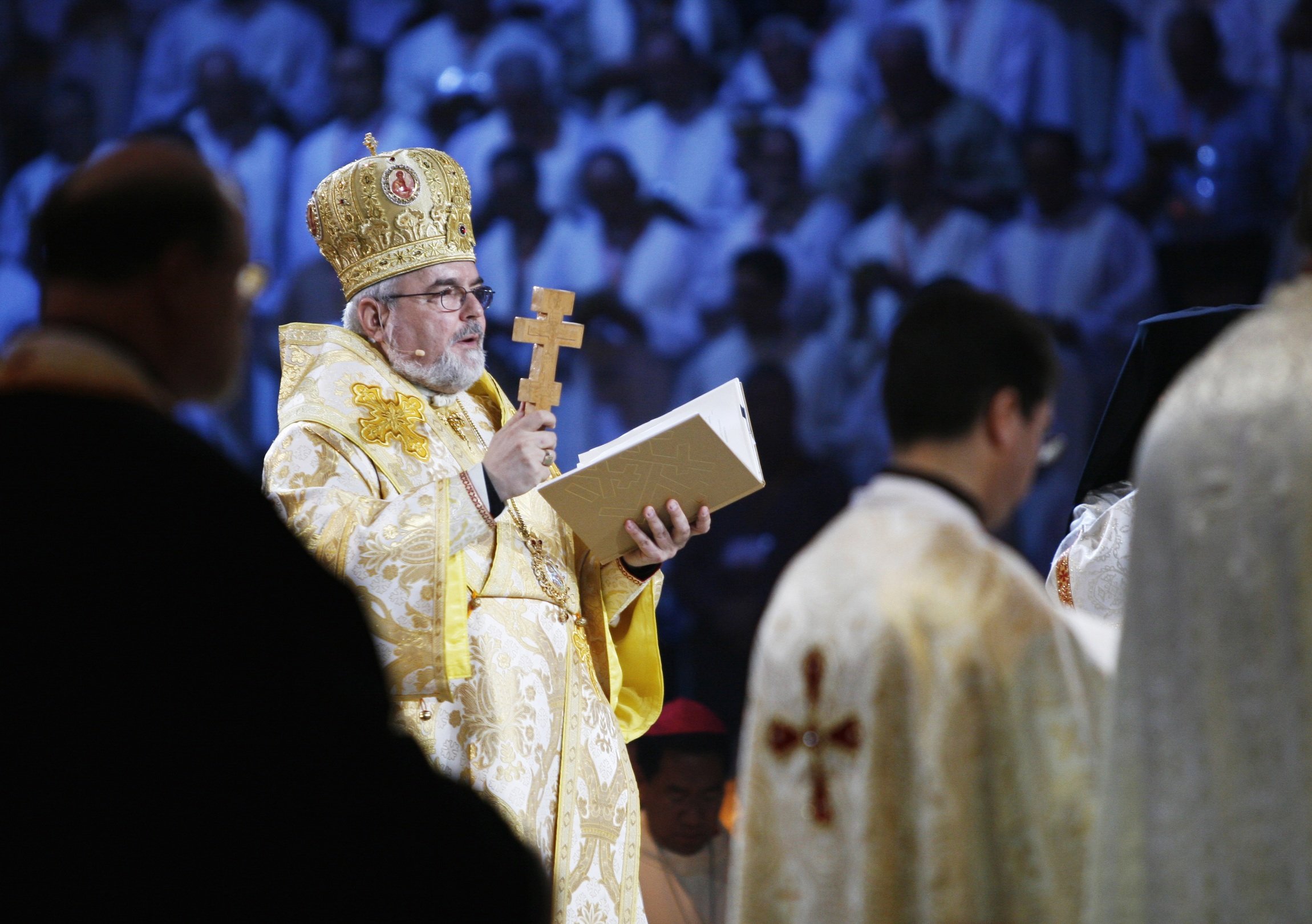
TORONTO (CCN) — As the Ukrainian Greek Catholic Church in Canada prepares to welcome a new metropolitan Nov. 8, it also extends gratitude to an archbishop whose two decades of leadership have been marked by a commitment to communion, consultation and pastoral continuity.
Metropolitan Lawrence Huculak, OSBM, retired on July 9, after his 75th birthday earlier this year, as prescribed by canon law. His successor, Bishop Michael Kwiatkowski, born in Hamiota, Manitoba, will assume leadership of the Archeparchy of Winnipeg and the metropolitan province, encompassing Canada’s Ukrainian Catholic archeparchy and four suffragan eparchies.
For Huculak, who became metropolitan in February 2006, the position has involved more than overseeing the Ukrainian Catholic faithful of Manitoba. It has also meant helping sustain the relationships through which the Ukrainian Catholic Church in Canada acts together.
Huculak, born in Vernon, British Columbia, Jan. 5, 1951, entered the Basilian Order in 1969, after completing high school. He was ordained a priest in 1977 and went on for further studies in Ottawa and then Rome. He returned to Canada in 1986 and served as a parish priest in Mundare, Alberta.
In 1997, Huculak became the bishop of the Ukrainian Catholic Eparchy of Edmonton, which includes all of Alberta and where he served until his appointment as metropolitan archbishop.
Protodeacon Cyril Kennedy of the Ukrainian Catholic Eparchy of Edmonton explained that a metropolitan possesses responsibilities of oversight among the bishops of his province, particularly in fostering their cooperation. These responsibilities include convening episcopal gatherings and encouraging collegiality so bishops can respond together to challenges facing the Church.
“They can speak with a single voice,” said Kennedy, who teaches at Newman Theological College in Edmonton. He explained this cooperation concerns both the Church’s public witness and its internal life. This understanding of church leadership emphasizes the importance of maintaining relationships rather than only exercising administrative authority.
Huculak’s commitment to consultation and responsiveness across Canada’s Ukrainian Catholic Church also characterized his leadership within the Archeparchy of Winnipeg, tested by considerable demographic and cultural changes.
“Certainly here in Manitoba, it’s the downsizing and change from a heavily rural ministry to an urban one,” Huculak told Canadian Catholic News in an interview.
As Ukrainian Canadians have increasingly moved from rural settlements into cities, many historic parishes have struggled to sustain themselves. For communities whose churches and cemeteries represent generations of sacrifice, these changes can be especially painful.
Huculak acknowledged some parishioners regard their bishop as something of a “museum curator,” responsible for preserving the buildings inherited from previous generations.
But he insisted that the Church’s mission cannot be reduced to maintaining its physical inheritance. Rather, he explained, bishops must encourage the faithful to look beyond their buildings toward the continuing work of evangelization.
This emphasis on the Church’s ongoing mission also shaped Huculak’s response to technological changes during his two decades as metropolitan. The COVID-19 pandemic, in particular, accelerated the adoption of livestreamed liturgies and online meetings, introducing new possibilities for maintaining connections among the faithful.
“How do you evangelize using the means of the internet?” he asked, identifying a question that has become central to contemporary pastoral ministry.
This commitment to remaining responsive to the needs of the Church extended to Huculak’s relationships with his clergy.
Father Yaroslav Buduykevych, pastor of St. Anne Ukrainian Catholic Church in Winnipeg, experienced this approach firsthand. Having met the metropolitan in Ukraine in 2009, Buduykevych eventually moved to Canada and was ordained in 2013.
He remembers Huculak as a patient and attentive mentor who guided him through the intricacies of the Byzantine liturgical tradition. Before Buduykevych’s ordination, the metropolitan conducted extensive workshops, sometimes daily, helping the future priest understand the liturgy in both English and Ukrainian.
“He was very gentle in leading the Church” both in and beyond liturgical instruction, Buduykevych recalled.
The priest described a bishop who was accessible to his clergy, welcomed questions and even entertained disagreements. “He would never be, like, ‘my way or highway’,” he said.
Buduykevych also recalled working with Huculak to improve the archeparchy’s online presence, including developing a website that could communicate the life of the Ukrainian Catholic Church while preserving its distinctive spiritual and cultural identity.
Underlying these efforts was Huculak’s appreciation for the communities that sustained Ukrainian Catholic life in Canada. During the interview, he spoke extensively of the faithful.
He recalled rural liturgies celebrated in modest churches, sometimes poorly heated, with the smell of food rising from parish halls as congregations prepared to gather after worship. These memories, he said, capture the heroic struggle among Ukrainian Catholics in western Canada to maintain an integrated sense of faith, culture and community.
Huculak said he anticipates a smooth transition to Kwiatkowski, who previously served as a priest and chancellor in Winnipeg.
His advice to his successor reflects the pastoral approach that characterized his own ministry: “Take the first year slowly, learn to understand the people, the lay of the land,” he said.
Huculak said he intends to remain in Winnipeg in retirement, contributing to the life of the Church through educational work, retreats and conferences.
As the responsibility for guiding the archeparchy will soon pass to another bishop, his parting advice captures his legacy: The work of shepherding the Church begins with listening to its people.