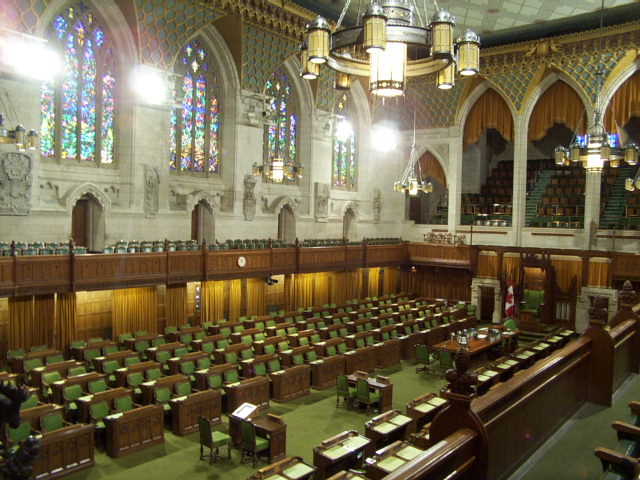
With the publication of his first book, “The Crisis of Canadian Democracy,” Andrew Coyne has returned attention to Canada’s “democratic deficit.”
The phrase, however, remains vague to many Canadians: We hold regular elections, ballots are counted, and Parliament legislates through the members we elect. Where, then, is the deficit?
Coyne offers an incisive, two-part answer: On the one hand, our electoral system can produce majority or powerful minority governments elected with only a small share of the vote, which undermines the logic of democratic voting; on the other, the centralization of power has hollowed out the role of most members of Parliament, fracturing the logic of representation. Both problems deserve careful unpacking.
The first front, closer to home, concerns the manner in which votes contribute to the selection of candidates. Canadian MPs are elected using a single member plurality system — colloquially known as first-past-the-post — wherein a candidate in each riding need only secure more votes than his or her competitors. In practice, this means candidates often win seats with roughly 40 per cent of the vote yet represent their ridings as if they had earned the support of all constituents. Though statistically unlikely given regional stratification, a party could, in principle, win every seat in the House of Commons with far less than a majority of voter support. Government formation, then, is structurally disconnected from the popular will.
Even if this gulf between voter preference and parliamentary composition were closed, a deeper problem would remain. Coyne devotes far more of “The Crisis of Canadian Democracy” to showing how the House of Commons and MPs have become politically impotent, constrained by party discipline, overshadowed by the Prime Minister’s Office, and increasingly excluded from meaningful legislative work. The logic of a representational system such as Canada’s is that MPs should bring their constituents’ concerns to Ottawa so they may be nationally recognized and, when possible, addressed. Current practices on the Hill, however, have corroded this notion.
The predominant problem is the structure of political parties. Coyne lays out how Canada’s political parties have evolved into highly centralized, leader-driven organizations, creating a top-down structure in which power flows inward to party leaders and the Prime Minister’s Office rather than outward to elected legislators. This centralization distorts the designed balance of parliamentary government by reducing MPs to instruments of the party line rather than representatives of their constituents. In a system where party support is indispensable for election, candidates become mere vessels for the party’s message rather than advocates for their communities.
In practice, this means that both the House of Commons and the cabinet are now effectively subordinate to the prime minister’s will. This is especially evident in the growth and reach of the PMO, which now employs more than 100 staff and participates in coordinating caucuses, managing cabinet communications, and shaping legislative priorities. Since the days of Prime Minister Pierre Elliott Trudeau, successive governments — continuing under Prime Minister Mark Carney today — have expanded the PMO’s influence, so that it often functions as an executive command centre. Between strict party discipline and a PMO with tendrils throughout the machinery of government, the democratic, representational and deliberative character of Parliament has been severely diminished.
These issues — skewed electoral results and the consolidation of power in party leaders — are the two major structural weaknesses besetting Canadian democracy. Coyne identifies still more: the dwindling legitimacy of elections marked by low voter turnout; the democratic awkwardness of an appointed Senate; an oversized cabinet and bureaucracy; and increasingly incoherent party conventions and leadership contests. Yet he returns repeatedly to the same conclusion: Canada’s electoral system and the unchecked authority of party leadership are the primary sources from which these other dysfunctions flow.
A central challenge in addressing Canada’s democratic deficits is that the very institutions capable of reforming the system are controlled by those who benefit from its current distortions. Party leaders, empowered by the status quo, have little incentive to loosen their grip on candidate nominations, caucus discipline, or the PMO’s administrative reach. Institutional rigidity thus becomes self-reinforcing: the system is difficult to fix precisely because it is designed — both formally and informally — to resist the forces that might fix it.
Canada therefore faces a stark choice. Either citizens mobilize to demand meaningful reform, applying the kind of sustained pressure that makes obstruction costlier than change, or we wait for the improbable emergence of a reform-minded political leader who manages to navigate and then dismantle the very structures that elevated them. The latter is possible, but historically rare; the former is the reliable path.