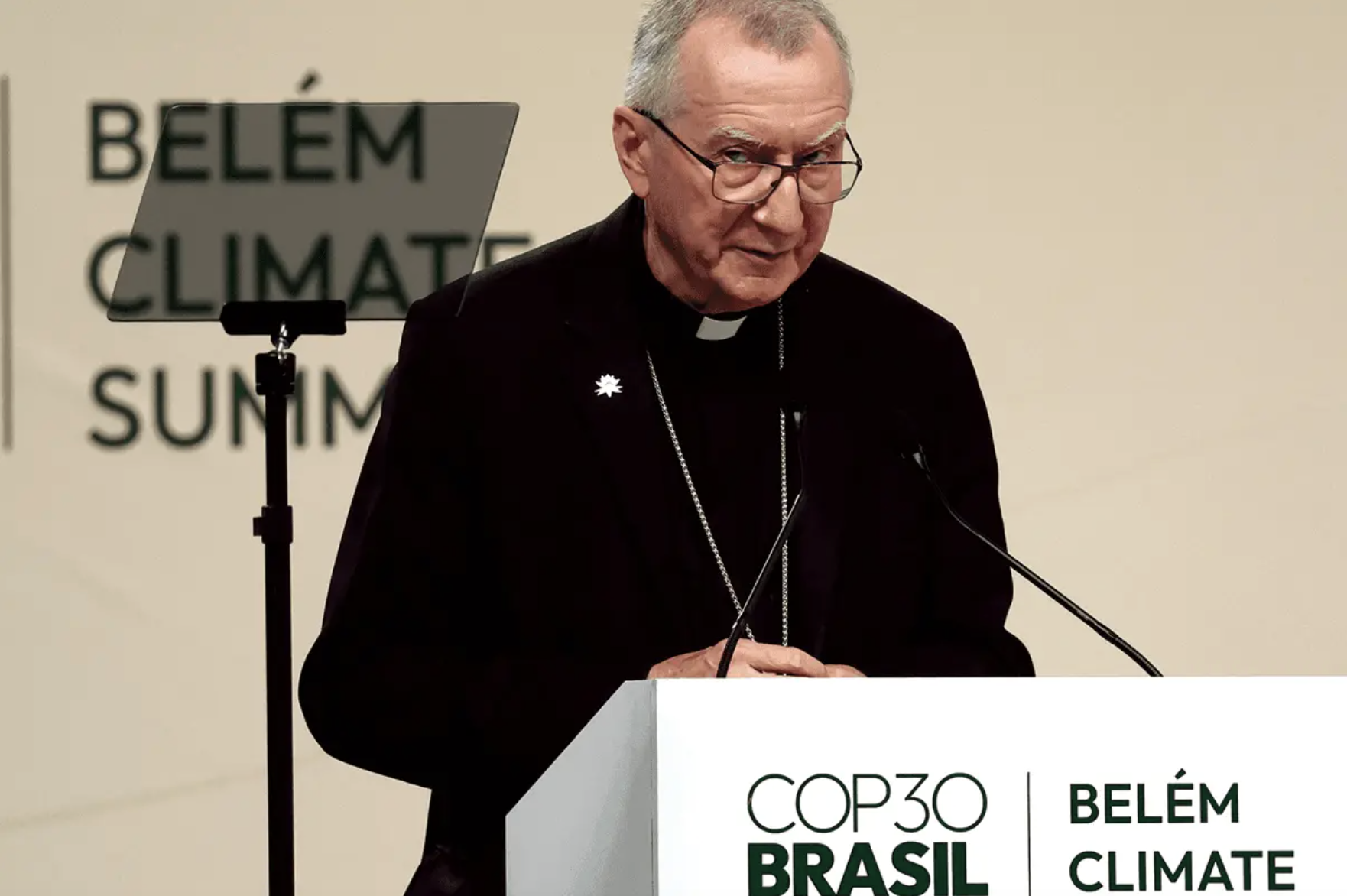
This past week our delegation returned from COP30 in Belém, Brazil. We were eight people in the delegation, including two bishops representing the CCCB at their request; Bishop Martin Laliberté of Trois-Rivieres, and Bishop Jon Hansen of Mackenzie Fort-Smith.
The Church was present at COP30 like no other before it. The sheer number of events organized by the Church linked to the Climate conference was inspiring. Particularly present were Cardinals Jamie Spengler, Fridolin Ambongo, and Felipe Neri, the respective presidents of the Continental Episcopal Conferences for Latin America (CELAM), Africa (SECAM) and Asia (FABC). They appeared in many events in relation to their collective call to action released this past June 12entitled “A Call for Climate Justice and the Common Home: Ecological Conversion, Transformation and Resistance to False Solutions.”
Inspired by their document, we helped organize an event responding to their prophetic voice as civil society and the Church in the North. Speaking on the panel, Bishop Jon said, “I’d like to thank the Canadian Conference of Catholic Bishops who sent both myself and Bishop Martin here…perhaps a small token to send two bishops, but it’s still an acknowledgement that we need to begin to talk about these things together, a historical coalition of north and south.”
By the end of COP30, this coalition came together to speak in one voice. The following statement represents the voices of five Cardinals, 23 bishops, and many clergy and lay people representing more than 80 Catholic organizations from 30 countries present at COP30, as well as more than 300 Catholic organizations from 40 different countries standing with them. It is reproduced here in full:
“From November 10 to November 21, world leaders, negotiators, peoples’ movements, and more traveled to Belém, Brazil, for COP30 and the Peoples’ Summit. Among them is an unprecedented diversity of voices from our Church—lay people, religious sisters and brothers, cardinals, bishops, clergy, pastoral movements, youth organizations, NGOs, and many more—who have sought to amplify what Pope Francis, in Laudato Si’, called the “cry of the earth and the cry of the poor.” Moved by what we have experienced through this COP, we offer this statement to all Catholics and people of good will to join us in a renewed commitment and action to care for our common home.
“Ten years after the Paris Agreement and Pope Francis’s call to protect our common home, the world faces more extreme weather and environmental degradation. Hosting COP30 in Brazil, a country where the Church, Indigenous peoples, and social movements have long walked together in defense of life, further strengthened the hope felt throughout the Catholic community. Months before COP30, Catholics began expressing their hopes, concerns, and prayers related to this important conference. On June 12, the Catholic Bishops Conferences of Asia, Africa, and Latin America and the Caribbean published a joint statement entitled A Call for Climate Justice and the Common Home, a powerful appeal for concrete and courageous action from those most affected by the climate crisis. Similarly, Catholic movements and organizations dialogued together, sharing perspectives and supporting one another.
“Catholics arrived at COP30 to discover a spirit of true synodality, walking together, unified in God’s love for the poor and creation. Sharing our time in meals, conference panels, advocacy, the Peoples’ Summit, Masses, and a procession of the Virgem de Nazaré, we encountered a Church ready to speak up alongside people and the planet. We leave with renewed hope, empowered by the witness of the Church and the grace we have experienced together.
“In Laudato Si’, Pope Francis, boldly grappling with the reality of climate change, called for an “ecological conversion.” Pope Leo XIV, in a message to those gathered for COP30, wished that “all the participants in this COP30, as well as those actively following its work, be inspired to embrace with courage this ecological conversion in thought and actions, bearing in mind the human face of the climate crisis.”
As we continue this journey of ecological conversion, we ask for the grace to care more tenderly for creation, to walk in deeper solidarity with one another, and to grow in the courage needed to respond faithfully to the urgent challenges of our time, which affect us all, but especially women, youth, migrants, Indigenous peoples, and the most marginalized.”
As Pope Leo has just reminded us: “We walk alongside scientists, leaders and pastors of every nation and creed. We are guardians of creation, not rivals for its spoils.”