EDMONTON (CCN) — Pope Leo XIV has appointed Canadian theologian Brian A. Butcher to a five-year term as a consultor to the Dicastery for the Eastern Churches.
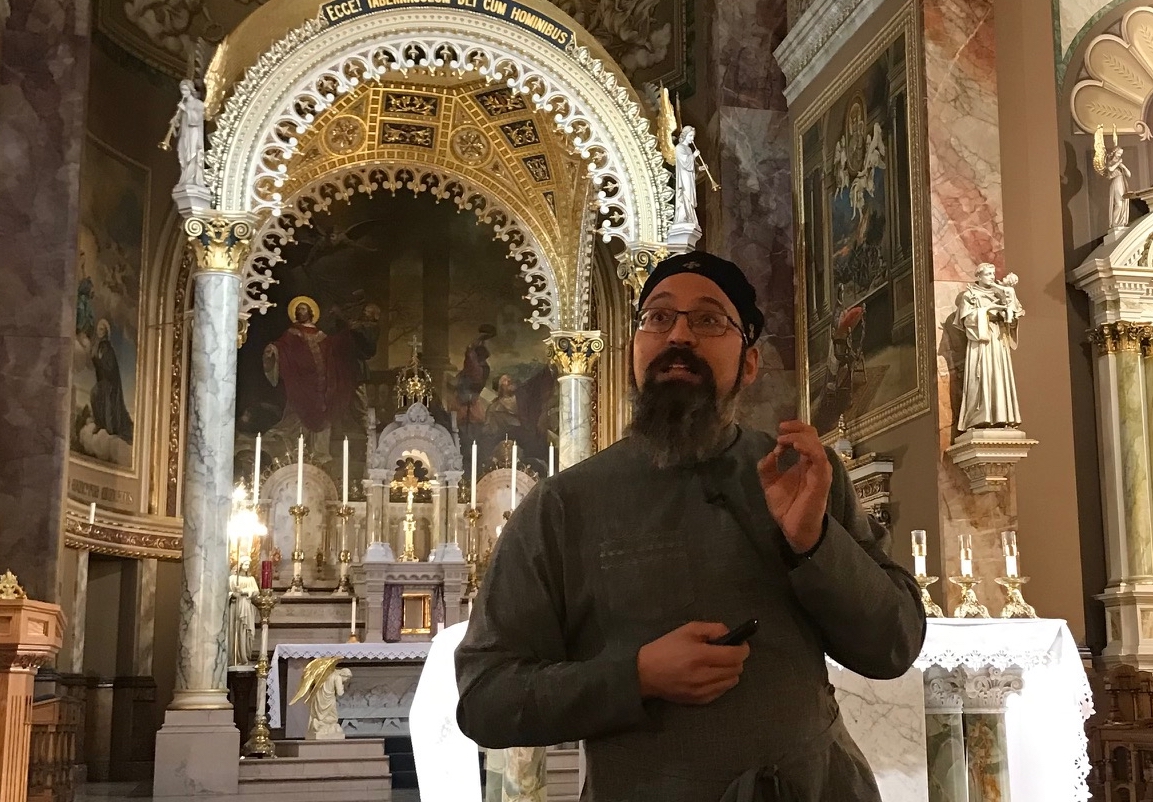
Butcher is currently the adviser and commission secretary for ecumenical and interfaith relations at the Canadian Conference of Catholic Bishops (CCCB). As a subdeacon in the Ukrainian Greek Catholic Church, he contributes expertise in Eastern Christianity.
Butcher’s appointment was announced Nov. 21, along with the appointments to the same dicastery of Fathers Khaled E. Anatolios and Yury P. Avvakumov, both theology professors at the University of Notre Dame, and Father Stefano Parenti, theology professor at the Pontifical University of St. Anselm in Rome.
Butcher said he learned of the appointment by email from a Vatican official, with a PDF attachment of a letter from Pope Leo XIV. Butcher said understands he will be one of 50 consultors serving the dicastery.
Under the apostolic constitution “Praedicate Evangelium,” consultors are appointed by the pope for five-year terms and chosen for their expertise, proven ability and prudence. They study questions referred to them and usually give their opinions in writing. They also may be called together to examine particular matters.
Butcher said the work ahead is unclear. He also has no illusions about how much influence his recommendations might carry.
“I actually don’t know the specific matters that I will be consulted on in the next five years,” he said.
The dicastery deals with matters affecting the Eastern Catholic churches, including their structure and organization and the exercise of their teaching, sanctifying and governing functions. Those churches, which include the Ukrainian Greek Catholic Church, are in full communion with the pope but keep their own liturgical, theological, spiritual and canonical traditions.
Pope Leo XIV, then Archbishop Robert Prevost, was a member of the same dicastery while serving as prefect of the Dicastery for Bishops, according to a Holy See bulletin.
The dicastery has a specific request from the current pontiff concerning Eastern Catholics outside their homelands. On May 14, 2025, six days after his election, Leo asked the dicastery to help define principles, norms and guidelines by which Latin bishops can support Eastern Catholics in the diaspora. He said war, persecution, instability and poverty have forced many Eastern Christians to flee their homelands and that, on reaching the West, they risk losing their religious identity.
Butcher came to Eastern Catholicism as an adult. Raised in a devout Baptist family, he said his questions about Christian history began during a year in Italy before university. Rome’s historic churches raised questions about Christianity’s development that his upbringing had not fully answered.
“I was raised in a very pious family, loved the Scriptures, loved Jesus,” he recalled. “I realized that I knew the Bible, but I did not know anything about Christian history.”
While studying at McGill University in Montreal, an Orthodox friend invited him to Vespers, an evening prayer service. Around the same time, a Catholic chaplain asked him to contribute his musical abilities to Masses at the university’s Newman Centre.
“I fell in love with Orthodox liturgy,” Butcher said.
He was drawn to Eastern Christian worship and theology but was also impressed by the Catholics he met.
“I felt I wanted to be Orthodox,” he recalled, while also being “deeply impressed at the holiness of life of many Catholics that I met.”
A presentation by members of Madonna House, a Catholic community in Combermere, Ontario, which has an appreciation for Eastern Christian spirituality, introduced him to another possibility: embracing Eastern Christianity within a Church in full communion with Rome. He entered the Ukrainian Greek Catholic Church in 1998.
He earned a doctorate in Eastern Christian Studies from Saint Paul University and the University of Ottawa in 2011. His scholarship includes the 2018 Fordham University Press book “Liturgical Theology after Schmemann: An Orthodox Reading of Paul Ricoeur.” He has held teaching appointments at McGill University, St. Augustine’s Seminary in Toronto and the online Agora University.
His work at the CCCB supports the bishops’ engagement with other Christian churches and religious communities, including formal ecumenical and interfaith dialogues.
Since the Second Vatican Council, Butcher explained, Eastern Catholics have been encouraged to recover their authentic traditions rather than imitate the Roman Catholic Church to demonstrate their Catholic identity.
He believes that distinction matters for relations with Orthodox Christians, whose churches share much of the same Eastern Christian heritage but are not in full communion with Rome. Eastern Catholics, he said, can show that communion with the pope need not require giving up their own theology, liturgy, spirituality or church law.
The central challenge, as he described it, is achieving “unity without uniformity and diversity without division.”
Pope Leo met Ecumenical Patriarch Bartholomew I in Istanbul on Nov. 29, 2025. In a joint declaration, the two leaders said they would continue on the path of dialogue toward the hoped-for restoration of full communion between their churches.
Butcher said the papacy remains the greatest obstacle to Christian unity. Catholics, he said, experience it as what makes that unity possible, but Orthodox Christians and Protestants see it differently. Many Orthodox, he said, acknowledge Rome’s primacy at some point in history but believe it got out of hand.
He pointed to Pope John Paul II’s 1995 encyclical “Ut Unum Sint,” which acknowledges that the ministry of the bishop of Rome is “a difficulty for most other Christians” and invited them to help consider how it might be exercised in ways more conducive to unity without abandoning what Catholics regard as essential to the papacy. Butcher suggested that powers and prerogatives the papacy has accumulated over time could be returned to other actors in the Church under the principle of subsidiarity.
Asked what perspective the Canadian Church experience can offer the Dicastery for the Eastern Churches, Butcher pointed to the changing makeup of Eastern Catholic communities. The Ukrainian Greek Catholic Church was established in Canada to serve immigrants from Ukraine and their descendants. He said some communities have grown more diverse, drawing people through marriage, adult conversion or an attraction to Eastern Catholic worship.
“All the Eastern Catholic churches are called to be missionary,” he said.
He said that calling is not always understood by those who associate Eastern Catholic churches mainly with particular ethnic populations.
His Ottawa parish, he said, has both a Ukrainian-speaking community and a multicultural one, whose members speak English, French and other languages. He called Canada “a laboratory” for how Eastern Catholic churches can extend their mission beyond the immigrant populations they were established to serve.
He said Canada also brings several Eastern Catholic traditions into contact with one another and with Roman Catholics, giving bishops and the faithful opportunities to encounter forms of worship and spirituality that are less familiar in the West. He believes those encounters can help Roman Catholics to appreciate Eastern Christianity and encourage closer relations with Orthodox Christians.
At his Ottawa parish, he said, many young people, particularly young men, walk in off the street seeking God.
“Our church happens to be the portal through which they come,” he said.
Asked what he hopes to accomplish through his Vatican appointment, Butcher said he would like to share the needs and experiences of Eastern Catholic communities living far from their ancestral territories. The Ukrainian Greek Catholic Church, he said, is not simply a Church in Ukraine or a collection of immigrant communities preserving their customs abroad. It is also drawing people with no Ukrainian ancestry who have embraced its spiritual heritage as their own.