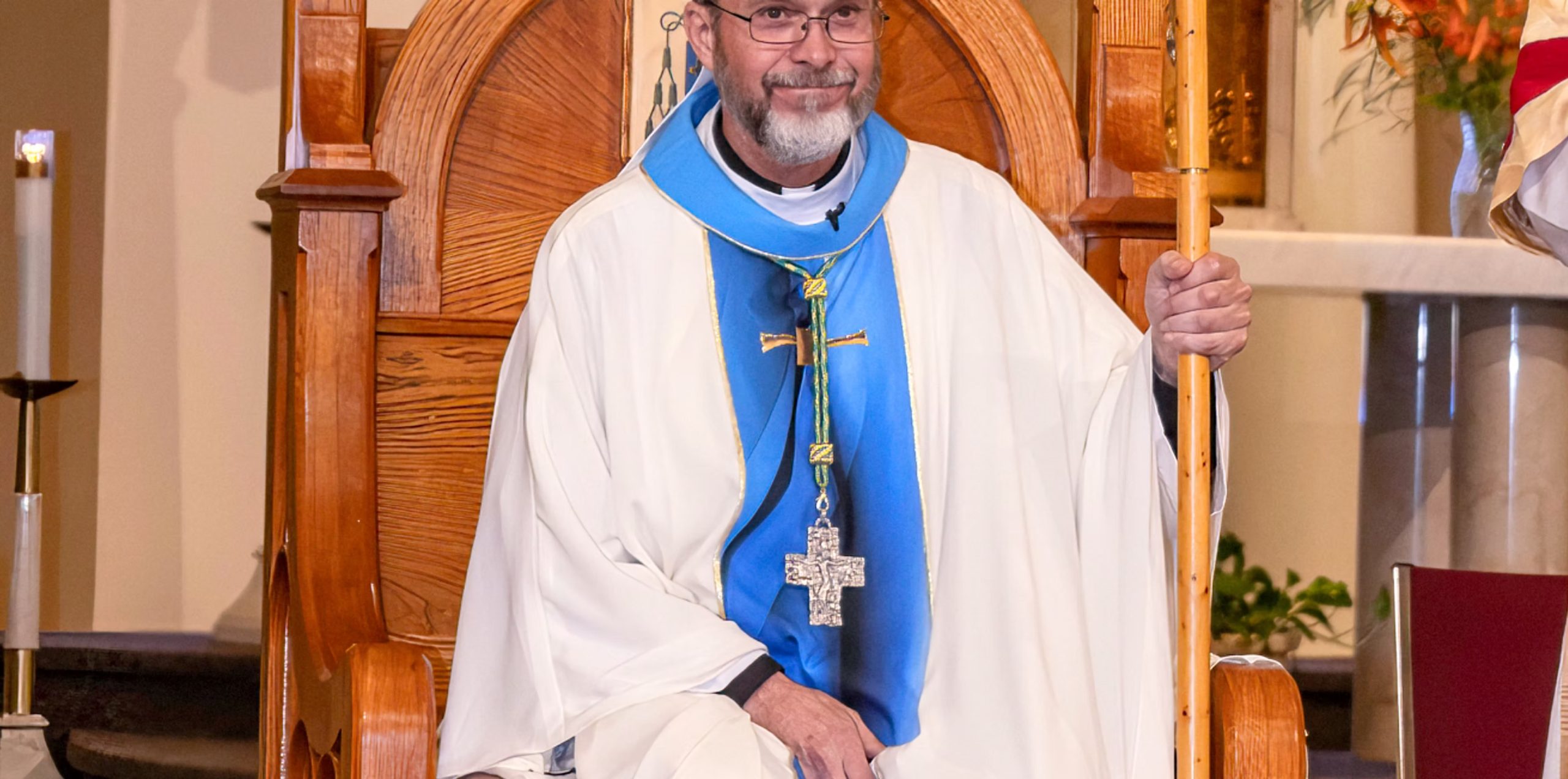
VANCOUVER (CCN) — The Diocese of Prince Albert, Saskatchewan, was both familiar territory and an unexpected assignment for Bishop Kenneth Thorson, OMI.
Thorson, who was ordained and installed as the bishop of Prince Albert Aug. 22, had grown up in the neighbouring town of Nipawin. He had begun his priestly formation studying for the Diocese of Prince Albert. However, within the year, he had discerned his vocation with the Oblates of Mary Immaculate.
He began his Oblate formation by entering the novitiate in Arnprior, Ontario, with further studies in Saskatoon, Edmonton, Rome and Toronto. He later became the Oblate provincial in Ottawa, overseeing Oblates in dioceses and parishes across Canada.
He said he never expected to return to Saskatchewan, where the Oblates have an extensive history but over the years had wound down their missions.
Yet, on May 28, 2026, Pope Leo XIV appointed him bishop of his childhood diocese, and his return, to some extent, continues the Oblate history in a diocese where the Oblate charism is never far away.
Father Andrew Stendzina, who succeeded Thorson as provincial in 2025, noted at Thorson’s episcopal ordination that the Oblates had long been part of the Diocese of Prince Albert.
“The history of this local church and the history of the Oblates have been intertwined from the beginning,” said Stendzina, recalling that Bishop Albert Pascal, OMI, was Prince Albert’s first bishop.
“A mission entrusted to one generation is being entrusted anew to another,” he said Aug. 22.
In an interview with Canadian Catholic News, Thorson said he began his new assignment the same way he starts any new mission. He gets to know the people: The first step is to reach out to and visit the various communities in the diocese, not only Catholic but other traditions and faiths.
“My goal is to listen to the people, to the place, and to begin to learn how God is already present and at work here in the people of the place, not only in the Catholic community or Christian community, but beyond that as well,” he said.
The Diocese of Prince Albert is predominantly rural, with numerous small communities. They range from northern and Indigenous communities and cultures to ecumenical communities, as well as civic leaders, other faith groups, and interfaith groups.
“I’m wanting to slowly reach out and just hear what’s happening in the different communities that are a part of the diocese.”
But his outreach did not happen quite as he expected. One of his first challenges was reaching out to the Orthodox community in Meadow Lake, Saskatchewan, after their church was destroyed by fire.
The Catholic parish in Meadow Lake offered their Orthodox neighbors space for liturgy and prayers.
“We feel terrible for them because, of course, we’ve seen this happen too many times across the country over the last number of years,” he said. “There’s no cause yet given for the fire as far as I know. They’re still investigating, and that will take the time it takes.”
One of his first pastoral visits was to Leoville, north of Prince Albert. The 70 parishioners gave their new bishop a warm prairie welcome, he said, and were excited to have someone who had spent his early years in the diocese.
Thorson is familiar with and appreciates the vastness of the territory.
“I lived in the centre of Ottawa for the last number of years, and you just don’t get those open skies in the centre of Ottawa that we get here,” he said. “It’s just been a blessing to be home again, unexpectedly, with this new mission.”
Responsibility for a diocese is vastly different from his 12 years in Oblate leadership, including six years as provincial, where his responsibility was for the Oblate priests working in dioceses and parishes across the country.
He was also the point man for the Oblates as they responded to residential school issues involving the order, travelling at the invitation of various communities where the Oblates had residential schools.
The meetings with Indigenous communities “were always quite profound, if difficult,” he said. “But almost without exception, I left feeling that some healing had happened.”
Significant steps were taken through conversations with Indigenous communities with residential school histories, who “were able, finally, maybe for the first time in some of these communities, to speak with an Oblate leader about their experience.”
As provincial, Thorson was also instrumental in the complex process of ensuring the Oblates’ residential school history — mostly in the release of personnel files of the Oblates who worked in the schools — would be made available to the National Centre for Truth and Reconciliation (NCTR).
“That was a lot of work with our archives,” as well as other places that held Oblate records. Ensuring the NCTR received what it was supposed to meant “a lot of administrative work with my team in Ottawa … and that’s [still] happening today.”
Thorson responded to questions about whether the Oblates provided records quickly enough by saying they had to observe protocols for releasing documents, privacy legislation and personnel files that were sealed.
The Oblates eventually concluded it was best to hand everything they could legally to the NCTR, including personnel files and the “Codex Historicus,” the daily log kept by each Oblate community. Thorson said he saw no reason not to and the work of transferring them continues.
He said there is now a “clear and active process” with the NCTR and a good working relationship. However, that chapter of his life was to close and a new one to open with his episcopal appointment.
“I had no expectation of living or working in Saskatchewan again, and then the call came from the pope,” he said. “Here I am back in Saskatchewan, and I’ll be here for the next 15 years, God willing, walking with the people. It’s been a blessing so far.”
Residential-school records face 2027 deadline
Residential school records remain an important issue with next year’s deadline for destroying thousands of testimonies of former residential-school students.
The testimonies were collected as part of the 2006 Indian Residential Schools Settlement Agreement to settle lawsuits from former residential school students against the federal government and churches.
To receive additional compensation for sexual abuse, serious physical abuse, and other wrongful acts, claimants had to go through the Independent Assessment Process (IAP), where their claims were adjudicated to determine eligibility and compensation. They were assured that their testimonies would remain confidential.
In 2017, the Supreme Court of Canada upheld a ruling to destroy the confidential IAP records after a 15-year retention period, unless claimants chose to preserve them.
Former students were to be notified, but relatively few claimants have requested preservation. On Sept. 30, the Indian Residential School Records Project was launched by journalist Connie Walker and former federal independent special interlocutor Kimberly Murray with the aim of raising awareness.