MASHGHARA, Lebanon (CNEWA) — At the entrance of the hillside village of Mashghara, in Lebanon’s Bekaa Valley, remnants of armed concrete indicate where a branch of Qard el Hasan, Hezbollah’s financial facility, used to be.
On March 2, the building was bombed by Israel, damaging the school of the Sisters of the Sacred Hearts of Jesus and Mary across the street. Students and teachers spent the rest of the school year online.
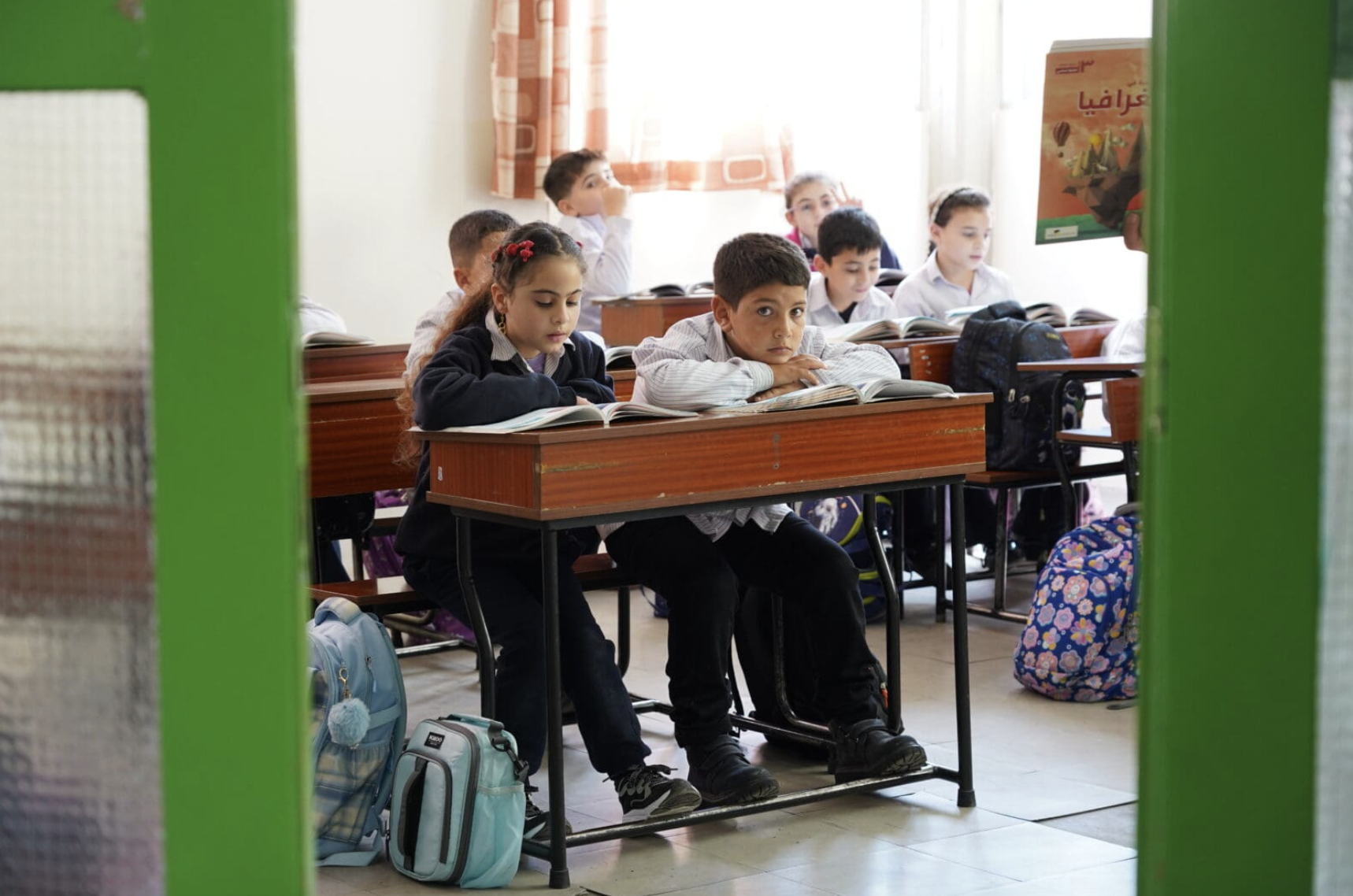
On Sept. 28, the school reopened, with many windows still missing and repairs underway.
“I am very happy to see my friends again,” said Fatima Chahchouh, 14. She said she was relieved to be back in class, as she was due to take the “brevet,” a national exam for grade 9 students.
“We pray every day for a normal school year,” said Sister Colette Moghabghab, school director, although the $250,000 cost of repairing the kindergarten remains beyond reach.
The school has 250 students; most are Shiite Muslims. Christians make up 20 percent of the student body.
Some of the nearly 2,000 families in the village fled March 2. Others left March 23, when the Israeli army issued an evacuation order the village.
“Our students faced very difficult situations,” said Sister Colette, who is looking to hire a school psychologist. Seventy of her students had their homes destroyed over the next three months.
In late September, UNICEF reported that 29 per cent of children attending school throughout Lebanon were “unable to learn as expected” because of “difficulty concentrating and emotional distress.”
In Mashghara, about 25 per cent of homes have been damaged since October 2023, when the Israeli-Hezbollah war started, said Iskandar Barakeh, municipality president.
Throughout Lebanon, since the war began, more than 11,000 buildings were destroyed in Israeli strikes, the United Nations reported in June. In early August, Israeli Defense Minister Israel Katz said the Israeli army had destroyed at least 24 villages in south Lebanon; the Lebanese Ministry of Public Health reports nearly 9,000 inhabitants have been killed across the country.
During the 2026 spring escalation, Hezbollah militia sought shelter in deserted houses in Mashghara, which were then targeted by the Israeli army.
“The municipality worked to keep all houses vacant,” Barakeh said. “Mashghara is a ‘small Lebanon,’” he said, referring to the diversity of religious groups and political parties, “and a place of reconciliation.”
The city’s main street offers views of Mount Hermon, the border with Syria and the Israeli-occupied Golan Heights, as well as bombed buildings.
St. Nicholas Greek Orthodox Church stands on the main road. An airstrike on a nearby house April 2 destroyed the church windows, the doors to the church hall and 1,000 roof tiles.
On Sept. 30, three more windows needed repair, but the usual service schedule — “on Saturday night, twice a month” — was restored, said Mashghara resident Bassem Hajjar.
Standing on her covered veranda, where tarps covered bombed-out windows, Rose Salloum described how an airstrike destroyed the doors to her house, the suspended ceiling, and the water and fuel tanks. She and her family were displaced due to the damage and in debt for the repairs.
Her husband works in the army and earns $500 per month. The family must repay $450 in monthly installments toward $5,600 of repairs.
“My parents and my brother help cover our daily expenses, as we are staying with them,” Salloum said.
UNICEF reported in late September 2026 that 82 per cent of households in Lebanon were “finding it more difficult to afford basic necessities than they did three months earlier.”
Milia Ibrahim paid $8,000 in repairs to her house, damaged by a strike on a nearby home April 17, two hours into a ceasefire that was never fully implemented.
“It is a miracle that our house is still standing,” the restaurant manager said from her balcony, overlooking the rubble of her neighbor’s home.
She spoke of a lingering feeling of fear, pointing to the suitcases packed in a corner of her bedroom in case of a renewed escalation.
“Even though my life was impacted, I want to continue living with my Christian and Muslim brothers,” said Ibrahim, who is Greek Orthodox.
“What does the future hold for us?” she asked, displaying the tattoo on her forearm that reads, “My Mashghara.”
Nadia Eidy, a Shiite mother of three, expressed similar feelings: “In times of war or not, as Shiite or Christians or Muslims, we all live together. We were brought up this way.”
Eidy and her husband have paid nearly $12,000 in repairs for their first-floor flat, which was heavily damaged when a missile struck their building May 25. Her husband’s business on the ground floor, a family-owned cold storage for apples, was also heavily damaged. An entire wall of the building came down.
Inside their flat, the couple erected walls of concrete blocks to delineate their balcony from the living room. Opposite their flat entrance, the couple and their two teenage daughters gathered their belongings destroyed by the missile, including their refrigerator, sofas and stove, to be discarded.
Barakeh, the municipality president, said reconstruction was the village’s most pressing concern: “If the inhabitants do not receive international support, I don’t think they will be able to repair their homes.”
Republished with permission of Catholic Near East Welfare Association.