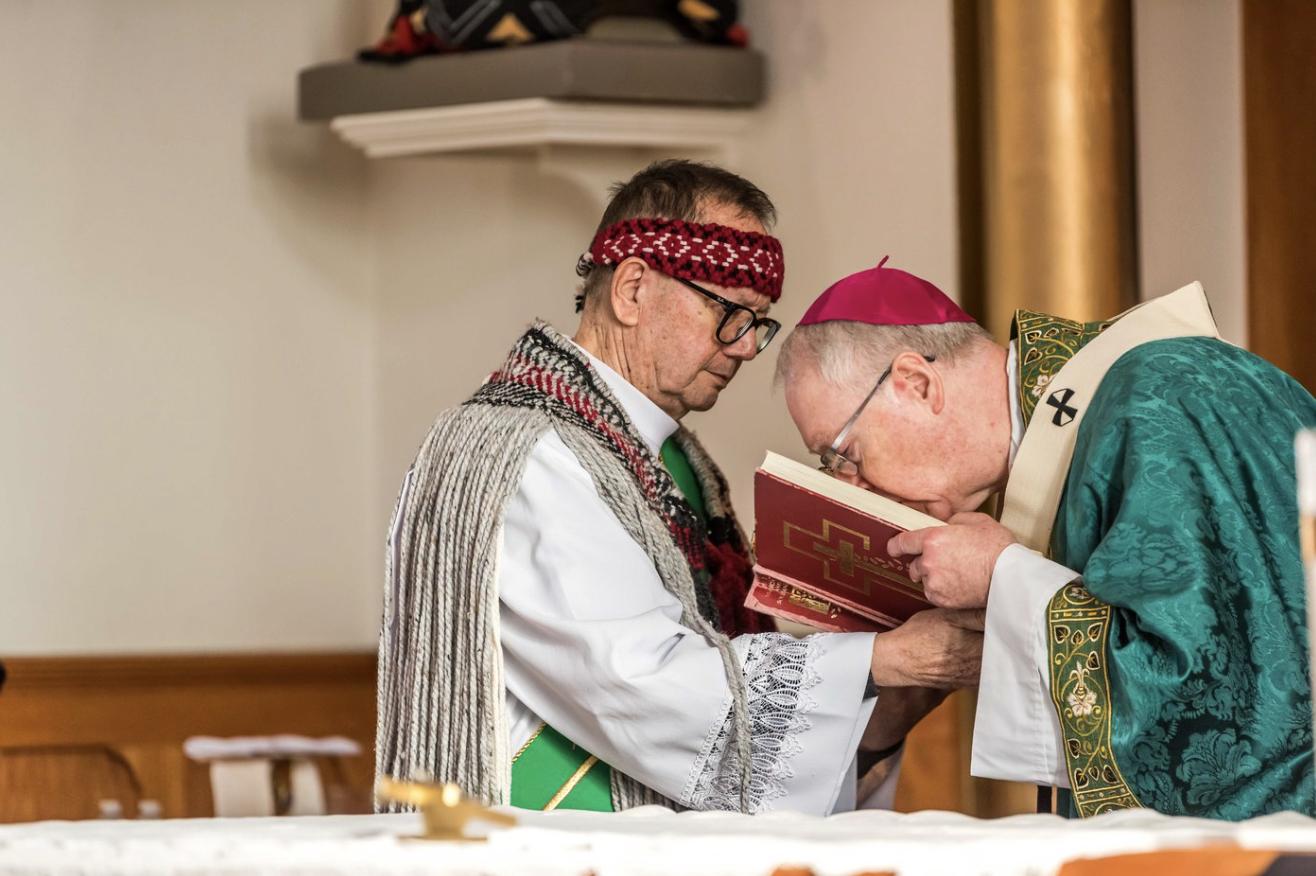
VANCOUVER (CCN) — Archbishop Richard Smith drew on Indigenous imagery to speak about faith and reconciliation at St. Paul’s Squamish Nation Church in North Vancouver, telling parishioners that Christ is the weaver who binds humanity together.
“When we share faith in Him, we are brought together as his people and we are created by the Lord into something of astonishing beauty,” he said in his homily during the pastoral visit.
Archbishop Smith met with Squamish Nation elders, a meeting he personally requested. “We talked and shared stories for almost two hours,” he said. “The non-Indigenous—our country broadly—has so much to learn from Indigenous ways, from the traditions, from the culture, from the learnings.”
Reflecting on the ceremonial paddle he was given by the Squamish First Nation when he arrived in Vancouver last year, he recalled elders telling him the paddle was a lifeline, necessary for traversing the water in a canoe. Christ is the same, he said, “Jesus is our eternal lifeline. He, and he alone, is the one sent by the father to lead us to heaven.”
Many people in the world today “need to be thrown that lifeline,” he said. “There is great suffering in our world today. There is a great sense of loneliness” amid the world’s “fracturing” and “division,” from warring nations to families.
During his visit, Archbishop Smith was shown Indigenous baskets made of cedar root and cherry bark, an image he used to reflect on Christ’s role in uniting humanity. Christians, he said, are like a basket woven together by Jesus himself. “Who does the weaving? [It’s Jesus,] because he is the lifeline,” he said, “the one who does the intricate interweaving that brings humanity together.”
As he finished his homily, he reaffirmed the Archdiocese of Vancouver’s commitment to truth and reconciliation. “I want you to know—I want the people to know—that I am committed, and the Archdiocese is committed to that ever-closer interweaving among ourselves,” he said.
“My hope and my prayer is that as we grow in reconciliation—the Church and Indigenous peoples together—as we look at that basket as see it as symbolic of the interwovenness that we want to exist between ourselves.”
He ended with a call to work together, asking the Lord “to interweave us so that we will become a beacon for others that says unity and reconciliation is possible.”
Hope is real and tangible, he said, “and we can touch it the more deeply that we are reconciled with one another. We ask the Lord Jesus to help us move through the waters of this life.