The writings of a Ukrainian archbishop, who led the Ukrainian Greek Catholic Church through two world wars and died in 1944, still speak to the concerns of the contemporary world, once again marked by war and displacement, says the translator of his pastoral letters.
Daniel Fedorowycz has taken on the translation of Metropolitan Andrey Sheptytsky’s social teachings from Ukrainian into English in view of making the prelate’s thought accessible to a broader readership.
A research associate at the Public History Lab at the University of Toronto’s Munk School of Global Affairs and Public Policy, Fedorowycz manages the lab’s partnership with the Ukrainian History Global Initiative, a collaboration of more than 90 researchers aimed at presenting the history of contemporary Ukraine in a manner that is both scholarly and accessible.
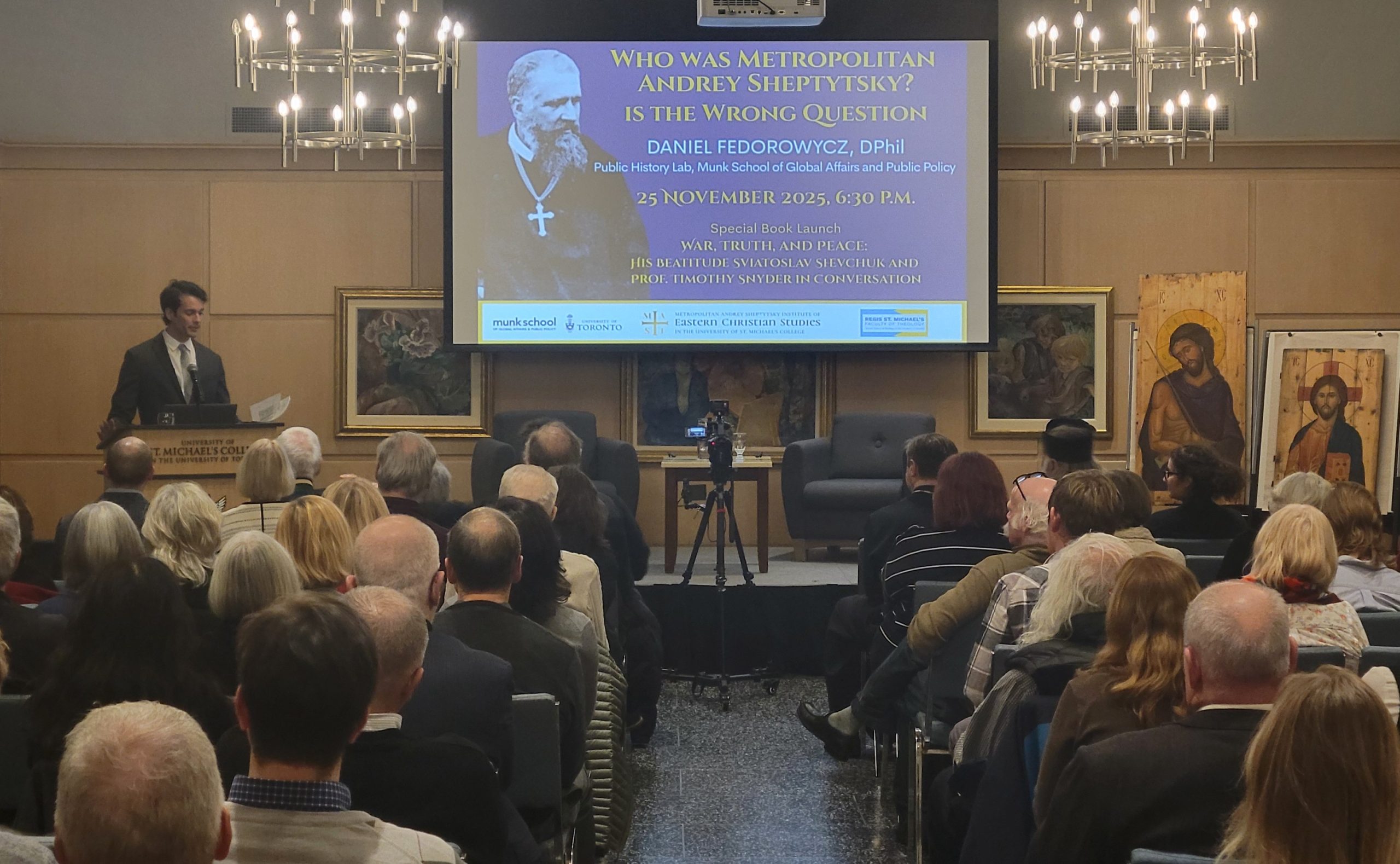
He spoke about the archbishop’s writings and what they reveal about the church leader during a public lecture on the theme, “Who is Metropolitan Andrey Sheptytsky? Is the Wrong Question.” The event was held at the Metropolitan Andrey Sheptytsky Institute for Eastern Christian Studies at the University of St. Michael’s College Nov. 25.
During his presentation, Fedorowycz explored how Sheptytsky — deeply rooted in the specific social, political, and ecclesial conditions of his day — illuminated enduring truths about human dignity, national identity and Christian discipleship. He wrote on themes ranging from economic justice and pastoral responsibility to national renewal and the moral formation of youth.
Sheptytsky’s life and contributions cannot be summarized in a tidy biography, Fedorowycz said. To understand Sheptytsky is to understand a vocation lived dynamically in response to a people whose circumstances were constantly in flux, he added.
In sharing this “inside picture,” Fedorowycz illuminated both the breadth of Sheptytsky’s concerns and the depth of his spiritual commitments. His texts reveal a pastor who was articulating a coherent vision for how a Christian community can flourish amid political uncertainty, cultural pressure and moral upheaval, he said.
They also reflect his desire to cultivate a resilient and dignified Ukrainian people, capable of carrying forward faith and culture even under hostile regimes, Fedorowycz said. Sheptytsky was not flawless, but his actions, even when imperfect, were animated by a sincere intention toward holiness and service, he added.
Fedorowycz highlighted the relevance of Sheptytsky’s vision today and what the archbishop’s life reveals about leadership rooted in faith, the demands of community, and the possibilities of moral courage.