The intrusion of AI notwithstanding, articles do not write themselves, and so some of you may wonder who this author is. By now, you may have discerned that I am not one who dwells in the realm of vapid religiosity.
And so it goes with my handling of Lent.
We enter Lent with good intentions. We enter Lent with some understanding of what it is. We recognize that it culminates, in some way at least, with the celebration of Easter. And then, for many of us, it is over, and we move on until Advent — or some organized sport — offers us another seasonal pause.
It seems that our culture has accommodated our Christian seasons as much as we have quietly accommodated them ourselves.
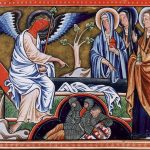
So I find myself asking: what can be said at this point in Lent — now Palm Sunday and the Sacred Triduum, at the threshold of the sepulchre — that might shake us out of familiarity? What might move us beyond routine remembrance into something more honest?
We do not deny that Jesus suffered. We do not deny that He was crucified. We do not deny that He died.
But I wonder if we have, in subtle ways, learned to look past what that actually means.
We move quickly from Good Friday to Easter. We move quickly from death to resurrection. We move quickly from fact to meaning. And in doing so, we risk losing something essential.
We do not avoid the Cross. We surround ourselves with it.
And yet, even here, something revealing occurs.
In some places, Christ hangs in visible agony — the weight of His body, the violence of His execution, the humiliation made unmistakable. In others, notably the churches of our Byzantine brothers and sisters, He appears composed, even serene, already reigning from the Cross in quiet victory. Both images see something true.
And yet, perhaps we have learned, in our own way, to look past the one thing neither image allows us to escape: He died.
Not symbolically. Not as a passing moment. Not as a prelude we are meant to rush through.
He died.
There was a moment — however we understand it theologically — when the Son of God entered fully into death. Not the idea of death. Not the appearance of death. Death itself: the stillness, the silence, the absence.
And this is what we do not linger with. We avoid the finality. We avoid the abandonment. We avoid the silence that follows when nothing more can be said or done. We prefer, understandably, to move to what comes next.
But what if something is lost in that movement? What if we have become so accustomed to the language of redemption that we no longer feel the rupture it presupposes?
At times, I am struck by the unsettling clarity of Friedrich Nietzsche, who declared that God is dead. He did not mean this as a theological statement of faith, but as a diagnosis of a culture that no longer lives as though God matters.
And I wonder whether we, in our own way, have made a similar move, not by denying God but by domesticating His death.
We commemorate it. We ritualize it. We surround it with music, liturgy and meaning. And all of this is good, even necessary. But it can also create a distance — a way of holding the event at arm’s length. We know what it means, and so we no longer have to face what it is.
But what is it?
It is the death of a man.
It is the death of the one we confess as the Son of God.
It is the moment in which no intervention comes, no rescue arrives, no visible reversal takes place.
He is handed over. He is executed. He dies.
And the world goes on.
This is not sentiment. It is not symbol. It is not something to be softened or quickly resolved. It is the central fact of our faith. And perhaps Lent is given to us, in part, so that we do not look away from it, not to dwell morbidly on suffering, not to rehearse guilt, but to stand, if only briefly, in the presence of something we cannot control, explain away or rush past.
To stand at the edge of the sepulchre. To remain there long enough for the silence to speak.
Because only then might we begin to understand what it means to say that death has been overcome.
And only then might we begin to ask what such a death asks of us.