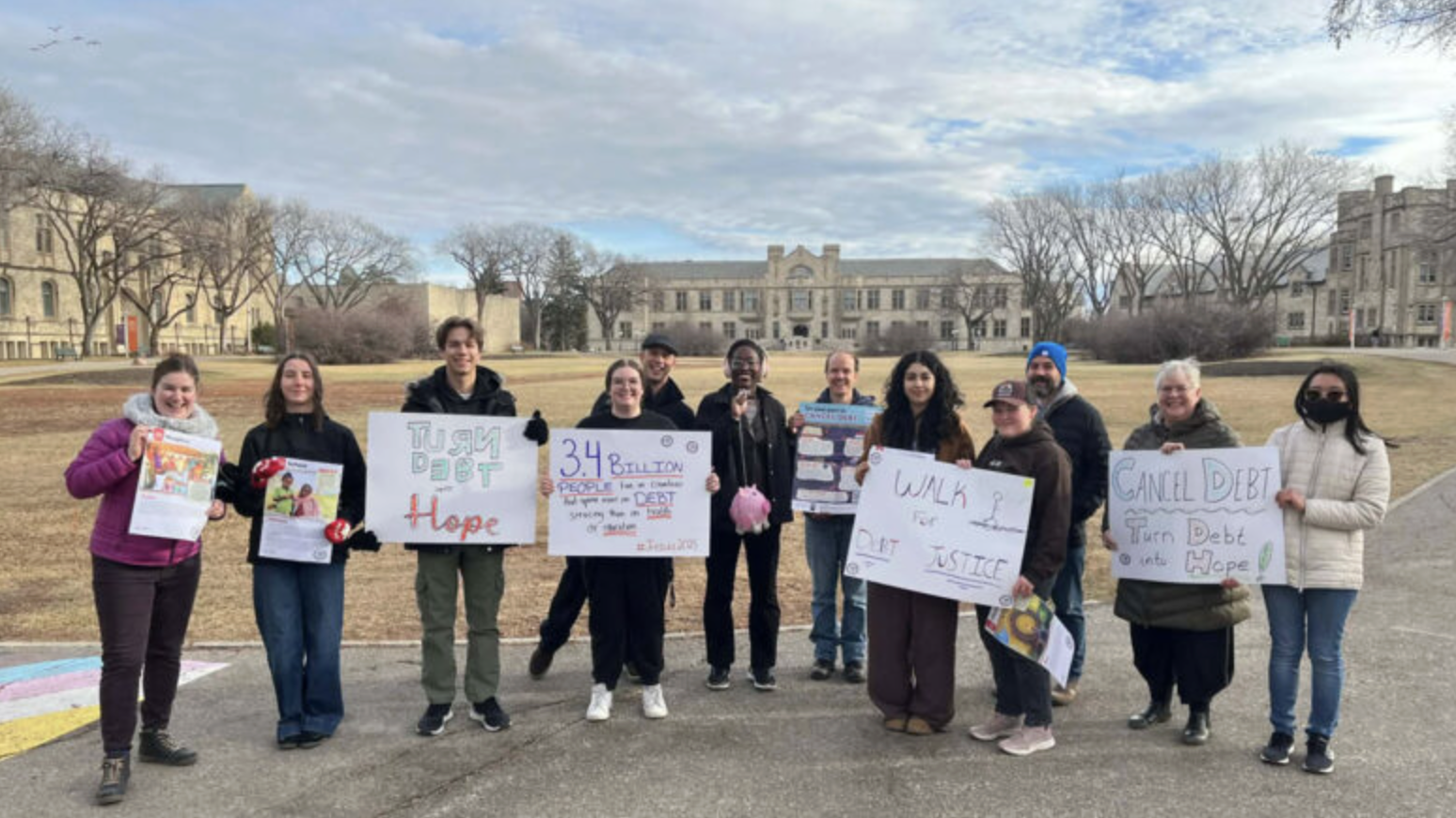
SASKATOON, Sask. (CCN) — The JustYouth group at St. Thomas More (STM) College and parishioners from St. Mary Catholic Church in Saskatoon were among those across Canada recently participating in a Development and Peace-Caritas Canada solidarity walk to reflect, raise awareness, and stand with those in the Global South who are burdened with unjust debt.
The St. Mary Parish solidarity walk was held Nov. 16, coinciding with this year’s World Day of the Poor, established in 2016 by Pope Francis, and with the celebration of a “Jubilee of the Poor” at the Vatican, led by Pope Leo XIV. The STM event was held the following day, on Nov. 17, 2025.
The solidarity walks included stops along the way to raise awareness and to reflect upon the human rights and dignity of the poor through the lens of the “Turn Debt into Hope,” Development and Peace-Caritas Canada’s (DPCC) Fall Action Campaign.
“We had a relatively small group, but for most of our students, it was their first solidarity walk,” reported Celeste Woloschuk of STM Campus Ministry. “The students made signs, and brought the “Accountability Pig” (our name for him) – one of DPCC’s solidarity symbols for the campaign, made by Sam Medernach, one of the group’s leaders who also served this last year as a Development and Peace Youth Ambassador.”
The solidarity walk at St. Mary Parish began at the church building in the city’s core neighbourhood after Sunday Mass Nov. 16, and included prayers for those suffering from injustice and poverty, both locally and around the world.
The walk began with a reflection on the call to “ecological conversion” in the papal encyclical Laudato Si’, where Pope Francis wrote: “the foreign debt of poor countries has become an instrument of control,” adding that there is “a real ecological debt” that the global north owes the south.
Echoing Pope Francis’s call to “forgive the debts of countries that will never be able to repay them,” the St. Mary solidarity walk pilgrims reflected on the situation in countries like Peru: “where mining industries make up almost 15 per cent of the economy and over 60 per cent of exports but (where) 30 per cent of Peruvians live below the national poverty line” and were mining “leaves a trail of environmental degradation, conflict and human rights abuses.”
The solidarity walk pilgrims then stopped at St. Mary’s Wellness and Education Centre, reflecting how funding education becomes a major challenge when governments must spend public budgets to repay burdensome debt. They heard how Ethiopia increased its education budget to reach $1.4 billion, but at the same time, had to spend more than $2 billion on servicing its debts.
“In a camp for internally displaced persons in Ethiopia, DPCC’s partner, Daughters of Charity of Saint Vincent de Paul, provided food, dignity kits and psychosocial support to 568 women and children,” participants heard. “Among them were Ade and her five-year-old daughter, Melati. They had fled the conflict in West Tigray. Ade says the assistance they received saved their lives.”
The St. Mary pilgrims next stopped at the parking lot of a former Credit Union on 20th Street West to recall the Jubilee of 2000, when $100 billion in foreign debt for 36 of the world’s most impoverished countries was cancelled. Participants heard how dozens of countries still face a debt crisis 25 years later, because the global economic system does not tackle the root causes of unsustainable debt — including the fact that poorer countries can only get loans at very high interest rates.
In Tunisia, which is facing an acute debt crisis, a DPCC partner — the Tunisian Economic Observatory (OTE) — analyzes Tunisia’s debt and economic policies helping citizens understand complex issues and sustainable economic alternatives.
St. Paul’s Hospital was the fourth stop on the St. Mary Parish solidarity walk, where pilgrims heard how billions live in countries that pay more in interest on debts than they can invest in health care.
In Sudan, were civil war has displaced over 14 million people and some 25.6 million face acute food insecurity, “Sudan’s debts are over 2.5 times the size of its entire economy,” pilgrims heard, before learning how DPCC supports its partner Trócaire to provide cash assistance to vulnerable families. With Canadian Foodgrains Bank funding arranged by DPCC, Trócaire also provides therapeutic food and treatment to malnourished women and children at 17 health facilities.
The solidarity walk concluded back at the church, with participants reflecting on how they are called to be “Pilgrims of Hope” during this Jubilee Year and beyond.
Petitions for the DPCC Turn Debt into Hope awareness campaign were available at the church for signing. The petition is also available online at: devp.org (LINK).