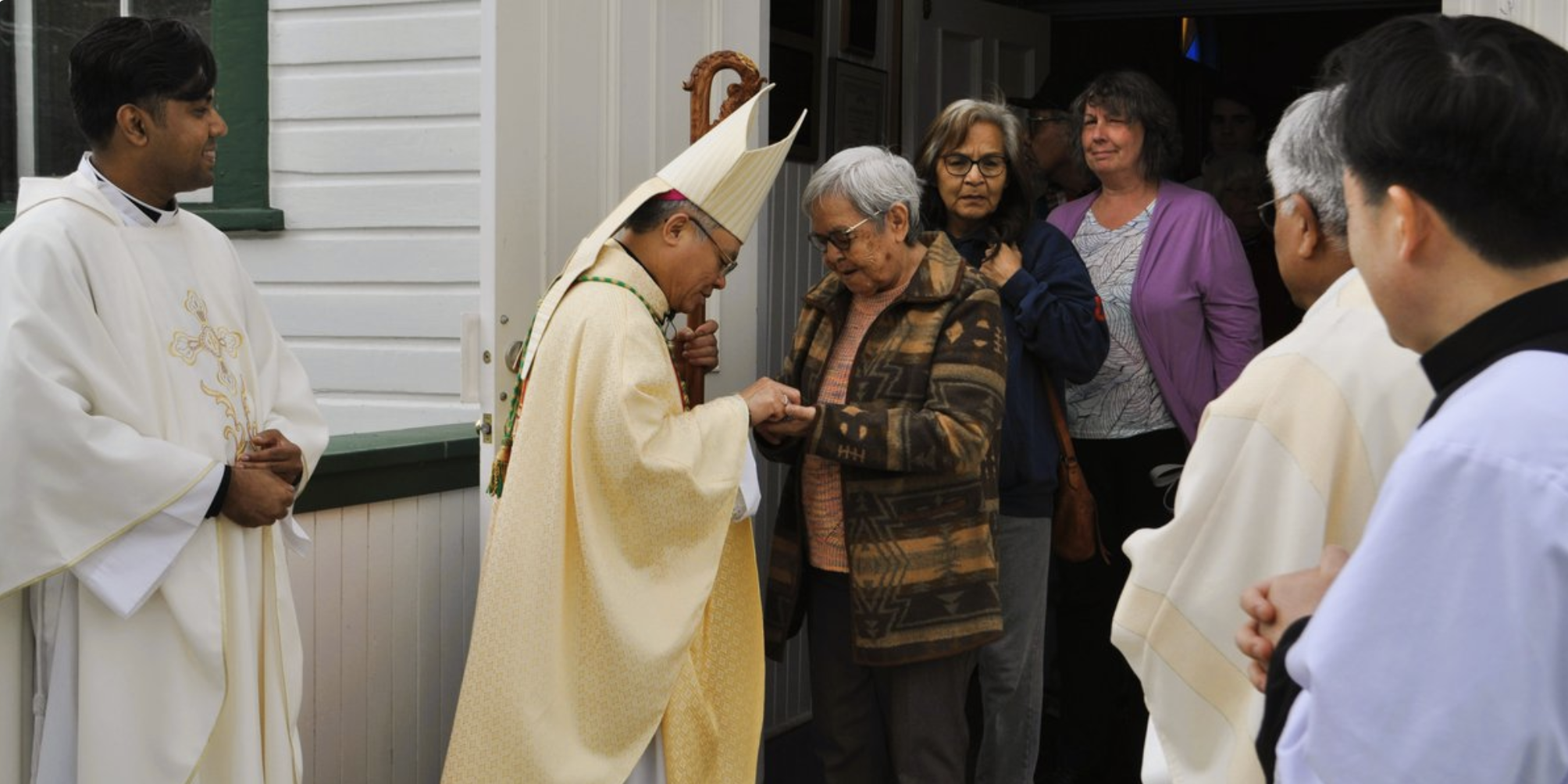
KAMLOOPS, B.C. (CCN) — As Canadian Catholics marked the National Day of Prayer in Solidarity with Indigenous Peoples on Dec. 12, the local Church looked back on 2025 as a significant moment in reconciliation history.
Vancouver Archbishop Richard Smith, chair of the Canadian bishops’ Committee on Indigenous Issues, described the past 12 months as a watershed moment.
“This has been a defining year where we have seen the seeds of apology begin to bear the fruit of concrete action,” said Archbishop Smith. “From the return of artifacts to the living out of the Sacred Covenant, 2025 has shown us that ‘walking together’ is no longer just a hope; it is becoming our daily reality.”
In the Archdiocese of Vancouver and the Diocese of Kamloops, that journey together was reflected in the recognition of the Sacred Covenant signed on Easter Sunday, 2024. The covenant outlined shared commitments to truth, healing, and moving forward together.
The first anniversary of the historic agreement between the dioceses and Tk’emlúps te Secwépemc (Kamloops) was commemorated this past Easter, April 20, 2025. The milestone occurred just weeks before Archbishop Smith’s installation, during the final days of Archbishop J. Michael Miller’s tenure, and one day before the death of Pope Francis.
The timing of the anniversary was significant, as Kúkpi7 (Chief) Rosanne Casimir described the late Pontiff as pivotal to the process. “We honour his journey to be welcomed by the Creator,” Casimir said in a statement released shortly after the anniversary. She noted that the Pope’s 2022 apology and visit were catalysts for the local agreement, acknowledging that while his words were symbolic, they had “profound emotional and spiritual impact for many.”
In a commemorative letter marking the one-year point, Archbishop Miller, Bishop Joseph Nguyen, and Casimir described the covenant not just as a document, but as a “living foundation” for their work.
The signatories highlighted progress in four specific areas over the last year:
Historical: A Joint Research Agreement is now in place. Teams from the First Nation and the Church are collaborating to review documentation from government and Church sources. The stated goal is to provide clarity regarding students of the former Kamloops Indian Residential School (KIRS), including documenting causes of death and burial locations.
Scientific: The dioceses are providing technical and scientific expertise to help answer questions raised by previous ground-penetrating radar (GPR) surveys.
Commemorative: Joint efforts continue to honour children who died at residential schools, with the aim to “never forget the children lost and the void created by their deaths.”
Restorative: The parties are sharing ideas to help the community heal and thrive as Tk’emlúps te Secwépemc plans for the future.
“In a culture of increasing division and cynicism, we have created a relationship that stands in contrast to those negative forces,” the three leaders wrote.
During the April anniversary ceremony, Casimir shared a message from Cardinal Pietro Parolin, the Vatican Secretary of State. The message conveyed Pope Francis’ “cordial greetings” and his encouragement to “walk together, pray together, and work together,” words that Casimir noted carry “the power of unity and responsibility.”
The anniversary also served as a moment to look forward to the Church’s leadership transition. Casimir expressed gratitude for Pope Francis’ example while calling on his successor, Pope Leo XIV, to continue the journey with “humility and action,” including a clear mandate for all dioceses to work with First Nations on reparations and cultural revitalization.
The anniversary helped set a tone for the year that continued through recent developments. On Dec. 6, representatives of the Indigenous community and Canadian bishops gathered in Montreal to receive a gift of more than 60 artifacts from the Vatican.
In its Dec. 12 message for the day of prayer, the Indigenous Council invoked the concluding Jubilee year, calling on Catholics to be “pilgrims of hope.”
“This is both a Church endeavour and a personal one,” the Council wrote. “We pray that our families will continue to be strong in their faith and that the elders and the young will work closely together to create a better future.”
For the signatories of the Sacred Covenant, that future is being built on the “mutual respect and understanding” established over the last 20 months.
“The Sacred Covenant is not merely a commitment; it is a way of life,” the B.C. leaders wrote. “We look forward to another year of progress on this path to true and lasting reconciliation.”