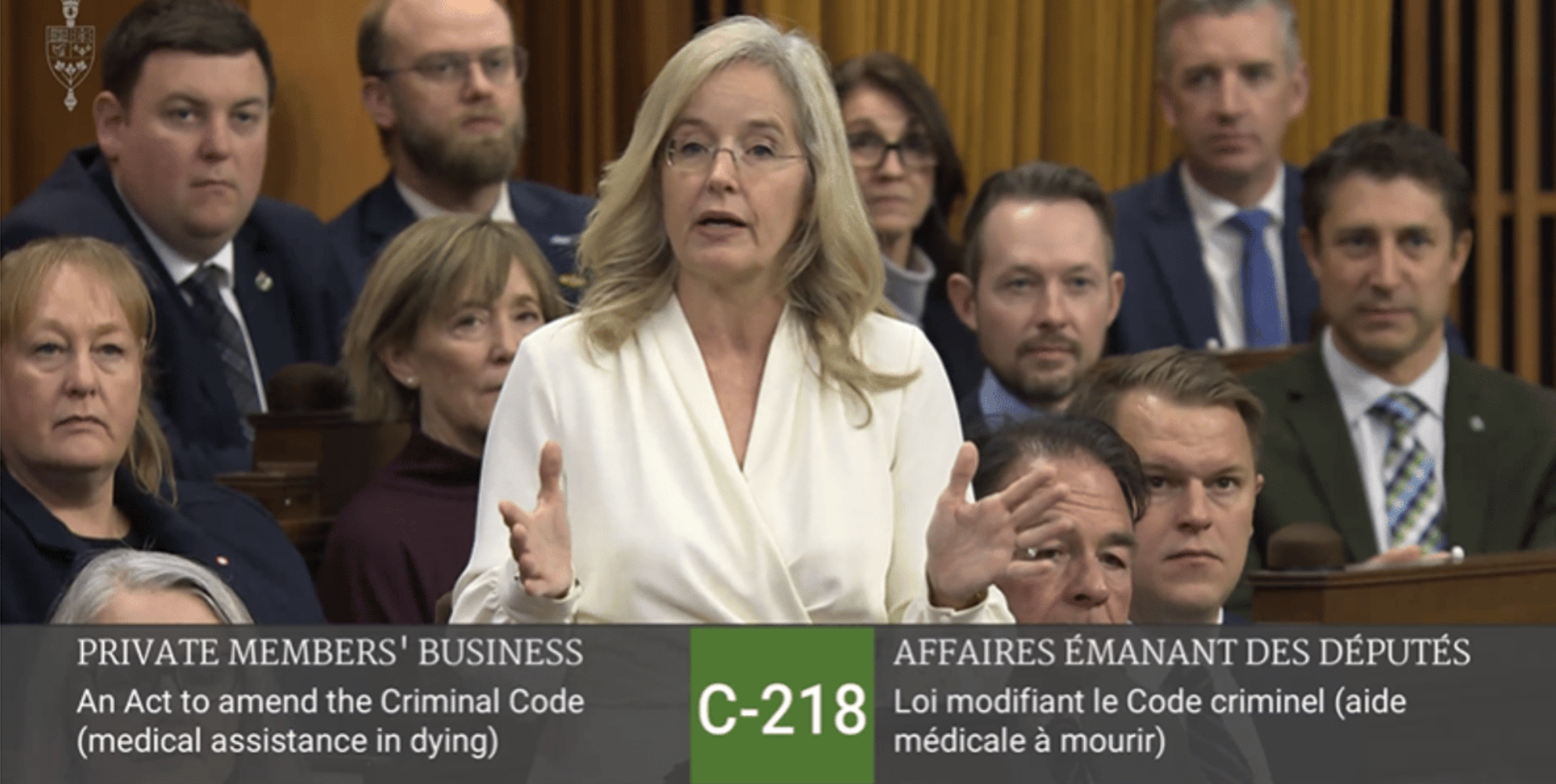
LANGLEY, B.C. (CCN) — A Langley Conservative MP’s effort to block the future expansion of medical assistance in dying (MAiD) to include mental illness alone prompted emotional debate in the House of Commons Dec. 5, as members sparred over balancing personal autonomy, medical uncertainty, and the protection of vulnerable Canadians.
Private member’s Bill C-218, introduced by Cloverdale—Langley City MP Tamara Jansen, would amend the Criminal Code to state that a mental disorder “is not a grievous and irremediable medical condition” for which a person could receive MAiD. The government is currently scheduled to lift the exclusion on MAiD for mental illness in March 2027. The bill had its first reading on June 20 and completed the first of its two scheduled debate sessions on Dec. 5.
During second reading, Jansen said expanding MAiD to people whose “only condition is mental illness” risks sending those in acute psychological distress toward ending their lives before receiving adequate treatment or support. She opened her remarks with the story of a young man who struggled with illness, addiction, depression, and anxiety, only to have MAiD raised before his mental-health care had meaningfully begun.
“This actually happened here in Canada,” she said, arguing that MAiD was being proposed to patients who are “vulnerable, scared and hanging on by a thread.”
Jansen said Parliament never fully considered the implications when mental illness was added to the MAiD framework through a Senate amendment in 2021. Since then, psychiatrists across Canada have emphasized that irremediability cannot be reliably predicted in mental illness and that “people get worse, but they also get better, and most do.” She added concerns about safeguards and assessments: “We are already witnessing cases where safeguards fail, where capacity is misjudged and where people are assessed in moments of confusion, exhaustion or pressure. If the system cannot uphold basic protections now, it will not and cannot protect those suffering from severe psychological distress. An expansion would be reckless.”
“The very feelings that drive someone to seek MAID, hopelessness, despair or the belief that they are a burden, are the same signals that every suicide prevention worker is trained to treat as a cry for help,” she said. Jansen argued that expanding MAiD would deepen contradictions in Canada’s approach to suicide prevention. “A suicidal person calling a crisis line is urged to hold on, yet if they request MAID, that same despair may be treated as justification for death,” she said. Her bill, she added, aims to ensure Canadians “a real right to recover.”
One of the most personal interventions came from Conservative MP Andrew Lawton (Elgin—St. Thomas—London South), who told the House that he survived a suicide attempt 15 years ago after struggling with severe mental illness.
“If the laws that are coming into force in 15 months had been there 15 years ago, I would probably be dead right now,” he said.
Lawton described seven weeks in hospital on life support, followed by years of recovery. Today, he said, he has a family, fulfilling work, and a life “I never in a million years would have believed… possible.”
“By design, a mental illness is a distortion of the person’s ability to see clearly,” he said, warning that many in moments of suicidal despair could present their wishes as rational. “There is no clear way to separate suicidal ideation as a symptom from a request… to help in ending one’s life.”
Lawton said he launched an “I got better” campaign inviting Canadians to share recovery stories. Many wrote that they would likely have chosen MAiD if it had been available during their darkest periods. One woman wrote that after enduring an abusive relationship she is “damn happy it was not” available, saying her life today is full of joy.
Remarks from multiple Liberal MPs and a Bloc Québécois representative signalled the two federal parties are unlikely to support C-218. Their comments emphasized waiting for the conclusions of a joint parliamentary committee on MAiD, which is scheduled to convene on Feb. 28, 2026. That committee — created under Bill C-62, which imposed a three-year delay on MAiD for mental illness and passed in February 2024 — is mandated to hear expert testimony and may issue recommendations, including possible Criminal Code amendments.
Liberal MP Juanita Nathan said MAiD eligibility for mental illness requires “exceptional caution” but pointed to expert panels, parliamentary committees, and clinical guidelines as part of a framework designed to ensure safe practice once provinces are ready. “These concerns are not new, nor are they trivial, and their desire for caution is laudable,” she said. She urged Parliament to rely on “the rich body of evidence” already produced, noting that a full parliamentary review is scheduled for 2026.
Liberal MP Aslam Rana of Hamilton Centre offered a similar message, emphasizing the need to understand the clinical and legal evolution of MAiD and the readiness of provincial health systems. Changes, he said, “must be informed by the experience of the people responsible for health care in Canada.”
Bloc Québécois MP Claude DeBellefeuille said her party would not support C-218, arguing that the decision on whether to proceed in 2027 should remain a clinical question rather than a political one. She said Quebec’s provincial framework rejected MAiD for mental disorders due to lack of scientific consensus.
Outside Parliament, culture-of-life advocates and several medical professionals held a news conference earlier in the day, urging that Canada not proceed with MAiD for mental illness. Speakers included Kelsi Sheren, a 36-year-old Canadian Armed Forces veteran diagnosed with PTSD and a traumatic brain injury. Sheren said there have been 20 documented cases of veterans being offered MAiD, adding that “one in September actually accepted it.” She argued that treatments for PTSD, depression, and chronic trauma remain difficult to access.
Montreal physician Dr. Paul Saba told reporters “that we know already that nobody can know who is treatable and untreatable,” noting that assessments can vary widely between physicians.
Alicia Duncan described how her mother Donna, of Maple Ridge, B.C., was granted MAiD on Oct. 29, 2021, while experiencing mental illness. Duncan said her family’s advocacy prompted an Abbotsford police investigation in 2022, which closed in 2023 after health-authority documentation was unavailable.
The debate comes at a time of growing national unease as several provinces have urged Ottawa to delay expansion, while opinion polls show most Canadians oppose MAiD for mental illness alone.
Bill C-218 remains before the House awaiting further debate and a vote to determine whether it will proceed to committee for study.