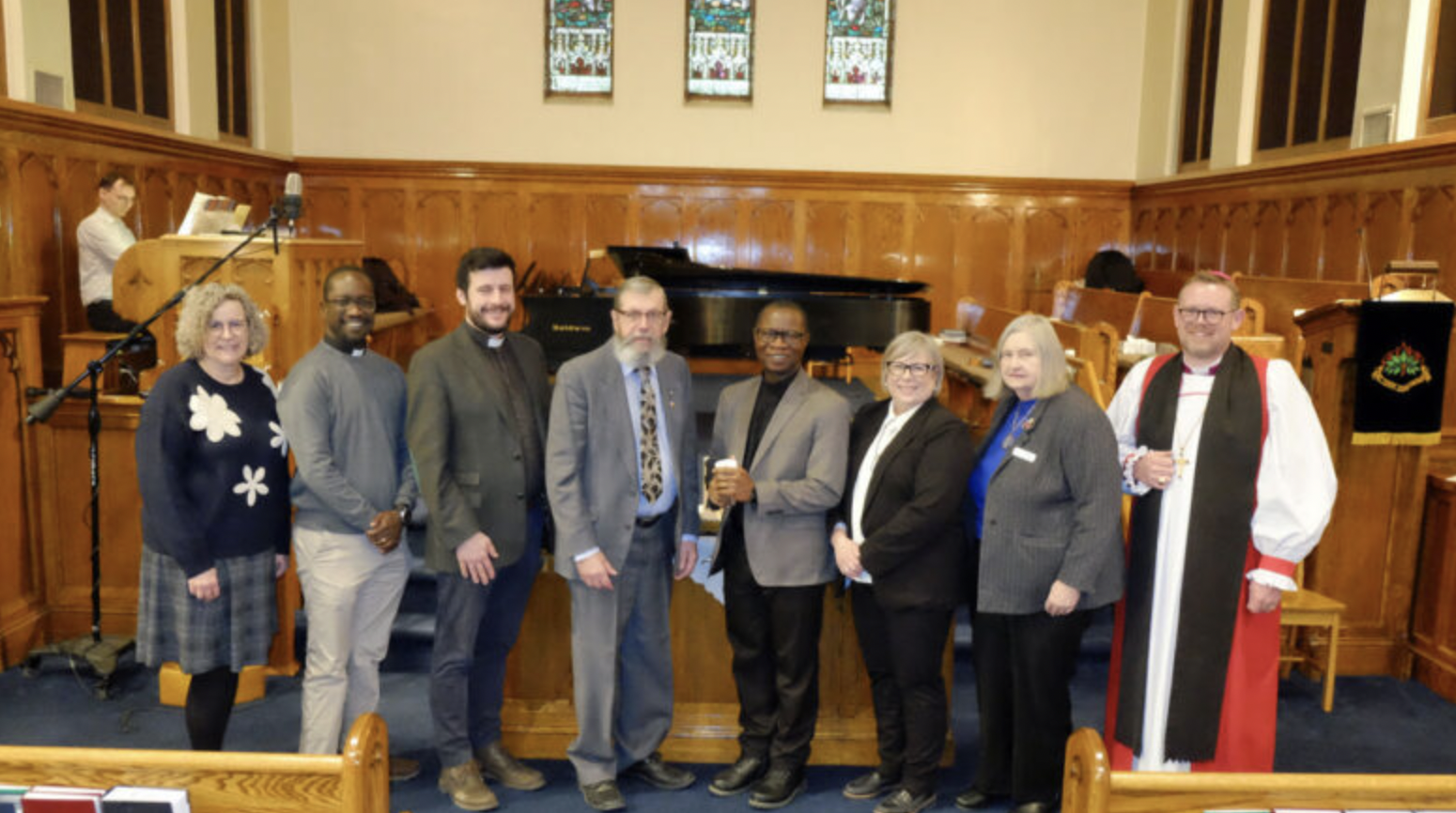
SASKATOON, Sask. (CCN) — With prayer, song, reflection, and the symbolic sharing of the Light of Christ, Christians from many traditions gathered for the closing of the Week of Prayer for Christian Unity Jan. 25 at St. Andrew Presbyterian Church in Saskatoon.
Mary Nordick, chair of the Prairie Centre for Ecumenism, welcomed those gathered for the Sunday afternoon worship service, reflecting on the “blessed week” of prayer, events, and reflection from Jan. 18-25.
She noted in particular the Saskatoon events, such as “the beautiful daily prayer services that came from many traditions that comprise our Christian faith, the delicious breakfasts and even better, the conversations and getting to know our brothers and sisters in Christ as we ate together.”
She also pointed to this year’s De Margerie Series for Christian Reconciliation and Unity, held during the week of prayer in both Saskatoon and Regina, which was “so ably presented by this year’s De Margerie lecturer, Dr. Jeremy Bergen, where we learned about Christian martyrs and the ecumenism of blood and signs of hope for our current world, and the workshop where we considered apologies, reflecting on what they mean and most importantly, how they can inform our future.”
Using prayer materials prepared by the Armenian Apostolic Church for the world-wide celebration of the week of prayer Jan. 18-25, those assembled began the service with the Lord’s Prayer, followed by an invocation, prayers, scripture readings and the sign of peace, led by leaders from several area churches, with music ministry provided by Paul Suchan.
Anglican Bishop Chad McCharles was guest preacher at the closing service, reflecting in his homily on his own grassroots experiences of prairie ecumenism and the blessings and challenges of shared ministry in a small town setting.
“We, all of us, as human beings, have preferences, things that fit us and suit us, that make us comfortable… (and we) amplify that when we come and sit at a pew, for whatever denomination. We carry that with us,” he said, describing initial difficulties encountered when two denominations began sharing a church building. But with patience, perseverance, and communication, gradually two communities came together in greater unity.
“You could see the light starting to peek through the cracks of that darkness of fear. And there was inspiration, and community members began to be attracted and drawn to this ecumenical shared ministry, not because they had an Anglican background or a United Church background, but because they believed in the unity that we were committing to, (and) that we were putting first.”
Just as Jesus prepared his listeners for his impending death in the Gospel reading from John 12:31-36, Jesus prepares us for the path of reconciliation and unity, McCharles said. “So much about who we are has changed as the Church, especially here in the west, and we are grieving and anticipating death-upon-death and end-upon-end. But Jesus reminds us that if we focus on the light, the darkness of that fear gets driven back.”
The cross of Christ is our light, he stressed. “That dark and fearful instrument made light. Our symbol of light, that which unifies us, whether we are Presbyterian, United, Anglican, Catholic, Lutheran, Methodist — whatever we are, we all share the cross,” McCharles said.
“To live into this reality of light is to lift high the cross, to know that this is our foundation, and this — no matter what changes, no matter what amalgamations take place, no matter what pieces of our identity seem to be slipping — this piece of our identity will not be undone. For that light, which shone from the cross, the day of the crucifixion, the resurrection of Christ, that light shines on.”
He concluded: “The cross of Christ is our light. We do not lose light by sharing it. Our light only becomes brighter. And so let us, without fear, with courage, share what we have with one another, with the world, because we need not fear losing who we are because the cross goes before us.”
After praying the Nicene Creed together, candles were lit from a common candle and shared throughout the assembly.
Closing prayers concluded as the service had opened, with the Lord’s Prayer.