It’s been more than 20 years since Cardinal Giorgio Marengo arrived in Mongolia as a young Italian Consolata Missionary, where he helped to plant the first Catholic parish in Arvaikheer.
In this central Mongolian town of no more than 25,000, he worked toward fulfilling his religious society’s mission of first evangelization in a place where the Church was largely unknown and absent.
The experience marked one of his life’s turning points, and remains a reality that impacts his current ministry as the apostolic prefect of Ulaanbaatar, a missionary jurisdiction covering all of Mongolia.
“ (In Arvaikheer) I have experienced what it means to be at the service of the Church in a place where it is not known, and was not even present at that time when we arrived there,” he told The Catholic Register.
“Experiencing daily the beauty as well as the challenging side of sharing our faith with people coming from other traditions, who had never had the chance before to come in contact with the Church and the Gospel message, has been shaping the part of the ministry I’m now offering to the Church,” he said.
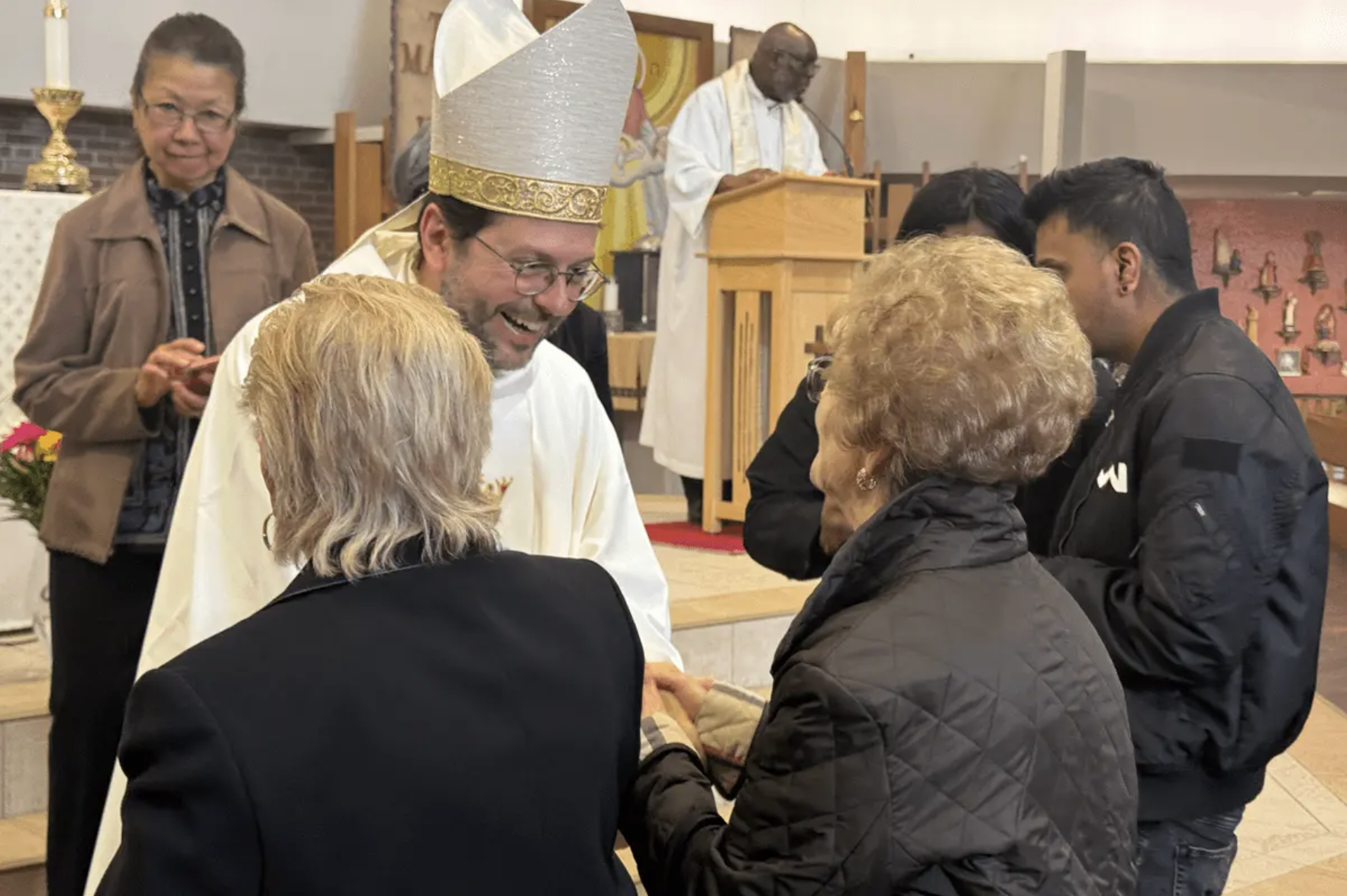
Last month, Marengo visited St. Andrew’s Parish in Toronto, which is served by Consolata Missionaries and has supported the Church in Mongolia for years.
“ I’ve been very much enriched by the recent encounter when I passed through Toronto. It has been a great blessing, as now our relationship is even deeper. It was beautiful to celebrate the Holy Mass together and spend some time together for moments of communal sharing,” he said.
Marengo was named cardinal by Pope Francis in 2022 at age 48, making him one of the youngest members of the College of Cardinals, second only to Cardinal Mykola Bychok of the Ukrainian Catholic Eparchy of Sts. Peter and Paul of Melbourne, Australia. From that point, Marengo’s missionary work in a remote corner of the planet, where only approximately 2 per cent of the population is Christian, received more attention.
“ After the initial surprise and relative shock at the news of my appointment as cardinal, I tried to continue offering the service I was already performing: seeking to deepen and consolidate it while increasing my prayers and efforts to honour this office and place it at the surface of the Universal Church,” he said.
However, proclaiming the Gospel in an area where it was relatively unknown, even just a few short years ago, is not a mission without its challenges.
“ The reality of the Church in Mongolia is comparable to the one described in the Acts of the Apostles when a first community of believers was established through the witness, preaching and the work of the Apostles,” he said.
Marengo said most members of the Catholic communities in the Mongolian Church are first-generation Christians, explaining his experience as he accompanies them throughout their new faith journeys.
Regarding the openness to discern the call to priesthood or consecrated life, Marengo believes it comes down to a day-by-day deepening of a personal relationship with Jesus Christ.
“This has fostered the life of prayer in families and in individuals so that the seed of the divine call to follow Christ in that particular way may be received and welcomed and bear fruit,” he said. “Our attention is especially oriented to providing a good spiritual life so that by being attuned with the Holy Spirit, young men and women may also be more attentive to the calling of the Lord.”
Buddhism is the dominant religion in Mongolia, adhered to by just over half of the country’s population. Interreligious dialogue with the Buddhist majority is a daily reality, as well as a historic priority for the Church in Mongolia.
Marengo shared that regular participation in Buddhist–Christian colloquia has occurred, and Mongolian Buddhist delegations met Pope Francis in May 2022 and this past January; they also met Pope Leo XIV in October. These were “truly important in our mutual understanding and in building bridges of collaboration,” he said, voicing his hopes that local and international meetings will open up other initiatives, such as in Ulaanbaatar’s Catholic-run shelter for the homeless under the “House of Mercy” project.
“ My deepest desire and prayer is that together, the local Catholics in Mongolia and foreign missionaries, may increase the depth of being missionary disciples of the Lord,” he said. “I long for a local community that shows signs of great faith, determined by the charity and concrete hope of a mature community that keeps the freshness of this encounter with Christ.
“I also believe that an important step in fulfilling this dream is to grow in spiritual life; therefore, we also have a dream of establishing a Catholic contemplative monastery in Mongolia, when God will allow that and when the conditions will be ready for that.”