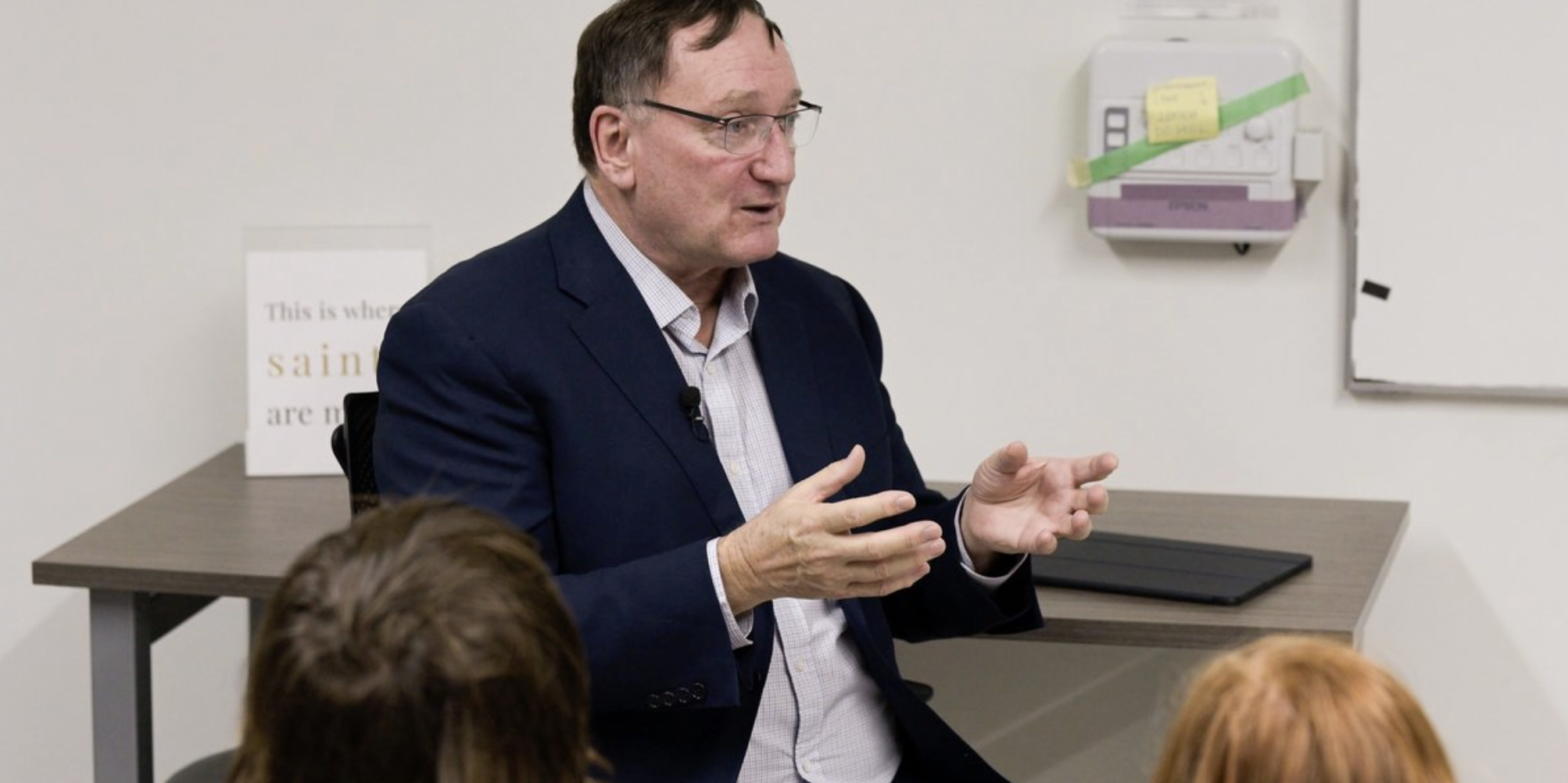
In an age when some philosophical materialists believe nothing exists beyond matter, Dr. David Neima says neuroscience itself points in another direction.
Neima delivered the first of five talks in the series Science and the Supernatural: Neuroscience, Near-Death Experiences, and Eucharistic Miracles at Christ the Redeemer Church in West Vancouver last month, drawing more than 100 attendees in person and online. In his opening presentation, he presented evidence for the existence of the soul.
The soul is what gives life to the body, Neima said, describing it as the source of abstract reasoning, intellect, and free will. While science has mapped many brain functions, he noted, it has not identified where abstract reasoning, intellect, or the will reside.
To support his case, Neima cited the work of Canadian neurosurgeon Wilder Penfield, who in the 1950s stimulated patients’ brains during surgery. If human action is entirely determined by biology, Neima said, a patient whose arm was raised through electrical stimulation should believe he chose to raise it. Instead, Penfield’s patients reported the movement was not their own but caused by the surgeon.
Neima also referenced research by American neuroscientist Benjamin Libet. When subjects performed an action such as flipping a light switch, measurable brain activity appeared beforehand. However, when subjects decided to cancel an intended action, the expected spike did not occur. Neima argued the human capacity to “veto” an action comes from outside brain chemistry.
Near-death experiences offer additional evidence, he said, particularly the 20 percent of reported cases that have been medically verified. He cited the widely discussed case of Pam Reynolds, who in 1991 underwent brain surgery at an Arizona hospital, during which her heart was stopped and brain activity was undetectable. Following the procedure, Reynolds described operating-room conversations, music, and surgical instruments used during the operation. Neima also said that in published medical accounts of near-death experiences, patients report encountering deceased individuals, not those still living.
Neuroscience, Neima argued, demonstrates that the brain governs memory, movement, perception, and emotion, but not intellect and will. While the brain assists these capacities — since people cannot think clearly when exhausted or intoxicated — it does not originate them.
Neuroscience suggests the human person is both matter and spirit, Neima said, and the soul, without physical parts, cannot be located within the body. When the body dies and disintegrates, the part that is able to choose to act or recognize external causes still endures.
He also drew on an analogy popularized by American neurosurgeon Dr. Michael Egnor, who reasoned that the number eight can exist physically, when written on paper, or conceptually, as an idea in the mind. If the paper is burned, the concept of eight does not disappear. In the same way, Neima said, abstract realities do not perish, and neither does the soul.
Addressing degenerative illness, Neima told attendees that a person with Alzheimer’s disease or in a vegetative state remains the same individual. Some patients recover from severe comas and resume normal lives, he said, and individuals with Alzheimer’s can experience terminal lucidity — a brief return of memory and clarity shortly before death. Such cases, he argued, suggest that personal identity does not reside solely in brain tissue but in the immaterial soul.
Neima, a medical ophthalmologist who began his career in 1972, has a background in neurophysiology research and practised for several years as a general practitioner before specializing in ophthalmology. He continues to practise part time and has participated in numerous medical mission trips. Raised in an atheist household, he became an evangelical Christian at university and entered the Catholic Church 32 years ago. He and his wife, married 51 years, have four children and four grandchildren.
The lecture series continues at St. Thomas Aquinas Secondary with Near Death Medical Data for Life After Death, Feb. 26; Medical Examination of Eucharistic Miracles, March 12; Big Bang Theory and Cosmological Constants, April 16; and The Fossil Record and Intelligent Design, June 4. All talks are at 7 p.m.