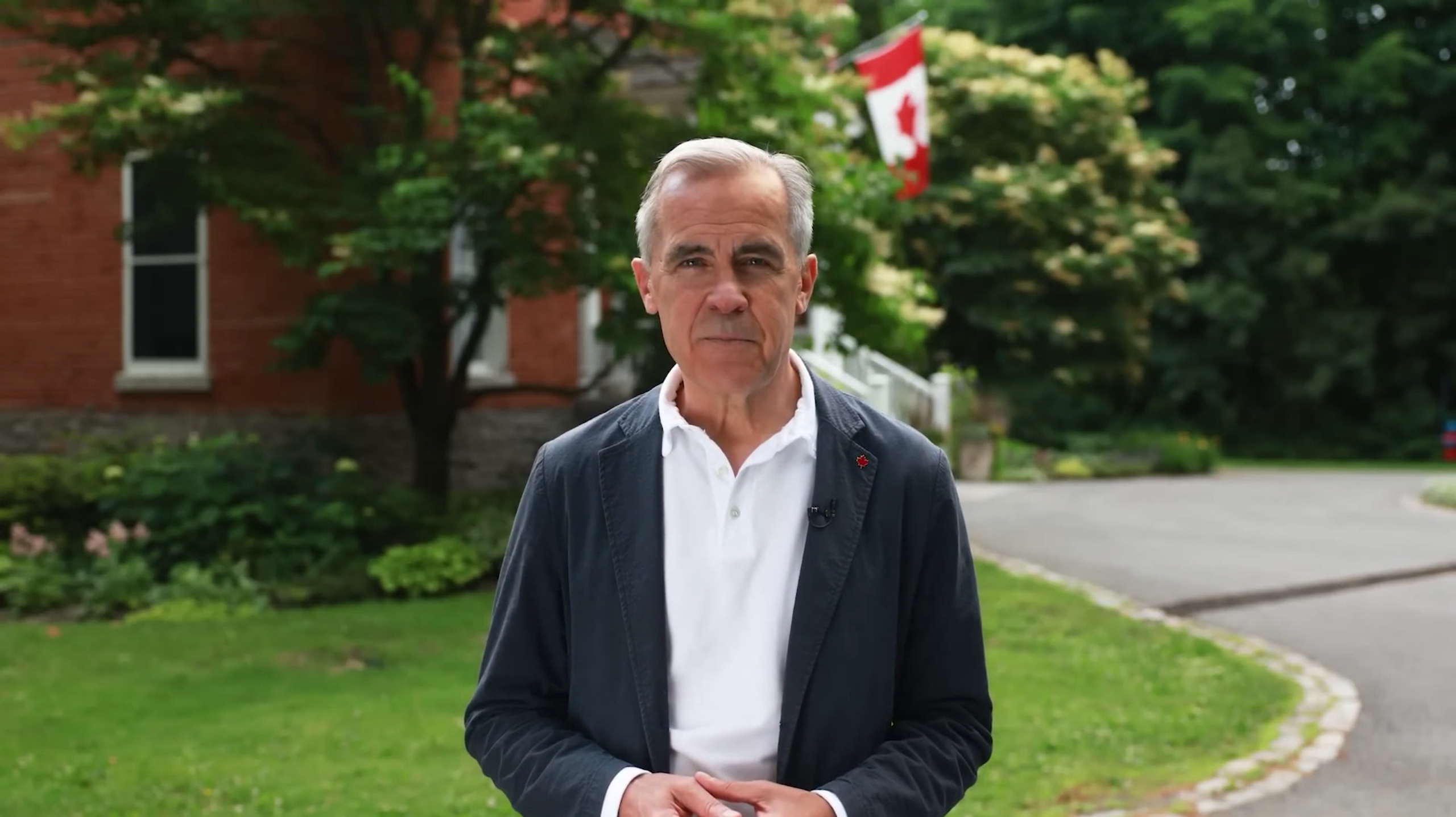
In a speech Jan. 20 at the World Economic Forum in Davos, Switzerland, Canadian Prime Ministry Mark Carney invoked Václav Havel’s famous essay “The Power of the Powerless” to diagnose the collapse of the “rules-based international order.” Like Havel’s greengrocer, Carney claimed that modern states have placed the “sign in the window,” affirming principles they privately knew were unevenly applied in order to get along. The system — whether Havel’s communism or Canada’s globalism — endured, not because it was just, but because everyone performed as if it were.
Carney is right about this much. The old international order relied on ritualized assent to abstractions that masked power, privilege and coercion. Honesty about that failure is overdue.
Where he goes wrong is in failing to complete the lesson he himself begins to draw. The danger Carney has identified is not merely international illusion; it is the habit of building cooperation without consent, coordination without conviction. And that danger is more acute at home than abroad.
Carney is correct that the world has changed. Economic integration has become a tool of coercion. Middle powers can no longer assume that rules will protect them when great powers decide otherwise. Strategic autonomy, diversification and resilience are rational responses to a more dangerous world. Nostalgia is not a strategy.
But if the old global order failed because it demanded assent without shared belief, then any successor must take seriously not just what we coordinate but how agreement is formed. On this point, Carney’s argument quietly inverts itself.
Internationally, he rejects top-down order sustained by ritual compliance. Domestically, however, he assumes a Canada unified enough to act decisively, bear costs willingly and speak with one voice about values, priorities and trade-offs. Yet this Canada does not exist. Canadians are deeply divided about energy policy, defence spending, relations with China and the balance between prosperity and sovereignty. These disagreements are neither merely technical nor economic: They are moral and political.
The cooperation Carney doubts is possible among states with divergent values is precisely the cooperation he presumes exists among Canadians. That presumption is not realism. It is administrative optimism at best or inadvertent authoritarianism at worst.
Here Catholic social teaching offers a clearer-eyed account of political legitimacy. The Church’s commitment to subsidiarity is often misunderstood as anti-state or nostalgic localism. In fact, it is neither. Subsidiarity is a theory of how authority becomes truthful. It insists that decisions be made at the lowest competent level, not because higher authority is illegitimate, but because genuine agreement must grow upward from lived social practices rather than be imposed downward in the name of efficiency.
Subsidiarity exists to prevent precisely the condition Havel warned against: people performing assent they do not inwardly give. It treats disagreement as a moral datum, not an inconvenience to be managed. It resists systems that run ahead of conviction and then rely on pressure, symbolism or procedural force to maintain the appearance of unity. In short, subsidiarity exists to keep us from living within a lie.
This matters because Carney’s vision of “values-based” international relations depends on moral language doing work it can no longer sustain. He speaks of shared values and standards, but these remain vague and selectively applied. Cooperation with countries such as China and Qatar may be prudent in narrow domains, but calling such relationships “values-based” thins moral language to the point of emptiness. A standard selectively adopted is not a standard; it is a strategy. Strategies may be necessary, but they cannot carry the moral authority Carney asks them to bear.
Subsidiarity offers a way through this confusion. It allows limited cooperation without pretending to deeper unity. It preserves moral language by refusing to overclaim. It acknowledges that not every good can be pursued at every level, and that legitimacy cannot be engineered by architecture alone.
Carney urges Canadians to “take the sign out of the window” internationally — to stop pretending the old order still works as advertised. That is a welcome call. But the more difficult task is domestic. If Canada is to model a more honest form of cooperation abroad, it must first relearn how agreement is built at home: patiently, pluralistically and from the ground up.
The Church’s defence of subsidiarity is not nostalgia. It is a warning. Cooperation imposed too quickly or assumed from mere history becomes coercion. Unity declared too early becomes fiction. And a politics that never asks if there is disagreement will eventually demand silence.
As Pius XI argued in “Quadragesimo Anno,” “Let those in power…be convinced that the more faithfully this principle of ‘subsidiarity’ is followed and a hierarchical order prevails among the various organizations, the more excellent will be the authority and efficiency of society, and the happier and more prosperous the condition of the commonwealth.”
If we are serious about living in the truth, honesty must begin not with new coalitions abroad, but with the harder, slower work of building real consent at home.