Should a country’s constitution be treated as a sacred document — one that cannot be questioned without risking political breakdown? Is resisting constitutional rights tantamount to a kind of quiet insurrection? Or is it possible for a constitution to anticipate disagreement so deeply that it builds in such mechanisms for contestation?
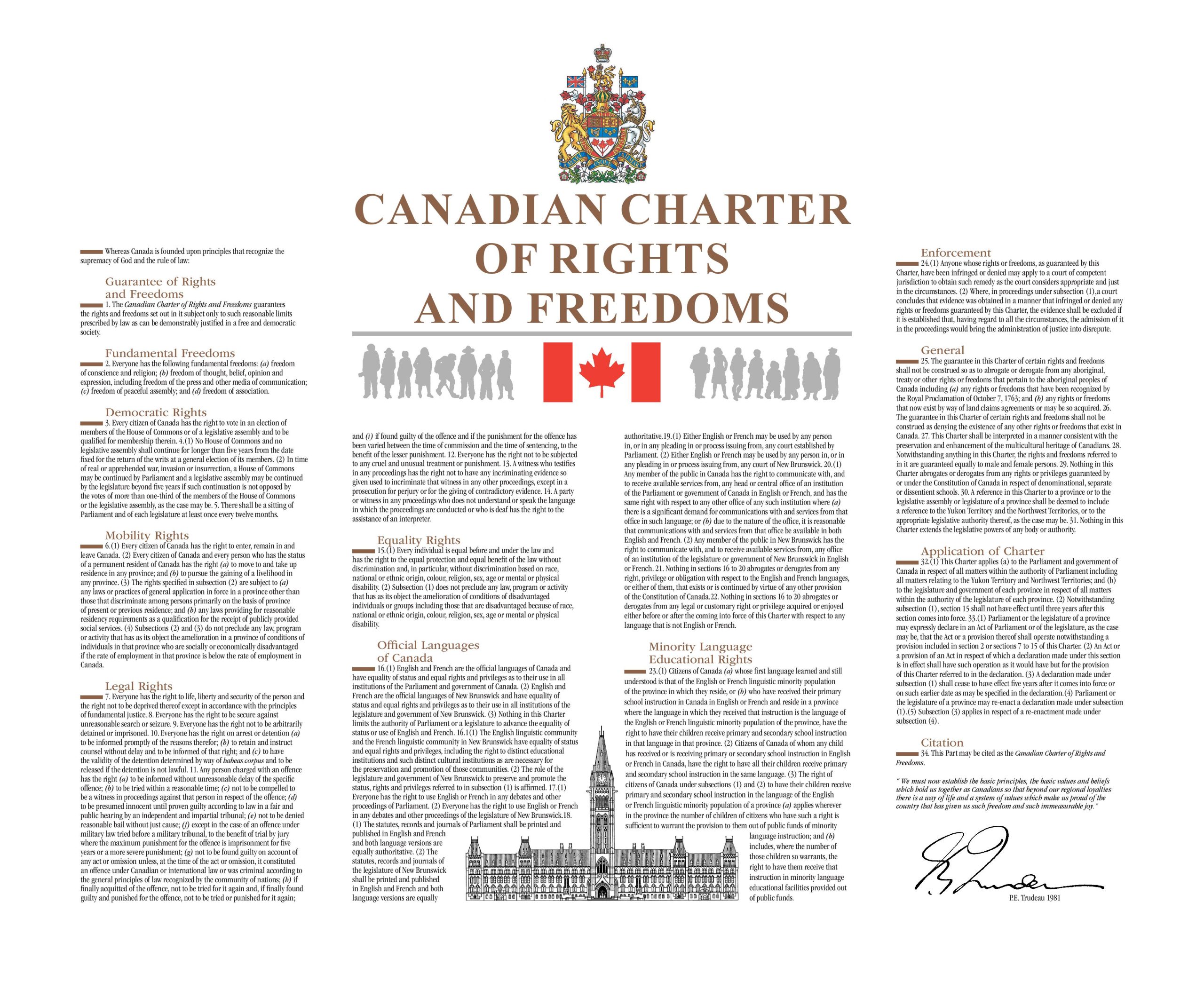
Canada’s Charter of Rights and Freedoms suggests that the latter is not only possible but essential. Yet recent controversy surrounding Quebec’s re-invocation of section 33 — the “notwithstanding” clause — has largely obscured this insight.
The issue arises again with Quebec’s Bill 21, which prohibits public servants from wearing visible religious symbols. For many religious Canadians, this law is not only immoral but a direct violation of the freedom of conscience and religion guaranteed under section 2(a) of the Charter. Under ordinary circumstances, such a law would invite judicial scrutiny and, quite probably, invalidation.
But Quebec has insulated the law from that scrutiny by invoking section 33, which allows legislatures to enact laws that operate “notwithstanding” certain Charter protections. The result is familiar: outrage from critics, defence from proponents, and a broader unease about whether something has gone wrong in our constitutional order.
Yet this reaction often misses what section 33 was designed to do.
The notwithstanding clause is not a loophole or an accident. It is a deliberate compromise embedded in the Charter — one that reflects the tension between two principles at the heart of Canadian governance: constitutional rights and legislative supremacy. The Charter affirms constitutional rights by entrenching rights against ordinary political interference. Section 33, however, preserves a space — narrow but real — for democratic institutions to assert themselves even in the face of those rights.
This dual structure is not a flaw. It is a recognition that a country as diverse as Canada cannot rely exclusively on courts to resolve its deepest moral disagreements.
Too often, debates about section 33 are framed as a stark choice: Are we on the side of courts or legislatures, of rights or public will? This framing is misleading. It turns constitutional disagreement into factional conflict, as though one must choose the “right side” of the Charter against those who would undermine it.
But section 33 invites a different interpretation. Rather than viewing its invocation as a breakdown of constitutional order, we might see it as a form of political discourse internal to that order — a legally sanctioned way of saying: This issue is not settled.
In this sense, section 33 functions less as an override than as a demand. It forces legislatures to take public responsibility for decisions that would otherwise be resolved by courts. It requires them to justify, in explicit and revisable terms, why a particular law should stand despite its tension with Charter rights. And because the clause must be renewed every five years, it ensures that this justification cannot remain static. It must be revisited, defended and — if necessary or appropriate — rejected.
This is not the suspension of constitutionalism. It is its politicization in the best sense: a return of contested questions to the arena of public judgment.
None of this is to deny the seriousness of what is at stake. Those who object to Bill 21 are right to do so. A law that restricts the public expression of religious identity raises profound concerns about the kind of society Canada aspires to be. But if section 33 is used, the appropriate response is not to treat the law as illegitimate by definition, nor to demand that courts intervene regardless.
It is to engage politically.
Section 33 redirects constitutional energy. It shifts the site of contestation from the courtroom to the legislature, from judicial reasoning to public persuasion. It tells citizens that if they wish to oppose a law, they must do so not only through litigation but through the harder work of democratic life: organizing, arguing, voting and holding representatives accountable.
Seen in this light, the notwithstanding clause offers something rare in modern constitutionalism: a structured alternative to the “all-or-nothing” logic that so often defines rights disputes. It neither abandons rights nor renders them absolute. Instead, it creates a space in which rights claims can be contested without threatening the stability of the constitutional order itself.
There is, however, a further dimension to this that is often overlooked. When section 33 is invoked repeatedly or in especially contentious cases, it may signal more than a disagreement over a particular law. It can reveal a deeper tension within the constitutional settlement itself — between how rights are articulated and how they are experienced across a diverse political community. In this way, the notwithstanding clause does not merely permit disagreement; it can expose when the terms of that disagreement are no longer widely shared.
A constitution that includes such a mechanism is not weakened by it. On the contrary, it gains a kind of self-awareness. Section 33 allows political actors to register, from within the system, that certain interpretations of rights or institutional roles may require reconsideration. This need not — and should not — be understood as a call to abandon the Charter. But it does suggest that constitutional orders, like the societies they govern, must remain open to reflection and, where necessary, revision.
In an era when political disagreements are increasingly framed as existential, this is no small achievement. Section 33 does not resolve our deepest conflicts, but it does something more important. It gives us a way to have constitutional conflict without tearing the system apart, and a method to recognize when the system itself needs to be reconsidered.
That is not a constitutional failure. It is a political opportunity.