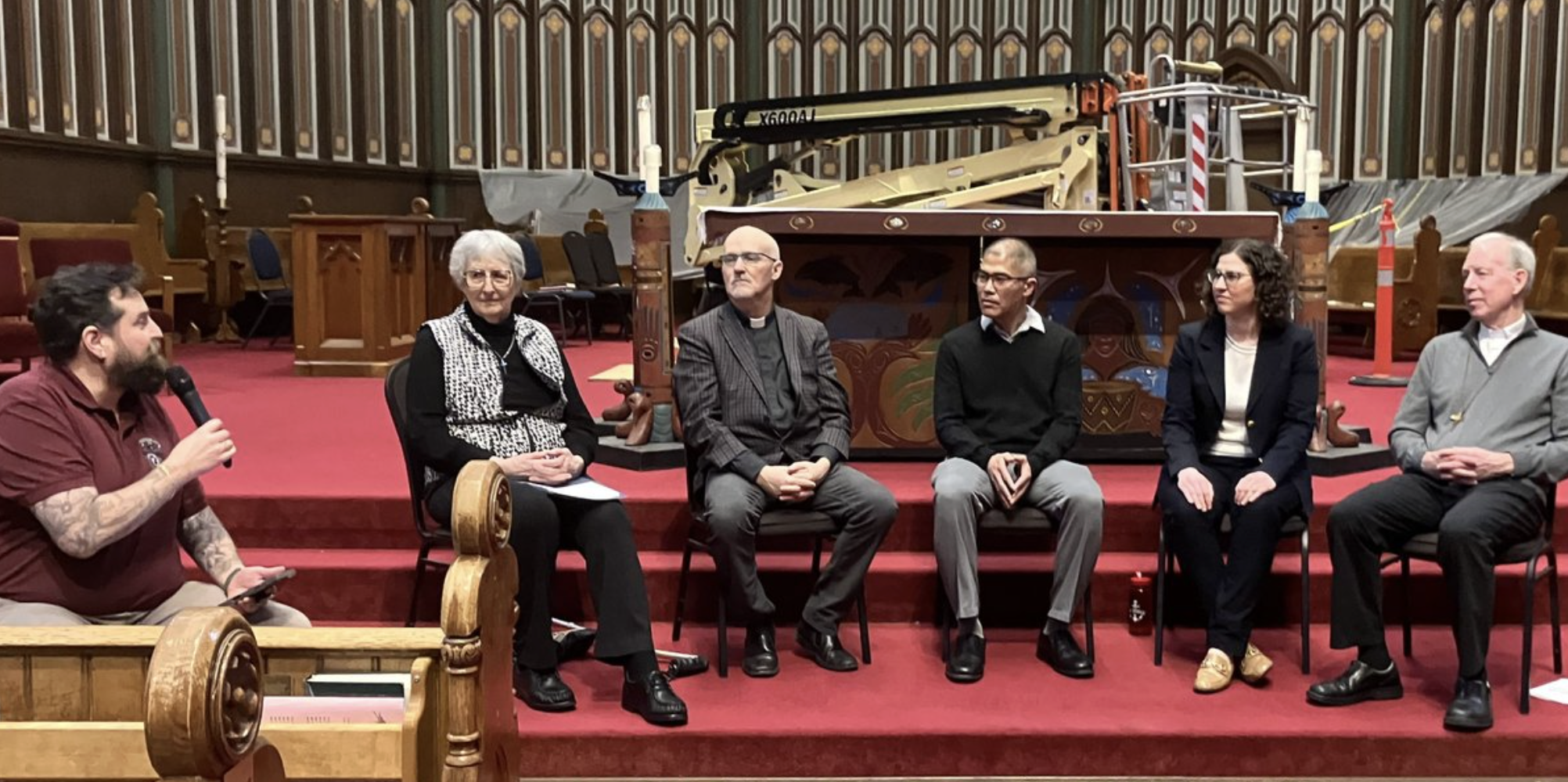
VICTORIA (CCN) — Amanda Achtman sets up her talk on MAiD in Canada with a story about a family who plan to move their elderly grandfather to a separate table at mealtime so they can eat undisturbed by his messiness.
The anti-euthanasia activist then asks a question that sheds light on the disturbing cultural shift that has happened in Canada since medicalized killing was legalized a decade ago: “Do the elderly have a seat at the table of our lives?”
It’s a question Achtman asks several times as she speaks to an audience at St. Andrew’s Catholic in Victoria, because it illustrates how far from its original limits Canada’s euthanasia regime has moved, changing the country’s attitudes about human worth, dependence, and suffering.
Achtman then makes a startling statement: “I am more personally concerned about fitting the government’s criteria that tells me I qualify for MAID than I am of getting any diagnosis, even a terminal diagnosis.”
Achtman traced the evolution of both policy and language — from “euthanasia” to “physician-assisted suicide” to “medical assistance in dying,” now shortened to MAiD — and said the rapid shift has softened public understanding of what is being done. “There’s an important distinction,” she said. Assisted suicide requires a person to self-administer a lethal substance. Euthanasia, which Canada allows, involves a physician or nurse delivering a lethal injection, a fact she said has contributed to MAiD’s rapid growth.
Initially legalized in 2016 for those whose deaths were “reasonably foreseeable,” MAiD has been expanded to include people with disabilities and, in 2027, potentially those suffering solely from mental illness. For Achtman, MAiD’s rapid trajectory results from the law itself and the message it conveys: once euthanasia is accepted as a response to suffering, pressure builds to make it available more broadly. “To be told that you qualify for a premature end to your life,” she said, “already deflates and defeats a person’s sense of self, sense of value.”
She pointed to federal reporting that shows leading reasons cited for MAiD include loss of meaning, loss of independence, and the inability to engage in activities that once gave life purpose, while physical pain is not among the top factors. Feelings of being a burden and experiences of grief and isolation also feature prominently. There is a deeper “cry of the heart” behind many requests rooted in loneliness and fear. She shared a specific story of a parent whose son sought hospital care not for treatment, but simply to talk to people.
Achtman notes a stark inconsistency in how society treats suicidal thoughts in young people versus the elderly. Younger people are met with prevention efforts, while older or seriously ill people may be offered assistance in dying. “Everybody deserves suicide prevention,” she said.
Achtman was joined by a panel of speakers who described how medicalized killing is shaping attitudes toward death. Father William Hann recounted his visit with a woman just three hours before her scheduled death. He arrived to find himself “shadowed” by a MAiD nurse and practitioners whose presence effectively prevented the traditional privacy of a priest’s final visit. He tried to attend to the woman’s obvious moral distress, which the medical team appeared blind to as they focused on preparing the technical procedure.
Dr. Felipe Adora, a family physician, shared his experience as his late mother suffered from a degenerative illness. At one point she asked him to help her die. “All I could say to her was I love her.” She continued to receive compassionate care from family and caregivers, and toward the end, she was no longer asking to die.
Sister Marie Zarowny, president of the Sisters of St. Ann, has worked with First Nations on Vancouver Island and noted the expanding of MAiD despite existing inequalities for Indigenous people who still face barriers to basic health care.
She pointed to a resolution from the Assembly of First Nations in late 2025 stating Indigenous voices were largely left out of MAiD policy development. She noted it risks building a “path to death” before there is a reliable path to care, reflecting a wider problem where MAiD can become a quick answer to deeper failures in care and support.
Closing the evening, Victoria Bishop Gary Gordon noted the crisis has become so widespread that the United Kingdom now has a “Minister of Loneliness” in its cabinet. Isolation has “infected our churches,” he said, sharing an email from a parishioner who had been sick for a month and received no visits other than from her atheist neighbor. “We no longer see our community as a vital way of living out our faith. It’s me and God in a personal relationship.”
He called the audience to “wear out our knees in prayer” even if not every effort turns out the way we want. He shared a 15-hour vigil he held in a family home, praying the Rosary in an attempt to dissuade a friend from choosing MAiD. The death was “very hurtful to the family” and difficult for him pastorally. “We are simply at the foot of the cross,” he said, calling the audience to respond to isolation with renewed, physical commitment to taking care of one another.
Achtman spoke at churches in Victoria, Duncan, Nanaimo, Sooke, Ladysmith, and Courtenay during her 10-day Tour of Hope at the invitation of Bishop Gordon and the Diocesan Healthcare Committee.