“Splashdown confirmed.”
With those words from NASA’s Mission Control came the end of a remarkable and historic 10‑day space mission, the likes of which arguably has not captivated the world since the heady days of the Apollo program, when man first—and last—walked on the moon.
For many, the moon landings are ancient history, happening before they were born. Others, like Senator Mark Kelly, a CNN commentator for the Artemis II mission and himself a storied Space Shuttle astronaut, were too young to remember those landings. He recounted, while viewers were waiting for the crew to be extracted from the Orion capsule, that his mother said he actually slept through Neil Armstrong’s historic first steps on the moon.
The Artemis mission did not include a moon landing. No moon rocks were brought back. Even so, it mesmerized many, perhaps because of the various superlatives frequently quoted in the extensive media coverage: the farthest any human has ventured from our home planet; the first astronauts to set eyes on certain parts of the so‑called dark side of the moon; the first astronauts to witness an eclipse while orbiting over that dark side; and the fastest speed ever achieved by humans, set just as re‑entry occurred into the home planet’s atmosphere.
There may well be additional superlatives as more data emerges from the mission. The four‑person astronaut crew will receive extensive post‑mission medical study. The return capsule will be subjected to particular scrutiny of its heat shield, an object of concern during the first Artemis mission when it was excessively ablated.
It is also worth noting that some of the superlatives repeated multiple times during mission media briefings were, in fact, a bit of hyperbole. Both the farthest‑distance and greatest‑speed metrics were only small incremental increases over those set by the Apollo missions in the 1960s and 1970s. Nonetheless, the Artemis mission has particularly captured the attention of students, some of whom may well become the first to live for an extended period somewhere other than on our home planet or in close orbit around it.
During the atmospheric return portion of the Artemis II mission, the tension was palpable not only for those in mission control but also for those watching from their homes. I, for one, was holding my breath for part of the six‑minute window during which Orion was subjected to maximum heating from the friction of re‑entry and was essentially surrounded by a plasma field that blocked any radio communication.
Here in Canada, we were proud to follow along with Canadian Space Agency astronaut Colonel Jeremy Hansen. Yes, we essentially bought a seat on the Artemis II flight by contributing more than $2 billion to the overall program, but Canada has a long history of space accomplishments.
Two of our best‑known astronauts, Roberta Bondar and Chris Hadfield, provided extensive commentary on the mission. Sadly, Canada’s first astronaut, Marc Garneau, passed away last year. Not only did he complete three missions on Space Shuttles, he subsequently served as president of the Canadian Space Agency before turning to politics as a Liberal MP and minister.
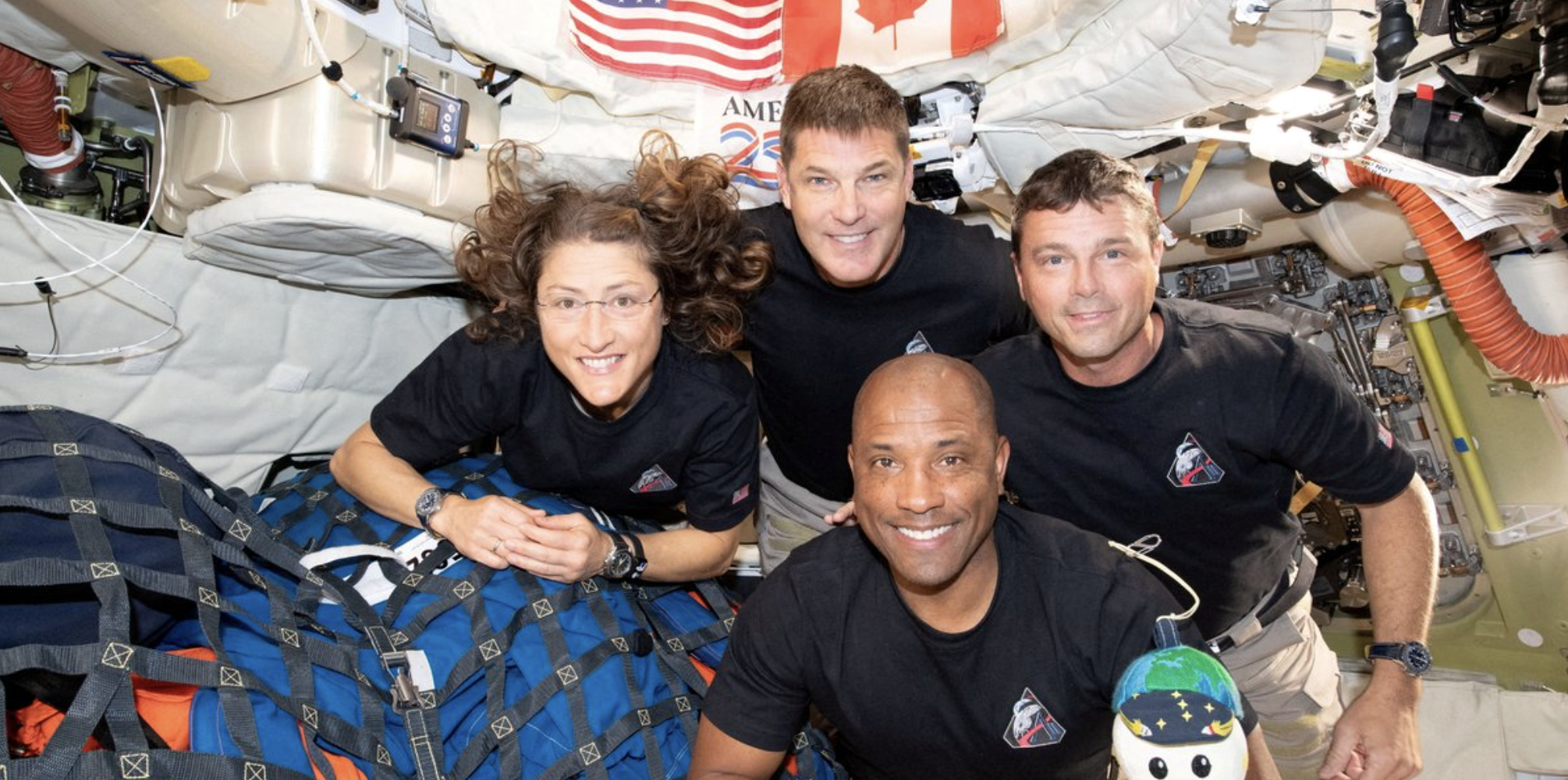
It is worth noting just how long Hansen has been waiting for this ride into space. All four members of the Orion crew are close to age 50, and all began astronaut training before they turned 40. Hansen, 50, was selected by the CSA in 2009, following a career as an RCAF CF‑18 pilot.
One of Hansen’s crewmates, Victor Glover, was asked in an interview with CBS News to reflect on being on the way to the moon while Easter was being celebrated back home.
“As we are so far from Earth and looking at the beauty of creation, I think, for me, one of the really important personal perspectives that I have up here is that I can really see the Earth as one thing,” Glover noted. “When I read the Bible and I look at all the amazing things that were done for us… you guys are talking to us because we’re in a spaceship really far from Earth, but you’re on a spaceship called Earth that was created to give us a place to live in the universe and the cosmos.”
Hansen also contributed to the CBS News reflection. “Happy Easter, everyone,” he said. “We’re talking up here as a crew, and we did want to send a special Easter message on this day. No matter your faith or religion, for me the teachings of Jesus were always a very simple truth of love—universal love.”
Perhaps these words, posted to Twitter/X by Artemis commander Reid Wiseman as he returned to shore from the recovery vessel, are a fitting bookend to the lunar mission: “On the helicopter leaving the ship right now. This planet is impossibly beautiful from every altitude I’ve seen it… surface to 250,000 miles.”