BAMENDA, Cameroon (CNS) — “The voices in the bushes.” That is the fear that defines daily life for many residents of this city in Cameroon’s troubled Anglophone region.
“You don’t know where they are,” Cajetan Nfor told Catholic News Service April 16. “You don’t know how many of them there are.” A resident of Bamenda since 1964, Nfor has witnessed firsthand the rapid decline of the city he calls home.
What began in 2016 as a political protest movement led by English-speaking teachers and lawyers over claims of professional and political marginalization by Cameroon’s French-speaking majority government quickly escalated into violence. Armed separatist groups emerged in the Anglophone regions, initially with some support from residents.
But as time went on, the movement shifted, and the separatist groups began terrorizing their own.
Armed groups began abducting civilians, looting businesses and enforcing their control through fear. Today, residents in northwest Cameroon say they live caught between separatist fighters and government forces, both capable of violence. Human Rights Watch estimated in 2024 that more than 6,000 civilians have died at the hands of both sides after a decade of conflict.
Thousands have been kidnapped, many killed, while others have been sexually assaulted, beaten and held for ransom.
Among them was Sister Carine Tangiri Mangu, a Sister of St. Anne, who told Pope Leo XIV during a community meeting April 16 that she and a priest were taken “into the bush” in November 2025 and held for three days.
They were denied food, water and sleep.
“We went on hunger strike and explained to our captors that we were just doing our work for the poor people and had nothing to do with the politics,” she said at the meeting, which included local representatives from different faiths and traditions. “They demanded us to give telephone numbers so that they could collect ransom.”
They prayed the rosary continuously, she said and were eventually freed after local Christians negotiated their release.
Other residents at the meeting with the pope shared similar accounts with Catholic News Service, describing abductions for ransom and beatings carried out while family members listened over the phone.
Anglophone separatist groups in Cameroon, which began fighting for independence of the country’s English-speaking regions, have increasingly turned to criminal activities to finance their rebellion, alongside a rise in violence against civilians. In the first half of 2024, the northwest region ranked as the second most dangerous administrative area for civilians in Africa, behind only Al-Jazirah state in central Sudan, according to the Armed Conflict Location & Event Data Project.
In addition to their fear of the separatists, many residents fear suspected reprisals from the military. Twice in the span of a week last month, Nfor said he woke up to gunshots on his street. Both times, he stepped outside to find the corpses of two residents sprawled on the road, roughly 500 meters from his home.
His road, he said, has become a “dumping ground,” where heavy rains can wash the corpses away. He believes those killed were victims of “regular enforcements of law and order.” Human Rights Watch reported in 2024 that the military has been known to target local civilians outright.
Before the crisis, he remembers a very different Bamenda — a vibrant city of 630,000, where this kind of fear did not linger.
“You can imagine a river, just rumbling slowly going, and you are on a boat enjoying the ripples,” Nfor said. “That was the kind of life that was here.”
That life has completely disappeared.
Once one of the country’s most economically active cities, Bamenda has been hollowed out by years of conflict. Business owners have fled after repeated looting and abductions. Farmers struggle to work their land for fear of abduction and killings. Roads are dangerous as separatists have strongholds along major routes, and goods rarely move freely.
Food prices have soared, and access to medical care is limited as the region has become increasingly cut off.
“No one stays out after 7 p.m.,” Nfor said. “If you are still hanging out and you don’t have transport… it becomes impossible.”
Even short journeys have become ordeals. Trips that once took a few hours can now take up to half a day, as drivers avoid conflict zones.
For Joseph Kitu, the violence has made returning to his home village impossible.
“For the past ten years, our lives have been miserable,” he told CNS while waiting for the pope to arrive at the community meeting. “We have lost relatives. They burned homes, looted our properties. I’m an orphan. My parents have all died because of this.”
As soon as Pope Leo arrived in war-torn Cameroon April 15, he did not shy away from bringing a message of peace that directly confronted the suffering the people face every day.
In clear, direct language, the pope spent his time in Cameroon denouncing violence, corruption and exploitation, while calling for reconciliation and credible leadership. He has repeatedly framed peace not as an abstract ideal, but as a responsibility shared by political leaders, communities and individuals alike.
When addressing the diplomatic corps in his first stop to Cameroon, he urged leaders to move beyond paralysis and fear.
“We are living at a time when hopelessness is rampant and a sense of powerlessness tends to paralyze the renewal so deeply desired by peoples,” he said in Yaoundé at the presidential palace April 15. “There is such a hunger and thirst for justice! A thirst for getting involved, for a vision, for courageous choices and for peace!”
The pope began his call for peace in the country during an address to the diplomatic corps and 93-year-old President Paul Biya, who has been in power since 1982 and whose long rule has drawn criticism from opposition figures and human rights groups. Quoting his spiritual father, St. Augustine, the pope said the saint believed those who rule should do so to serve the people, and they should rule “not from a love of power, but from a sense of the duty they owe others.”
“From this perspective, serving one’s country means dedicating oneself, with a clear mind and an upright conscience, to the common good of all people in the nation,” he said.
Throughout this leg of his apostolic journey, which covered hundreds of miles and three cities, Pope Leo condemned what he described as a global system that fuels conflict for gain. After residents described fear, loss and exhaustion during the April 16 meeting, the pope acknowledged both the violence within the country and the forces beyond it that have deepened the crisis.
“The masters of war pretend not to know that it takes only a moment to destroy, yet often a lifetime is not enough to rebuild,” he said during the community meeting in Bamenda. “Those who rob your land of its resources generally invest much of the profit in weapons, thus perpetuating an endless cycle of destabilization and death.”
“Added to these internal problems which are often fueled by hatred and violence, is the damage caused from outside, by those who, in the name of profit, continue to lay their hands on the African continent to exploit and plunder it,” Pope Leo said later April 16 in a homily during Mass at the Bamenda International Airport to an estimated crowd of 20,000.
The depletion of a land rich in resources and marked by suffering was a theme the pope returned to repeatedly.
“It is a world turned upside down, an exploitation of God’s creation that must be denounced and rejected by every honest conscience,” the pope said at the community meeting, describing the exploitation of both people and land. “The world is being ravaged by a handful of tyrants, yet it is held together by a multitude of supportive brothers and sisters!”
That is how he urged Cameroonians not to give in to resignation after years of violence — by working together and serving one another no matter what.
“This is the moment to change, to transform the story of this country,” Pope Leo said in his homily in Bamenda. “The time has come — today and not tomorrow, now and not in the future.”
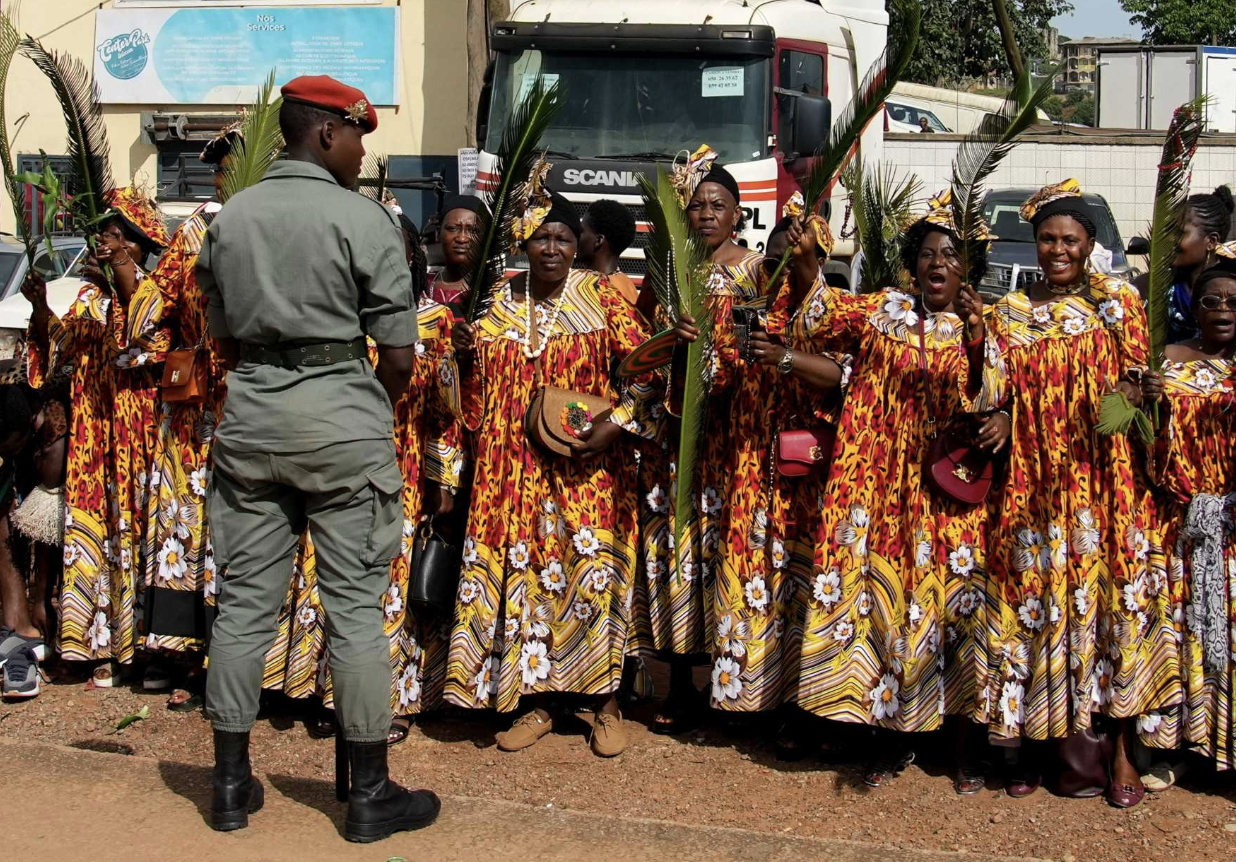
His presence alone has already had an effect on the Anglophone region of Cameroon. After years of neglect, Bamenda’s airport was repaired ahead of the papal visit, and the main road into the city was completed, making travel easier for residents, some locals told Catholic News Service.
Religious leaders in the region have begun pushing for dialogue between the government and separatist groups, describing the conflict as one of the world’s “forgotten crises.” Reverend Fonki Samuel Forba of the Presbyterian Church said the Vatican has shown willingness to support mediation efforts.
At a community meeting, Archbishop Andrew Nkea Fuanya of Bamenda told the pope that his visit came at a critical moment, saying that the soil of Bamenda has “drunk the blood of many of our children.”
“Bamenda will never forget that you visited them and prayed for them, and more especially, you visited them when they needed you most,” Archbishop Fuanya said following the pope’s homily at Mass at the airport.
For many residents, however, the path to peace is complicated by the realities on the ground. Years of instability have created incentives for young fighters to remain in armed groups.
“How would you watch somebody who made $5 or $2 a week and then suddenly he is earning $200 a day?” Nfor said. “How do you want him to leave his gun?”
The pope addressed that reality directly, especially in his appeal to young people — the very group most vulnerable to recruitment into armed groups.
“Dear young people … Be the first faces and hands that bring the bread of life to your neighbours, providing them with the food of wisdom and deliverance from all that does not nourish them, but rather obscures good desires and robs them of their dignity,” he said during a Mass April 17 outside the Japona Stadium in Douala to a crowd of more than 120,000. “Do not let yourselves be corrupted by temptations that waste your energies and do not serve the progress of society.”
Pope Leo urged them to see their future not in violence or quick profit, but in rebuilding their communities.
“Do not forget that your people are even richer than this land, for your treasure lies in your values: faith, family, hospitality and work,” he said at the outdoor Mass. He called on them especially to “proclaim the Gospel unceasingly.”
In a speech at the Catholic University of Central Africa in Duoala, Pope Leo continued this concept, saying that in order for change to occur, students need to lean into moral discernment.
“No society, in fact, can flourish unless it is grounded in upright consciences, formed in the truth,” he said to professors and students April 17. “Do not look the other way: this is a service to the truth and to all humanity.”
Many told CNS the pope’s visit has rekindled hope.
Jeneth Moki said she has lived through years of what she called “sad patience,” watching friends and family members die while fearing for her own safety.
“If I go [to my village], I will not come back,” Moki said ahead of the April 16 community meeting. “They’re going to abduct me.”
The pope himself seemed to recognize both the pain and resilience of the people before him.
“How beautiful are your feet as well, dusty from this bloodstained yet fertile land that has been mistreated yet is rich in vegetation and fruit,” he said during the community meeting. “Your feet have brought you this far, and despite the difficulties and obstacles, they have remained on the path of goodness.”
Addressing those who have endured years of suffering, Pope Leo said: “Bamenda, today you are the city on the hill, resplendent in the eyes of all! Sisters and brothers, be the salt that continuously gives flavour to this land. Do not lose your flavour, even in the years to come!”
The people at that meeting echoed that optimism. Regina Anchang said some people traveled for hours, days in advance, just to be present for the visit. Out of the entire world, she said, their community feels seen.
“We need nothing more than peace,” she said.
Again and again, the pope framed peace not simply as the absence of violence, but as something built through concrete acts of solidarity.
“There is bread for everyone if it is taken, not with a hand that snatches away, but with a hand that gives,” Pope Leo said during his homily in Douala, urging both leaders and the community to reject exploitation and choose mutual responsibility.
Each act of solidarity, he said, becomes “a morsel of bread for humanity in need of care,” but there also needs to be more.
“This alone is not enough: the food that sustains the body must be accompanied, with equal charity, by nourishment for the soul — a nourishment that sustains our conscience and steadies us in dark hours of fear and amid the shadows of suffering,” the pope said in Douala.
But translating that call for peace into reality for a country shaped by years of violence and distrust remains a challenge.
Vice president of Cameroon’s national bishops’ conference, Bishop Philippe Alain Mbarga of Ebolowa, cautioned that the pope’s visit is not a “magic wand,” and that the “walls of tribalism, the walls of hate,” must be torn down.
“The people are calling on us to be responsible, to recognize that the destiny of humanity, of the country, is entrusted to us,” he said in an interview with Catholic News Service. “They have called on political leaders, religious leaders and civil society to be responsible. Therefore, it is up to each of us to be aware of what is at stake.”
Archbishop Fuanya told Pope Leo that the people “shall not waste the chance that your presence offers us to continue to work for peace and justice and reconciliation.”
For now, residents return to their routines — navigating danger and weighing hope against experience. In Bamenda, the voices in the bushes have not disappeared.
But amid the fear, another voice, the successor of Peter, has broken through — one insisting that even here, in a place marked by violence, peace can still be chosen.