

The women who wept along the road to Calvary, moved by what they saw, were unable to remain untouched by the suffering unfolding before them. And yet, in a moment that has always seemed slightly out of place, Jesus turns to them and says, “Do not weep for me.”
It is a strange response. Not dismissive, but redirecting. As if to suggest that there is a way of seeing His suffering that does not yet reach its depth.
They see Him. They are moved. But they do not follow Him to the end.
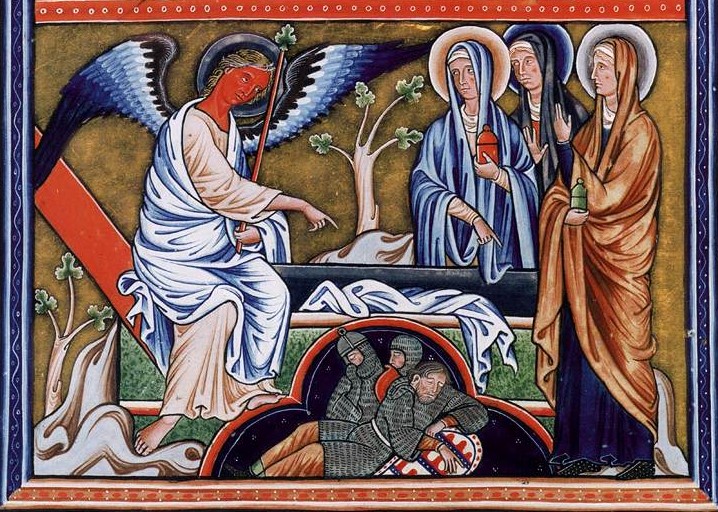
A few days later, another group of women makes its way to a different place — not along a road, but toward a tomb.
They carry myrrh — not for hope, but for burial. They go not to witness something, but because they cannot not go.
They know what has happened. They are not going to find a miracle. They go because love, once given, does not easily withdraw itself.
This is a different kind of fidelity. It is not driven by certainty. It does not rest on understanding. It does not calculate outcomes. It remains.
Unlike the month just passed, when much is said about the place and voice of women in our world, the Gospel offers something quieter, and perhaps more enduring. When the structures fail, when the disciples scatter, when expectation collapses, it is these women who return. Not because they know what will happen. But because they do not need to know. Their love has already passed beyond that.
We often imagine faith as clarity — the assurance that what we believe will be confirmed. There are moments when such assurance is given, but most of the time, we live otherwise.
We live, as the apostle says, “through a glass, darkly.” We see enough to begin. Enough to continue. But not enough to secure ourselves against doubt, loss or silence.
And so faith begins to look less like certainty and more like fidelity. Less like knowing, and more like remaining.
The myrrh-bearers do not go to the tomb because they are certain of the Resurrection. They go because their love no longer depends on the outcome. They go because the one they believe is the Son of God has been placed in a tomb — and even that does not end the relationship.
Love, at this point, has nothing left to gain. And yet, it goes.
This is what makes what follows so striking — it is to them that the Resurrection is first revealed.
Not to those who understood. Not to those who remained certain. Not even to those who hoped. But to those who came anyway.
The stone is already rolled away. The body is gone. The message is given. And the world, which had gone on as though nothing had happened, is quietly, irrevocably changed.
It is tempting to read this as reward — as though their faithfulness earned this privilege. But the Gospel does not present it that way.
It is gift. They are able to receive what is given because they have not come to confirm anything. They have come because love has carried them there.
And so they are not required to let go of certainty. They are asked only to receive what they did not expect. And now we are left with questions that do not belong to them alone: Do we see ourselves in them? What do they do now? What do we do now?
Lent is over. The Triduum has passed. The tomb has been opened. But is Easter something we have completed — or something we have only begun? Do we return to what we understand, what we can manage, what we can explain? Or do we accept that faith will always carry uncertainty and yet continue — drawn not by clarity, but by love that has passed through death and yet lives?
Easter does not remove that tension. It transforms it.
And perhaps the task now is not to resolve it, but to live within it — to go, as they went, into a world that continues as though nothing has happened, and yet has been irrevocably changed.
Easter, then, is not first entrusted to certainty. It is entrusted to love that remains. Love that does not require assurance. Love that does not withdraw when the outcome is no longer favorable. Love that continues, even when there is nothing left to see.
This is not a lesser faith. It may be the only kind that endures. And it may be the only kind capable of receiving what God gives.



Beautifully written!