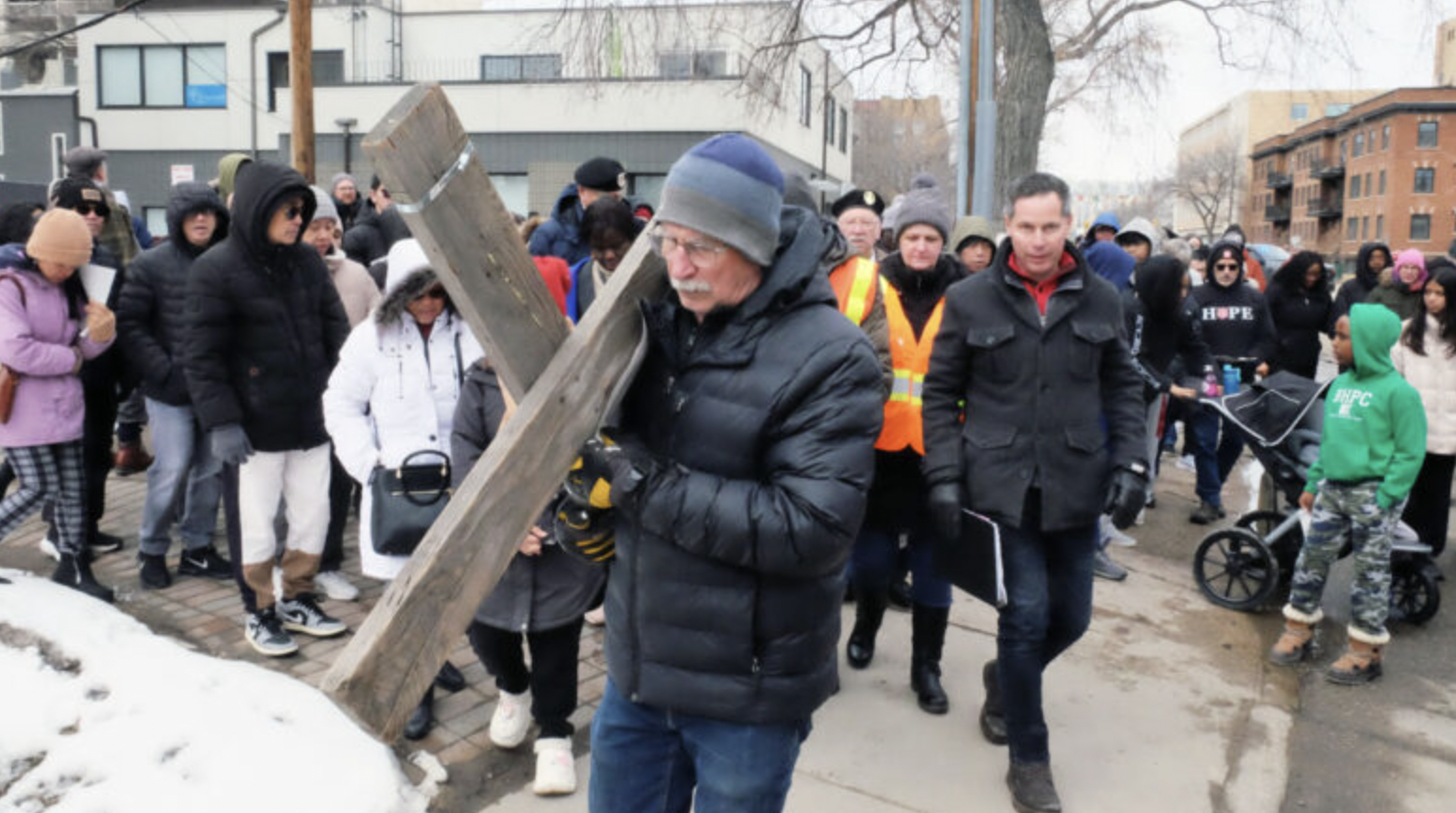
SASKATOON, Sask. (CCN) — Pilgrims of all ages and from many backgrounds followed the cross through Saskatoon’s downtown on Good Friday morning, praying and singing together, and recalling the passion and death of Jesus Christ in light of suffering, injustice, and issues in our world today.
The 25th outdoor Way of the Cross organized by the Roman Catholic Diocese of Saskatoon Justice and Peace Office again followed the 14 stations of the scriptural Way of the Cross introduced by St. John Paul II during his pontificate.
The theme of the 2026 event was “One human family,” said organizer Myron Rogal of the diocesan office introducing the annual Good Friday prayer walk.
Representatives of Our Lady of Guadalupe Indigenous Catholic Parish offered an opening prayer on the steps of the Court of Kings Bench building, with Elder Irene Sharp accepting a gift of tobacco from Rogal and beginning with prayer in her language, alongside Parish Life Director Ferdinand Gomez and parishioner Sandra Harper.
The prayer continued:
“Lord, we thank You for the gift of this land— for its beauty, its resources, and the lives it sustains. Grant us hearts of respect, justice, and reconciliation, that we may walk together in truth and charity, honouring the dignity of every person and seeking unity in the Body of Christ… help us to unite our prayers with the suffering of Your Son and Our Lord Jesus Christ, who walked in love, bore injustice, and offered His life for all. May His journey strengthen us to carry our own crosses, to seek healing where there is hurt, and to be instruments of Your peace.”
Solidarity in times of trial was the theme of the reflection on the first station — Jesus on the Mount of Olives (Luke 22:39-46) led by Michael and Julie LeBlanc on behalf of Development and Peace – Caritas Canada.
The LeBlancs reflected on the suffering of those in the Amazon rainforest whose communities are being devastated by an 892-km railway from the world’s largest iron-oxide mine.
“They, and all those living in so-called ‘Sacrifice Zones’ in the Global South, are suffering from poverty, climate change, and false solutions while justice sleeps in places of power. Their lives are at stake while we sleep in security.”
Tyrone McKenzie, Lead Chaplain with the Salvation Army carried the cross to the second station — Jesus, betrayed by Judas, is arrested (Luke 22:47-48) — leading a reflection about betrayal faced by those stricken by material poverty.
“As the Scripture says, if we have material possessions and see our brother in need, will we open our hearts to them? If not, how can the love of God be in us? This can be seen as betrayal,” McKenzie said.
“At The Salvation Army men’s shelter we see all kinds of poverty. Poverty of resources, relationships, mental and emotional health. This January, one young man lost his mom, his job and his home in the same month, and then lost his cousin to murder just over two weeks ago. Our staff are taking responsibility to provide a wealth of support, encouragement and prayer. Our core values of hope, service, dignity and stewardship guide us in relationship to the poor.”
He prayed: “May we have courage instead of cowardice. May we listen to Your voice and be encouraged in our generosity, devotion, faithfulness, honesty and love. As Isaiah challenges us, may we know what true fasting is – to share our food with the hungry, and give shelter to the homeless. Give clothes to those who need them, and to not hide from relatives who need our help. As Christ has commanded us, may we love our neighbour as ourselves and when we have done it unto the least of these brothers and sisters, be flooded with the truth that we have done it unto You Lord Jesus Christ. May we not close our fists or cross our arms, but may we like Christ on the cross, pour out our lives for those in front of us with hands and arms wide open to the world.”
Representatives of the Catholic Women’s League led the reflection and prayer at the third station — Jesus is condemned by the Sanhedrin (Luke 22:66-71) — focusing on the scourge of human trafficking.
“Jesus was judged and condemned despite having committed no crime. Similarly, individuals affected by human trafficking are often judged by society and blamed for their circumstances. Survivors and their families are frequently viewed as problems rather than people in need of support, while human traffickers often avoid prosecution,” said Donna Aldous, standing with Anne Ashcroft and Val Stone, who are among the CWL members working to raise awareness about human trafficking.
“The Church is called to welcome those who have experienced human trafficking into our hearts, our homes, and our communities, as we would welcome Christ himself. We must also raise our collective voice to ensure there are sufficient resources in our community to provide safe housing, effective programs, and ongoing support.”
Offering meaningful support to victims through advocacy to political represenatives, and providing financial help for organizations delivering frontline services are among the ways to help, said the CWL representatives.
“Open our hearts to provide the love and support to individuals and families experiencing human trafficking. Remind us that You were at times not believed during Your life on this earth. Let us pray for those who face human trafficking today who are also not believed and, as a result, are trapped in their situation. We pray they receive assistance as they look for it.”
At the fourth station — Peter denies Jesus (Luke 22:54-62) — Charlene Genkens reflected on the call to accompany those who are sick or dying.
The representative of hospital chaplaincy in the Roman Catholic Diocese of Saskatoon said that “accompaniment and care is a Christ-centred approach where we walk alongside others during times of illness, doubt, and suffering. We provide emotional, physical, and spiritual support to our brothers and sisters in the community.”
She described:: “Daily acts of love are present in time spent in prayer together; being present with the sick; the lonely, those facing medical challenges, walking beside those in palliative care, and visits with the home-bound.”
Krista-Dawn Kimsey, Community Engagement Specialist at The Mustard Seed, led the reflection and prayer at the fifth station — Jesus is judged by Pilate (Luke 23:13-25) — focusing on poverty.
Like Pilate, “we often know what is right but hesitate because we worry about how others will react,” she said. “People experiencing poverty or homelessness are often treated differently depending on who we are with. When we’re surrounded by like-minded people, we act with kindness and courage, showing empathy and generosity. But when we’re alone or with those who don’t share those values, we may ignore the same people we once helped.”
She prayed: “Lord you taught us that you will be found in our cities in the hungry, the thirsty, the naked and those in need of shelter. Help us to serve you and speak about you as you are found in this distressing disguise to others. Give us courage to always align our words and actions with the steadfast mercy you have poured out on us.”
Hannah Enti-Brown of the diocesan Office of Migration carried the cross to the sixth station — Jesus is scourged and crowned with thorns (Luke 22:63-65, John 19:2-3) — where she and other advocates reflected on how newcomers to Canada are seen as outsiders to be mocked.
“As one human family, we are called to recognize Christ in all who are shamed, excluded, or denied their dignity. Jesus knows the pain of humiliation. He stands with those who are mocked at borders, silenced by fear, or looked upon with suspicion instead of compassion. His crown of thorns reminds us that suffering caused by human cruelty still continues in our world. May this station open our eyes and hearts, so that we do not add to the suffering of others, but instead choose welcome, mercy, and justice.”
Lisa Hrycan, the Debt Centre Manager for Christians Against Poverty carried the cross to the seventh station — Jesus takes up the cross, (Mark 15:20).
“At Christians Against Poverty we walk with people who are overwhelmed by debt to find a way forward that is positive for them. We advocate with creditors and support those who are struggling to gain control of their situation and feel confident about managing their money,” she described. “We help carry the burdens and hurts and introduce people to Jesus with our words and actions.”
She then prayed: “Inspire us to act—to share what we have, speak for those unheard, and walk alongside our neighbours with justice and compassion. May we carry this cross not with pity, but with purpose.”
Jayson and Riah Sta Maria of Feast Light Saskatoon led the reflection at the eighth station — Simon of Cyrene helps Jesus to carry his cross, (Luke 23:26).
“Simon of Cyrene did not choose this moment. He was simply passing by when the soldiers pressed him into service, placing the cross on his shoulders. Yet in that unexpected act, he entered a sacred mystery: he shared in the suffering of Christ,” said Riah.
“This is what it means to belong to a spiritual community. It is not built on power or status, but on love that shares burdens. The Church is more than a place to pray—it is a family walking together toward Calvary,” she said.
“When one struggles in faith, others keep the light burning. When someone feels lost, weary, or weak, we offer support, encouragement, and presence. When a burden grows too heavy, we step forward to help carry it. In these acts of compassion, we become like Simon—sharing Christ’s suffering, participating in the redemptive love that transforms pain into hope, and building a community where no one walks alone.”
Members of the Saskatoon African-Canadian Catholic Community carried the cross to the ninth station — Jesus meets the women of Jerusalem, (Luke 23:27-31).
Samuel Obiora Agu led a reflection about extending empathy and solidarity beyond our comfortable circles.
“Jesus invites us to widen our compassion. How do we respond to the vulnerable, the poor, the needy, and new immigrants in our communities? Do we notice them? Do we listen? Do we make space for them to belong?”
He added: “True empathy goes beyond words. It is shown in simple actions—welcoming others, listening with care, sharing what we have, and walking with people in their struggles. Even in His suffering, Jesus cared for others. He calls us to do the same: to see, to care, and to act.”
Heather Peters, Peacebuilding Coordinator with the Mennonite Central Committee (MCC) Saskatchewan carried the cross to the tenth station — Jesus is crucified, (Luke 23:33,47) — where she reflected how domestic violence victims share in the cross of Christ.
“In our work with people who have experienced domestic violence, we sit with women who describe a similar sense of being held down or confined – not always by physical restraint, but by fear, control, financial dependence, and threats that limit every decision. Their worlds grow small as options disappear. What should be ordinary choices – where to go, who to see, what to spend – become calculations of what will cause the least amount of harm,” she said.
“Violence couldn’t erase who Jesus was. Likewise, the women we accompany are not defined by the harm they’ve endured. In the support groups we offer, in the gentle conversations around a circle, we see dignity and strength. We witness courage flourish.”
Representatives of the Prairie Centre for Ecumenism (PCE) led the reflection and prayer at the eleventh station — Jesus promises his Kingdom to the good thief, (Luke 23:33-34,39-43).
“Nothing can separate us from the love of God: the courageous call to Christian unity,” said PCE Chair Mary Nordick.
“At our baptism we became members of Jesus’ one family. Jesus founded his Church in unity and we in our human pride, ignorance, and sin have fractured that unity over the centuries. Like the Good Thief on the cross, we need to own our wrongdoing and call on our merciful Lord to remember us,” she said.
“Jesus did remember the good thief, and Jesus does remember us. The path He sets before us calls us to come to know our brothers and sisters in Christ, to work with each other wherever possible to counter injustice and relieve suffering, to reconcile past offenses, to learn to dialogue in hope and trust about our differences, and to pray together wherever and whenever possible. We ask Our loving Savior to give us the courage to answer the call to Christian Unity with faith, love, action, and resurrection hope.”
Rev. Sandra Beardsall then prayed: “Lead us in love to encounter our separated sisters and brothers in Christ, recognizing your Presence in each and every one of us and opening our hearts to receive the ecumenical gifts that each denomination has to offer.”
“Extending family through the cross” was the theme of the reflection at the twelfth station — Jesus on the cross, his mother and his disciple, (John 19:25b-27) — presented by Lynn Chotowetz Executive Director of Sons & Daughters. The organization mobilizes local church communities to serve and support families caring for children in the child welfare system, including Foster Parents, Kinship Caregivers, and Birth Parents reuniting.
“In our child welfare system, we have 6,000 children who’ve been removed from their homes and 1,600 of them are living in institutions, mostly professional group homes. These children have not been placed in a family because there wasn’t a family open to them. The consequences of a child being excluded from a family are devastating and feed cycles of inter-generational family breakdown and trauma,” he said.
“This is not acceptable. It is not acceptable to God. Psalm 68 tells us that a key piece of God’s work is to set the lonely into families. This is also a key work of the church.”
Members of the Saskatoon Knights of Columbus D’Arcy McGee Fourth Degree Assembly carried the cross and stood at attention during a time of silence at the thirteenth station — Jesus dies on the cross, (Luke 23:44-46).
Anglican Bishop Chad McCharles and Roman Catholic Bishop Mark Hagemoen carried the cross to the last station — Jesus is placed in the tomb, (Luke 23:50-54).
“Jesus dies as so many before and since, at the hand of others who oppress, exploit, and consume. His suffering is our suffering, for he takes upon himself the suffering of all, and he shares the fate of all humanity, to die and be placed in a cold dark tomb. Christian tradition holds that Jesus’ death was a true death, and that he descends into hell with all the souls of the dead. But in fulfillment of the prophets, he is raised again from the dead, and he breaks the chains of bondage, releasing those enslaved by sin, rescuing those who suffer injustice, restoring all creation, and reconciling all people,” said Bishop McCharles.
“So Jesus’ story does not end here, in the tomb of Good Friday. Our story does not end in tragedy and despair. We need not flee like the disciples in fear for the future, because we know as people of faith that Jesus will rise from this tomb, and so we live in faith and hope that we too will rise with Christ on the last day.”
Bishop Hagemoen continued: “Let us pray for all who suffer: for the hungry and the homeless, the deprived and the oppressed, for the sick, the wounded, and the handicapped, for those in loneliness and in fear, for those in confusion, doubt, and despair, for the sorrowful and bereaved, for prisoners, and all at the point of death, that God’s love will comfort and sustain them, and that we may be stirred up to minister to them.”
The two Saskatoon bishops then led all those assembled in praying the Lord’s prayer, before praying a final blessing.Pilgrims of all ages and from many backgrounds followed the cross through Saskatoon’s downtown on Good Friday morning, praying and singing together, and recalling the passion and death of Jesus Christ in light of suffering, injustice, and issues in our world today.
The 25th outdoor Way of the Cross organized by the Roman Catholic Diocese of Saskatoon Justice and Peace Office again followed the 14 stations of the scriptural Way of the Cross introduced by St. John Paul II during his pontificate.
The theme of the 2026 event was “One human family,” said organizer Myron Rogal of the diocesan office introducing the annual Good Friday prayer walk.
Representatives of Our Lady of Guadalupe Indigenous Catholic Parish offered an opening prayer on the steps of the Court of Kings Bench building, with Elder Irene Sharp accepting a gift of tobacco from Rogal and beginning with prayer in her language, alongside Parish Life Director Ferdinand Gomez and parishioner Sandra Harper.
The prayer continued:
“Lord, we thank You for the gift of this land— for its beauty, its resources, and the lives it sustains. Grant us hearts of respect, justice, and reconciliation, that we may walk together in truth and charity, honouring the dignity of every person and seeking unity in the Body of Christ… help us to unite our prayers with the suffering of Your Son and Our Lord Jesus Christ, who walked in love, bore injustice, and offered His life for all. May His journey strengthen us to carry our own crosses, to seek healing where there is hurt, and to be instruments of Your peace.”
Solidarity in times of trial was the theme of the reflection on the first station — Jesus on the Mount of Olives (Luke 22:39-46) led by Michael and Julie LeBlanc on behalf of Development and Peace – Caritas Canada.
The LeBlancs reflected on the suffering of those in the Amazon rainforest whose communities are being devastated by an 892-km railway from the world’s largest iron-oxide mine.
“They, and all those living in so-called ‘Sacrifice Zones’ in the Global South, are suffering from poverty, climate change, and false solutions while justice sleeps in places of power. Their lives are at stake while we sleep in security.”
Tyrone McKenzie, Lead Chaplain with the Salvation Army carried the cross to the second station — Jesus, betrayed by Judas, is arrested (Luke 22:47-48) — leading a reflection about betrayal faced by those stricken by material poverty.
“As the Scripture says, if we have material possessions and see our brother in need, will we open our hearts to them? If not, how can the love of God be in us? This can be seen as betrayal,” McKenzie said.
“At The Salvation Army men’s shelter we see all kinds of poverty. Poverty of resources, relationships, mental and emotional health. This January, one young man lost his mom, his job and his home in the same month, and then lost his cousin to murder just over two weeks ago. Our staff are taking responsibility to provide a wealth of support, encouragement and prayer. Our core values of hope, service, dignity and stewardship guide us in relationship to the poor.”
He prayed: “May we have courage instead of cowardice. May we listen to Your voice and be encouraged in our generosity, devotion, faithfulness, honesty and love. As Isaiah challenges us, may we know what true fasting is – to share our food with the hungry, and give shelter to the homeless. Give clothes to those who need them, and to not hide from relatives who need our help. As Christ has commanded us, may we love our neighbour as ourselves and when we have done it unto the least of these brothers and sisters, be flooded with the truth that we have done it unto You Lord Jesus Christ. May we not close our fists or cross our arms, but may we like Christ on the cross, pour out our lives for those in front of us with hands and arms wide open to the world.”
Representatives of the Catholic Women’s League led the reflection and prayer at the third station — Jesus is condemned by the Sanhedrin (Luke 22:66-71) — focusing on the scourge of human trafficking.
“Jesus was judged and condemned despite having committed no crime. Similarly, individuals affected by human trafficking are often judged by society and blamed for their circumstances. Survivors and their families are frequently viewed as problems rather than people in need of support, while human traffickers often avoid prosecution,” said Donna Aldous, standing with Anne Ashcroft and Val Stone, who are among the CWL members working to raise awareness about human trafficking.
“The Church is called to welcome those who have experienced human trafficking into our hearts, our homes, and our communities, as we would welcome Christ himself. We must also raise our collective voice to ensure there are sufficient resources in our community to provide safe housing, effective programs, and ongoing support.”
Offering meaningful support to victims through advocacy to political represenatives, and providing financial help for organizations delivering frontline services are among the ways to help, said the CWL representatives.
“Open our hearts to provide the love and support to individuals and families experiencing human trafficking. Remind us that You were at times not believed during Your life on this earth. Let us pray for those who face human trafficking today who are also not believed and, as a result, are trapped in their situation. We pray they receive assistance as they look for it.”
At the fourth station — Peter denies Jesus (Luke 22:54-62) — Charlene Genkens reflected on the call to accompany those who are sick or dying.
The representative of hospital chaplaincy in the Roman Catholic Diocese of Saskatoon said that “accompaniment and care is a Christ-centred approach where we walk alongside others during times of illness, doubt, and suffering. We provide emotional, physical, and spiritual support to our brothers and sisters in the community.”
She described:: “Daily acts of love are present in time spent in prayer together; being present with the sick; the lonely, those facing medical challenges, walking beside those in palliative care, and visits with the home-bound.”
Krista-Dawn Kimsey, Community Engagement Specialist at The Mustard Seed, led the reflection and prayer at the fifth station — Jesus is judged by Pilate (Luke 23:13-25) — focusing on poverty.
Like Pilate, “we often know what is right but hesitate because we worry about how others will react,” she said. “People experiencing poverty or homelessness are often treated differently depending on who we are with. When we’re surrounded by like-minded people, we act with kindness and courage, showing empathy and generosity. But when we’re alone or with those who don’t share those values, we may ignore the same people we once helped.”
She prayed: “Lord you taught us that you will be found in our cities in the hungry, the thirsty, the naked and those in need of shelter. Help us to serve you and speak about you as you are found in this distressing disguise to others. Give us courage to always align our words and actions with the steadfast mercy you have poured out on us.”
Hannah Enti-Brown of the diocesan Office of Migration carried the cross to the sixth station — Jesus is scourged and crowned with thorns (Luke 22:63-65, John 19:2-3) — where she and other advocates reflected on how newcomers to Canada are seen as outsiders to be mocked.
“As one human family, we are called to recognize Christ in all who are shamed, excluded, or denied their dignity. Jesus knows the pain of humiliation. He stands with those who are mocked at borders, silenced by fear, or looked upon with suspicion instead of compassion. His crown of thorns reminds us that suffering caused by human cruelty still continues in our world. May this station open our eyes and hearts, so that we do not add to the suffering of others, but instead choose welcome, mercy, and justice.”
Lisa Hrycan, the Debt Centre Manager for Christians Against Poverty carried the cross to the seventh station — Jesus takes up the cross, (Mark 15:20).
“At Christians Against Poverty we walk with people who are overwhelmed by debt to find a way forward that is positive for them. We advocate with creditors and support those who are struggling to gain control of their situation and feel confident about managing their money,” she described. “We help carry the burdens and hurts and introduce people to Jesus with our words and actions.”
She then prayed: “Inspire us to act—to share what we have, speak for those unheard, and walk alongside our neighbours with justice and compassion. May we carry this cross not with pity, but with purpose.”
Jayson and Riah Sta Maria of Feast Light Saskatoon led the reflection at the eighth station — Simon of Cyrene helps Jesus to carry his cross, (Luke 23:26).
“Simon of Cyrene did not choose this moment. He was simply passing by when the soldiers pressed him into service, placing the cross on his shoulders. Yet in that unexpected act, he entered a sacred mystery: he shared in the suffering of Christ,” said Riah.
“This is what it means to belong to a spiritual community. It is not built on power or status, but on love that shares burdens. The Church is more than a place to pray—it is a family walking together toward Calvary,” she said.
“When one struggles in faith, others keep the light burning. When someone feels lost, weary, or weak, we offer support, encouragement, and presence. When a burden grows too heavy, we step forward to help carry it. In these acts of compassion, we become like Simon—sharing Christ’s suffering, participating in the redemptive love that transforms pain into hope, and building a community where no one walks alone.”
Members of the Saskatoon African-Canadian Catholic Community carried the cross to the ninth station — Jesus meets the women of Jerusalem, (Luke 23:27-31).
Samuel Obiora Agu led a reflection about extending empathy and solidarity beyond our comfortable circles.
“Jesus invites us to widen our compassion. How do we respond to the vulnerable, the poor, the needy, and new immigrants in our communities? Do we notice them? Do we listen? Do we make space for them to belong?”
He added: “True empathy goes beyond words. It is shown in simple actions—welcoming others, listening with care, sharing what we have, and walking with people in their struggles. Even in His suffering, Jesus cared for others. He calls us to do the same: to see, to care, and to act.”
Heather Peters, Peacebuilding Coordinator with the Mennonite Central Committee (MCC) Saskatchewan carried the cross to the tenth station — Jesus is crucified, (Luke 23:33,47) — where she reflected how domestic violence victims share in the cross of Christ.
“In our work with people who have experienced domestic violence, we sit with women who describe a similar sense of being held down or confined – not always by physical restraint, but by fear, control, financial dependence, and threats that limit every decision. Their worlds grow small as options disappear. What should be ordinary choices – where to go, who to see, what to spend – become calculations of what will cause the least amount of harm,” she said.
“Violence couldn’t erase who Jesus was. Likewise, the women we accompany are not defined by the harm they’ve endured. In the support groups we offer, in the gentle conversations around a circle, we see dignity and strength. We witness courage flourish.”
Representatives of the Prairie Centre for Ecumenism (PCE) led the reflection and prayer at the eleventh station — Jesus promises his Kingdom to the good thief, (Luke 23:33-34,39-43).
“Nothing can separate us from the love of God: the courageous call to Christian unity,” said PCE Chair Mary Nordick.
“At our baptism we became members of Jesus’ one family. Jesus founded his Church in unity and we in our human pride, ignorance, and sin have fractured that unity over the centuries. Like the Good Thief on the cross, we need to own our wrongdoing and call on our merciful Lord to remember us,” she said.
“Jesus did remember the good thief, and Jesus does remember us. The path He sets before us calls us to come to know our brothers and sisters in Christ, to work with each other wherever possible to counter injustice and relieve suffering, to reconcile past offenses, to learn to dialogue in hope and trust about our differences, and to pray together wherever and whenever possible. We ask Our loving Savior to give us the courage to answer the call to Christian Unity with faith, love, action, and resurrection hope.”
Rev. Sandra Beardsall then prayed: “Lead us in love to encounter our separated sisters and brothers in Christ, recognizing your Presence in each and every one of us and opening our hearts to receive the ecumenical gifts that each denomination has to offer.”
“Extending family through the cross” was the theme of the reflection at the twelfth station — Jesus on the cross, his mother and his disciple, (John 19:25b-27) — presented by Lynn Chotowetz Executive Director of Sons & Daughters. The organization mobilizes local church communities to serve and support families caring for children in the child welfare system, including Foster Parents, Kinship Caregivers, and Birth Parents reuniting.
“In our child welfare system, we have 6,000 children who’ve been removed from their homes and 1,600 of them are living in institutions, mostly professional group homes. These children have not been placed in a family because there wasn’t a family open to them. The consequences of a child being excluded from a family are devastating and feed cycles of inter-generational family breakdown and trauma,” he said.
“This is not acceptable. It is not acceptable to God. Psalm 68 tells us that a key piece of God’s work is to set the lonely into families. This is also a key work of the church.”
Members of the Saskatoon Knights of Columbus D’Arcy McGee Fourth Degree Assembly carried the cross and stood at attention during a time of silence at the thirteenth station — Jesus dies on the cross, (Luke 23:44-46).
Anglican Bishop Chad McCharles and Roman Catholic Bishop Mark Hagemoen carried the cross to the last station — Jesus is placed in the tomb, (Luke 23:50-54).
“Jesus dies as so many before and since, at the hand of others who oppress, exploit, and consume. His suffering is our suffering, for he takes upon himself the suffering of all, and he shares the fate of all humanity, to die and be placed in a cold dark tomb. Christian tradition holds that Jesus’ death was a true death, and that he descends into hell with all the souls of the dead. But in fulfillment of the prophets, he is raised again from the dead, and he breaks the chains of bondage, releasing those enslaved by sin, rescuing those who suffer injustice, restoring all creation, and reconciling all people,” said Bishop McCharles.
“So Jesus’ story does not end here, in the tomb of Good Friday. Our story does not end in tragedy and despair. We need not flee like the disciples in fear for the future, because we know as people of faith that Jesus will rise from this tomb, and so we live in faith and hope that we too will rise with Christ on the last day.”
Bishop Hagemoen continued: “Let us pray for all who suffer: for the hungry and the homeless, the deprived and the oppressed, for the sick, the wounded, and the handicapped, for those in loneliness and in fear, for those in confusion, doubt, and despair, for the sorrowful and bereaved, for prisoners, and all at the point of death, that God’s love will comfort and sustain them, and that we may be stirred up to minister to them.”
The two Saskatoon bishops then led all those assembled in praying the Lord’s prayer, before praying a final blessing.