VANCOUVER (CCN) — The Church is crossing a “digital Rubicon” as it moves from the Age of Information into the Age of Intelligence, says the creator of the Catholic artificial intelligence platform Magisterium AI.
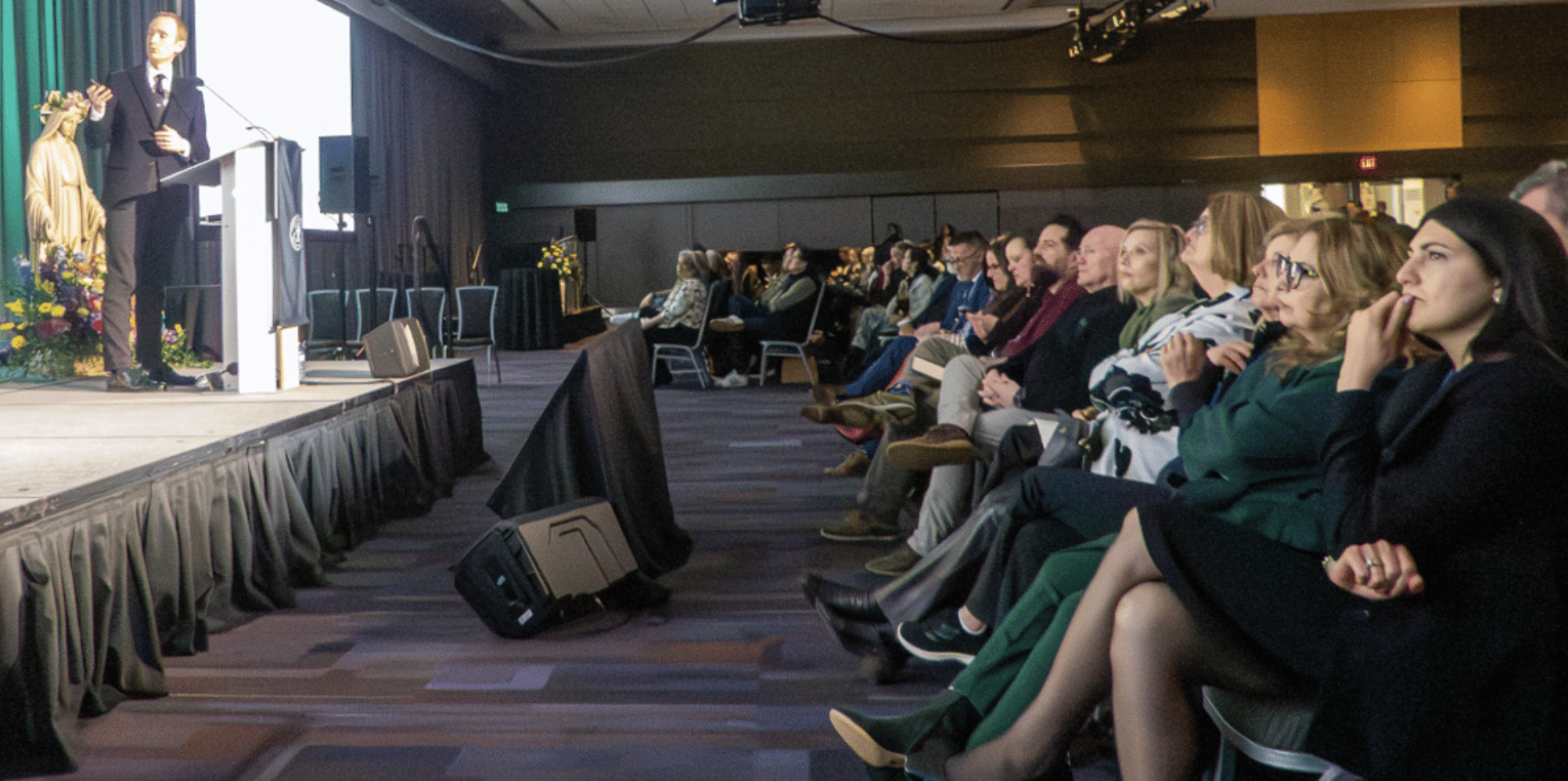
Matthew Harvey Sanders, founder and CEO of the Toronto-based technology company Longbeard, spoke at the 2026 Catholic Educators’ Conference in Vancouver in February. Artificial intelligence is advancing at extraordinary speed, he said, and Catholic education must respond with intention rather than drift along with the momentum of change.
Sanders spoke about the growing influence of artificial intelligence on relationships, learning, and culture, cautioning that while AI offers efficiency and expanded access to information, it can’t replace human judgment, a well-formed conscience, or authentic human relationships.
Catholic schools, he argued, have a particular responsibility in this cultural moment. Students must be formed not only to use technology competently, but to approach it with wisdom and moral clarity. Artificial intelligence can assist in learning, he said, but it can’t form character, cultivate virtue, or substitute for the lived encounter that lies at the heart of education.
Framing the rise of AI as a cultural turning point, Sanders urged educators to ensure that technological innovation remains ordered to the dignity of the human person created in God’s image. In an age of accelerating change, he said Catholic education must keep the human person — not the tool — at the centre.
The conference also heard from Father Michael Baggot, a priest and bioethicist teaching at the Pontifical Athenaeum Regina Apostolorum and the Pontifical University of St. Thomas Aquinas in Rome, who examined what he called “artificial intimacy” — technologies that simulate companionship or emotional response.
Such tools, he warned, risk blurring the line between authentic encounter and manufactured interaction. When that line becomes unclear, the virtues that sustain real relationships — patience, sacrifice, and self-giving love — can erode. He called educators to cultivate discernment in students, grounding identity not in digital affirmation but in Christ.
While in Vancouver Sanders spoke to staff of the Archdiocese of Vancouver at the John Paul II Pastoral Centre, telling them that by adopting AI to handle administrative burdens, the Church could free its leaders to focus more fully on the “fruit” of ministry.
Below is an edited version of his presentation.
Be not afraid: remaining human and Catholic in an artificial world
We are here to discuss how to remain human—and how to remain Catholic—in a world that is becoming increasingly artificial.
To understand the mission, we must first demystify the machine. There is a deep‑seated instinct, perhaps strongest among the most devout, to recoil from Artificial Intelligence as if it were a rival consciousness. This breeds fear. And fear is a terrible counselor.
But as Catholics, we possess a distinct confidence. We are the heirs of a tradition that has always believed that all truth—whether found in Scripture or in science—belongs to God. We do not look at innovation with trembling; we look at it with responsibility. Our task is not to flee from these systems, but to order them to the good.
For decades, computers were deterministic. If you typed “2+2,” the computer would always say “4.” But in the last few years, we have unlocked a new frontier. We stopped programming computers line‑by‑line and started growing them. We built neural networks designed to mimic, in a crude but effective way, the connectivity of the human brain. We fed them the entire public internet—and the machine learned.
Until recently, these models were “System 1” thinkers: fast, instinctive, and reactive. They were creative, but they weren’t careful. That has changed.
We have now entered the era of “System 2” reasoning. Think of it like a grandmaster playing chess. Blitz chess relies on instinct. Slow chess relies on deliberation. We have stopped playing blitz with AI; we have given it the clock.
The newest models can pause, generate multiple internal possibilities, evaluate them against logic, discard the bad ones, and deliver the best answer. Adoption rates reflect this shift. This is not a wave; it’s a tsunami.
Why This Matters to the Church
Why does this matter to a parish secretary, a youth minister, or the Chancery staff?
It matters because the barrier to doing things is about to collapse. The drafting of emails, the summarizing of meeting minutes, the translation of bulletins, the scheduling of volunteers—this administrative drudgery can be offloaded to machines that cost pennies to run.
But it also means something more dangerous. The knowledge economy—the writing, analyzing, and consulting work—is exactly what these machines do best. If we are not careful, we face a crisis of meaning. If the machine can do the work of the mind, what is the role of the human spirit?
This is where the Archdiocese’s priorities become our roadmap.
Because the machine can do the task, but it cannot fulfill the mission.
Make Every Sunday Matter
Your first priority is to Make Every Sunday Matter.
We all know the reality of parish life. The average pastor today is not only a shepherd, but also an administrator, fundraiser, counselor, and manager. He sits down on Saturday night to write his homily exhausted. What he writes is faithful and true—but is it burning?
Imagine that priest has an AI research assistant.
Let me be very clear: an AI cannot preach. Preaching is a sacramental act, mediated through the soul of the priest. An AI has no soul; therefore, it cannot preach.
But it can be the ultimate research assistant.
This is precisely the role Magisterium AI is designed to play. At Magisterium, we have built systems that have read the Church Fathers, the Councils, and the great theological tradition, so that in seconds a priest can surface material that would otherwise take hours in a library. The priest reads, prays, and reflects. The toil of research is gone, and he is left with the fruit of contemplation.
This is how we “celebrate like we mean it.”
Hospitality presents a similar challenge. In most parishes, the knowledge of the flock lives in one place: the head of the parish secretary. But what happens when she retires, or when a parish grows too large for any one person to hold all that information?
At Magisterium, we can build secure AI systems that help pastoral teams notice patterns and pay attention—not to control people, but to love them. It’s the difference between a government that watches you and a mother who watches over you.
Get Closer to Jesus
Your second priority is to Get Closer to Jesus.
Can a machine help someone get closer to God?
A machine cannot offer grace. It cannot forgive sins. It cannot love. But it can remove obstacles to the encounter. It can be a John the Baptist in the digital wilderness—preparing the way.
Right now, the digital landscape is filling with what we call “Catholic wrappers.” These are secular AI models given religious instructions. This is dangerous. A prompt is not a guardrail.
Magisterium AI was built differently. A trustworthy system must be architecturally different. It must stop, search authoritative sources, retrieve them, and only then generate an answer. Because of this architecture, hallucination is drastically reduced.
In our work at Magisterium, we are seeing such systems become staging grounds for difficult questions—questions people are too ashamed or afraid to ask a human being. The neutrality of the text box lowers defences. It clears intellectual debris.
But we must recognize a deeper shift: people are no longer browsing for truth. They are asking.
Increasingly, seekers turn to AI first. Secular systems are designed to keep people looping—vague answers that encourage endless questioning. Magisterium was intentionally built as a bounded system. It offers clarity and finality. When the intellect encounters a definitive answer, the anxiety of the search evaporates. The person can close the laptop and return to prayer, family, and parish life.
Strengthen Marriages and Families
This brings us to your third priority: Strengthen Marriages and Families.
Modern technology often offers hollow substitutes for intimacy. AI companions promise frictionless relationships and train people to prefer compliance over sacrifice.
We cannot simply condemn the fake; we must elevate the real.
Many couples face crises late at night, when the parish office is closed. If they turn to the open internet, they often find cynicism or advice that undermines their vocation. Magisterium AI is already being used not as a replacement for human connection, but as a reliable reference point—helping couples understand Church teaching with clarity and beauty, and encouraging them toward real pastoral accompaniment.
Used well, such tools can de‑escalate emotion and act as a digital off‑ramp, removing obstacles so that grace can enter.
But we must also secure the space where family life happens. This is why Magisterium is developing systems that can run locally, on personal devices, so that sensitive conversations never leave the home. This applies the principle of subsidiarity to code and protects the domestic church from becoming data for distant corporations.
Develop Parish Leadership
Your final priority is Developing Parish Leadership.
The tyranny of the urgent dominates diocesan life. Immigration paperwork, tribunal processes, compliance tracking—this toil exhausts staff and steals their capacity to lead.
We can change this ratio.
At Magisterium, we are already building administrative agents that handle the heavy lifting: guiding petitioners through complex forms, tracking compliance deadlines, and drafting routine documents. The machine handles the admin so the priest can handle the ministry.
This is the difference between toil and fruit.
The Cathedral of Truth
To do all of this, we need a foundation.
AI systems are not neutral. After training, they are given a hidden constitution—a set of philosophical guardrails that define what is safe or true. If we rely solely on secular models, we import their worldview.
We believe in the Logos. Truth is not a statistic; it is a Person.
This is why Magisterium established the Alexandria Digitization Hub and began digitizing the Church’s cognitive core—and why local Churches must contribute their lived reality. An intelligence that knows Aquinas but not Vancouver is incomplete.
By integrating diocesan norms, pastoral guidelines, and archives into Magisterium’s systems, we ensure that the digital future of the Church is not only accurate in theory, but accessible in practice.
Do Not Be Afraid
We live in a world that promises connection without presence and knowledge without wisdom. But we know the truth. We follow a God who did not remain in the cloud, but took on flesh and walked among us.
That is the difference between the machine and the Church.
The machine offers simulation.
The Church offers incarnation.
We are not adopting these tools to be efficient. We are using them to lift the toil of administration so we can return to the fruit of ministry.
An AI can calculate the distance to the stars, but it cannot feel awe. It can explain the Cross, but it cannot carry one.
Intelligence is not the highest value. Charity is.
So let this be our mandate:
We will use the artificial to protect the Real.
We will master these tools—not to become more like them, but to be more fully human.