SASKATOON, Sask. — Ijay Ufondu has seen homelessness at a young age, reflecting on the issue based on her observation after growing up and living in two different countries and three different cities.
The Grade 12 student at Holy Cross High School in Saskatoon says the hardest part of speaking about homelessness was admitting how rarely it is discussed.
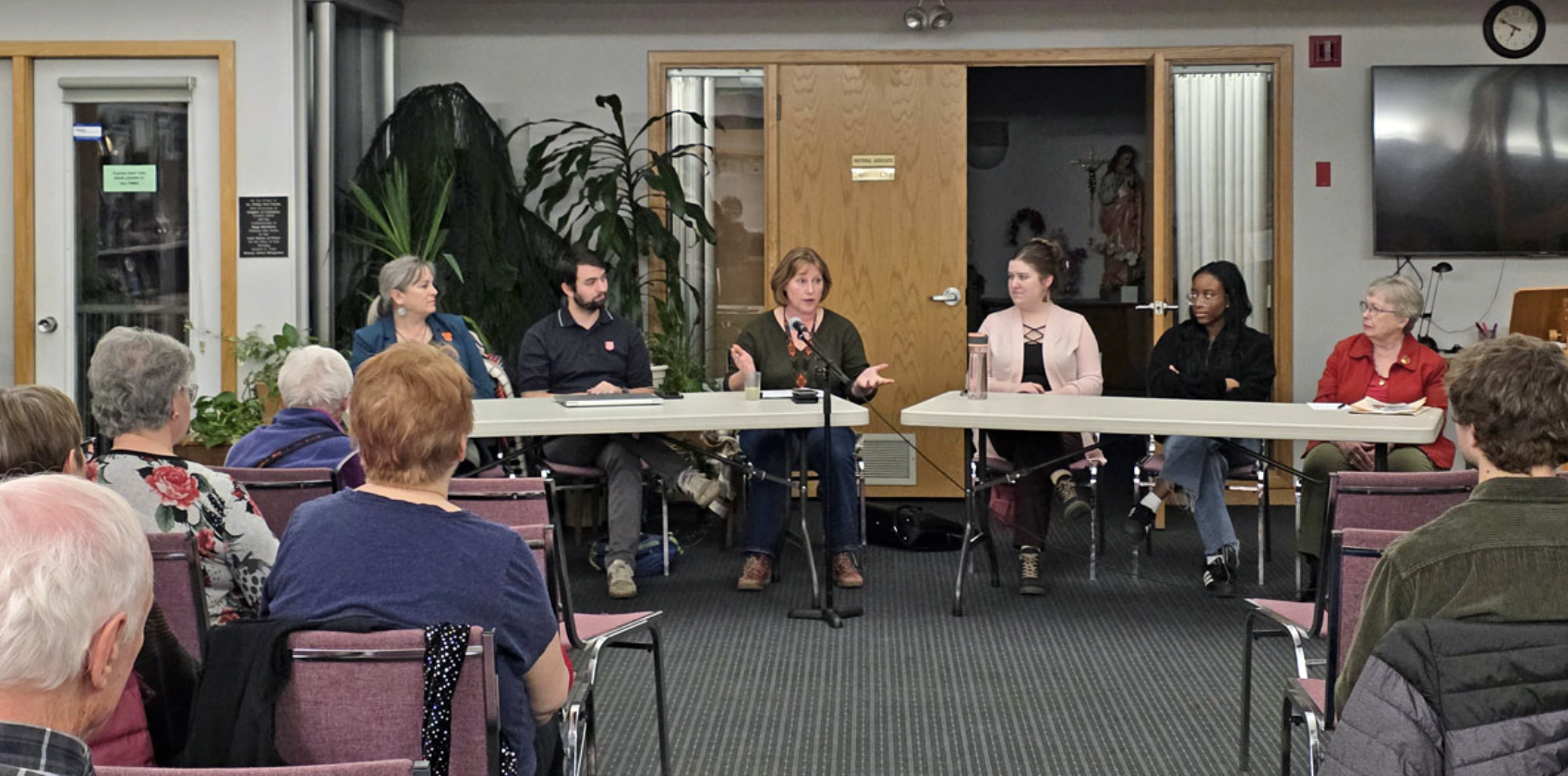
Ufondu was one of six speakers at a “Talking to Kids and Youth About Hard Things” panel discussion, held Feb. 11 at St. Philip Neri Parish in Saskatoon.
Members of the panel discussed how to engage young people of all ages — from children to young adults — on the issue of homelessness, addressing questions such as: why are some people homeless, are there kids like me who are homeless, where do they sleep, and how to help.
“Talking to Kids and Youth About Hard Things” was a sequel to an event held in November entitled “From Overwhelm to Relationship: Being Good Neighbours with Those Living in Material Poverty.” Both events were co-organized by the diocesan Office of Justice and Peace and the social justice committee at St. Phillip Neri Parish.
The evening began with a land acknowledgement, along with a prayer led by St. Philip Neri pastor Fr. Edward Gibney.
Myron Rogal, coordinator of the Office of Justice and Peace in the Roman Catholic Diocese of Saskatoon, opened the discussion with comments and a series of questions for participants.
“How many of you have been asked by your kids, grandkids, nephews, nieces, students why some people do not have a place to live? Think about how you have responded. Did you change the topic? Did you switch the channel to talk about another injustice that you feel more comfortable talking about? Did you maybe flip the question back to them?” he queried.
“Perhaps you’ve given an oversimplified answer like, ‘times are tough, or it is just the way the world is, or maybe its just that people who are homeless have a lot of problems, AKA its complicated.’”
Rogal asked those assembled to listen closely to the panelists as a way to move away from nebulous responses that can stagnate dialogue.
In addition to student Ijay Ufondu, panel members included David Clare, manager of Salvation Army Housing Services; teacher Wendy Dale of Holy Cross Catholic High School; Mildred Kerr, long-time justice and peace advocate and 2025 Saskatoon Citizen of the Year; Krista-Dawn Kimsey, community engagement specialist with The Mustard Seed; and Campus Minister Celeste Woloschuk of St. Thomas More College.
Ufondu said her reflection was shaped by her observations across different places where she grew up. Her family first lived in Dublin, Ireland, then moved to Nova Scotia, and finally settled in Saskatoon. She observed that homelessness has looked different in each city her family has lived in, but has always been present.
She said she felt uncomfortable when she was asked to talk about homelessness, since she does not want to really talk about it, even though she has seen it in the two cities her family lived in before coming to Saskatoon. She encountered the same thing when they finally settled in Saskatoon, joining others who don’t always want to engage.
“It may also be the negative experiences. That started to bother me. When I realized we actually discussed this in school. I understood homelessness differently when I was younger. When we lived in Ireland, I didn’t think much about social injustices or the housing crisis. I was just a kid, having fun,” said Ufondu.
One of Ufondu’s earliest memories of encountering homelessness dates back to when she was about six years old on a cold day in Dublin, and saw an elderly man sitting alone under a bridge. Despite not yet understanding the issue, she was struck by the man’s age and isolation, and the realization that someone could live an entire life and still end up alone. She said there was no judgment, only concern.
As she grew older, her understanding deepened. In smaller communities, homelessness was less visible, but not absent, with Ufondu and the other speakers emphasizing that it often exists beyond what people see, and is not limited to only those sleeping on the streets, but also to people who are couch-surfing, students unsure where they will sleep next month, or families relying on food banks as grocery prices climb.
Now living in Saskatoon, Ufondu said homelessness feels unavoidable: visible downtown, at intersections, and in daily routines. Yet despite its visibility, it remains largely unspoken about among her peers. Passing someone asking for change on the way to coffee has become normalized, she said, reinforcing a quiet belief that housing insecurity has become the new normal in the city.
Ufondu challenged that assumption by pointing to research on trauma and chronic stress. Long-term insecurity, she noted, reshapes brain function, affecting memory, decision-making, and behaviour. Addiction and harmful actions, should not be dismissed. — but neither should those realities be treated as the whole story, she said, arguing that accountability and dignity are not mutually exclusive.
Ufondu, drawing on her faith and ethics, rejected what she described as a subtle superiority complex that can emerge when housed people compare themselves to those without shelter. Supporting someone, she said, does not mean endorsing every decision they have made; it means recognizing shared humanity.
Much of Ufondu’s message focused on the role of young people. High school students, she argued, have more influence than they realize—through conversations in classrooms, and in challenging language that labels people as “lazy,” or perhaps by inviting speakers with lived experience, and connecting lessons in psychology or social studies to what is happening locally.
Action, Ufondu stressed, does not always begin with large initiatives. Eye contact, a greeting, a smile, or a brief conversation can disrupt the pattern of invisibility that surrounds homelessness, and even a small gesture can remind someone experiencing homelessness that they are seen, which can bring back their dignity and feeling that they still belong in the community, rather than just choosing to look away.
The diversity of comments shared by panel members was striking with each offering examples from their personal lives as well as some helpful professional practices, noted Rogal.
David Clare said that as he receives people in need of housing at his office, he is humbled by the “razor-thin line” of circumstances and life events whereby his and their roles could easily be reversed.
Krista-Dawn Kimsey offered the advice of having a non-anxious presence.
Wendy Dale emphasized the importance of getting to know the people we serve and the strong desire that youth have for that kind of relationship-based outreach.
While sharing her experience in working with young adults, Celeste Woloschuk of STM Campus Ministry stressed the importance of knowing who is “in the room,” noting that in a class of students there can be a spectrum of some who are very well off, while others are wondering where their next meal will come from.
As the final panellist, Mildred Kerr spoke from a vault of experience about the necessity to pay attention to particular systemic solutions that could be effective in lifting people out of poverty and allowing them to contribute to the economy.
“A common thread in the presentations of all presenters was that young people are watching us and the witnessing and modelling of our accompaniment with those in poverty is at least as important as what is said,” said Rogal.
The event concluded with a question-and-answer session and shared ideas for a possible “part three” to the first two awareness events.